Filmlexikon.
Support
IMAX 15/70
Camera · Technique

IMAX 15/70

Murnau AI illustration
imax imax camera 1431 imax 65mm 70mm vistavision

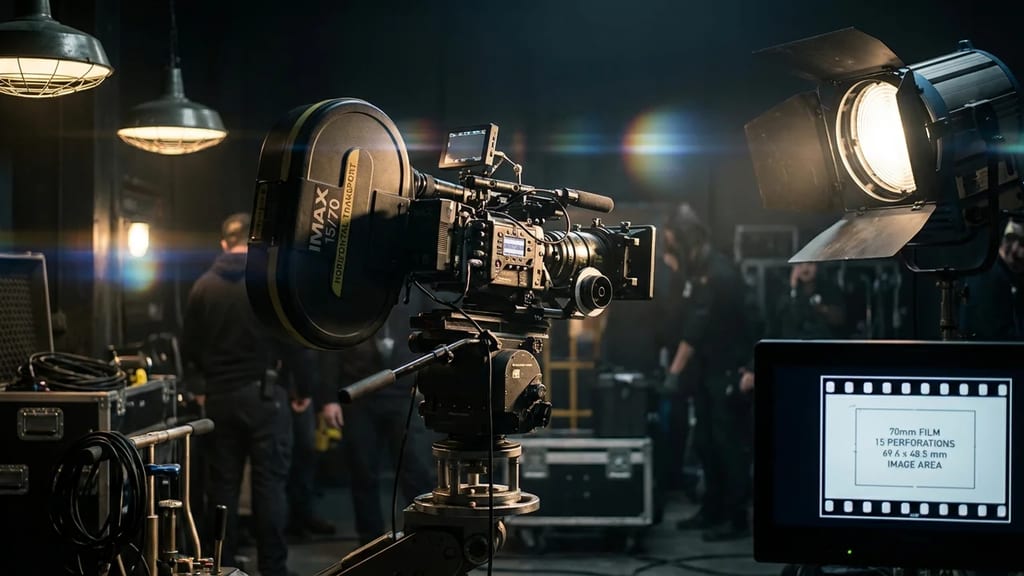
The original IMAX film format: 70mm film with 15 perforations per frame, transported horizontally. With 69.6 × 48.5 mm frame area, the largest commercially available film format – ten times larger than 35mm.

What is IMAX 15/70?

IMAX 15/70 refers to the original IMAX film format: 70mm wide film stock with 15 perforations per frame. The film runs horizontally through the camera and projector – unlike standard 35mm, which runs vertically.

The designation "15/70" stands for:

  • 15 = 15 perforations (holes) per frame
  • 70 = 70mm film width (including soundtracks)

Actual shooting is done on 65mm film; the 70mm prints contain additional magnetic soundtracks.

Technical Specifications

PropertyIMAX 15/70Standard 35mm
Film Width65mm (Negative) / 70mm (Print)35mm
Perforations15 horizontal4 vertical
Image Area69.6 × 48.5 mm22 × 16 mm
Aspect Ratio1.43:1variable
Equivalent Resolution~18K~2-4K
Image Area (Factor)10× largerBaseline

Horizontal Film Transport

The horizontal transport is crucial for IMAX quality:

Advantages:

  • Largest possible image area per frame
  • More stable image guidance during projection
  • Less film wear

Disadvantages:

  • Enormous film consumption (3× faster than 35mm)
  • Massive film reels (up to 500 kg)
  • Special projectors required

Rolling Loop System

IMAX projectors use the patented "Rolling Loop" system:

  • The film is not advanced jerkily
  • A vacuum plate presses each frame flat against the image window
  • Result: Absolutely stable, flicker-free projection

Film Consumption

At 24 fps, IMAX 15/70 consumes:

  • 102.7 meters per minute
  • 3 minutes per standard magazine
  • A 2-hour film = 12 km of film stock

The film reels for "Oppenheimer" (180 min) weighed over 250 kg.

Current Availability

IMAX 15/70 film is still being produced, but the infrastructure is shrinking:

  • Kodak still supplies IMAX negative material
  • FotoKem (LA) is one of the last labs for IMAX processing
  • Approximately 20 projectors for 15/70 film still exist worldwide

Notable 15/70 Productions

  • "The Dark Knight" (2008) – First Hollywood scenes in 15/70
  • "Interstellar" (2014) – Space scenes
  • "Dunkirk" (2017) – 70% shot in 15/70
  • "Oppenheimer" (2023) – Longest 15/70 sequences in history
From the crafts

Perspectives

Cinematographer

15/70 ist das Nonplusultra der Filmformate. Die Bildfläche ist so groß, dass selbst feinste Details bei 30-Meter-Projektion gestochen scharf bleiben. Aber die Kameras sind Monster – laut, schwer, drei Minuten pro Magazin. Jede Einstellung muss sitzen.

Director

Mit 15/70 zu drehen bedeutet, sich auf das Wesentliche zu konzentrieren. Die Kosten und die limitierte Laufzeit erzwingen Disziplin. Aber was man zurückbekommt, ist ein Bild, das den Zuschauer physisch überwältigt.

Producer

15/70-Produktion ist die teuerste Option: Filmkosten, spezialisierte Labs, wenige verfügbare Kameras. Aber für Prestige-Projekte ist es das ultimative Qualitätsmerkmal – Nolans IMAX-Filme haben bewiesen, dass sich die Investition auszahlt.

More in the lexikon

Related terms

Test your knowledge

Quiz

1. Was beschreibt „IMAX 15/70" am besten?

2. Zu welchem Department gehört „IMAX 15/70"?

3. Wie viele verschiedene Fachperspektiven bietet dieser Eintrag?

Report an error
From the Filmfarm ecosystem

Understand visual language, budget productions, connect crew.

The Lexikon is part of the Filmfarm ecosystem — alongside budgeting (FilmBalance), an industry magazine (FilmCircus) and crew networking (FilmCall, CrewMesh). One shared vocabulary for the whole production.

FilmFarm FilmRadarComing soonFilmPulseComing soonFilmNumbersComing soonFilmCapitalComing soonFilmLabComing soonFilmBalanceComing soonFilmCircusComing soon