Filmlexikon.
Support
70mm
Camera · Technique

70mm

Murnau AI illustration
open matte dci 4k trailer vfx control room production desk

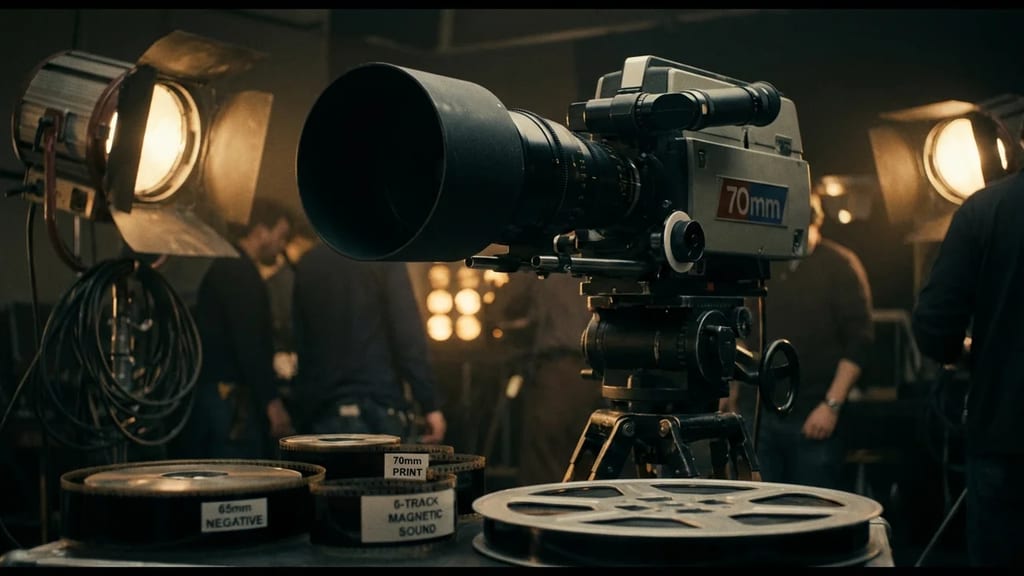
70mm is a high-resolution large-format film: shot on 65mm negative, projected as 70mm prints with significantly larger image area than 35mm.

Overview

70mm refers to a large-format film gauge for cinema production. The name refers to the width of the print film. A characteristic feature is the separation of recording and playback material: filming is done on a 65mm wide camera negative, while the print and projection is on a 70mm wide positive. The additional 5mm of the print historically provided space for four magnetic soundtrack stripes with six stereo sound channels; modern 70mm prints instead use digital sound encoding (DTS).

The format stands for high resolution and a large image area. The negative area is almost 3.5 times larger than the classic 35mm standard format, allowing for finer detail resolution and less grain. Well-known 65/70mm-based recording systems include Todd-AO, Super Panavision 70, and (anamorphic) Ultra Panavision 70.

Technical Data

There are two fundamentally different transport and image arrangements on 65/70mm film:

  • Vertical Transport (5-Perf): Classic 70mm (Todd-AO, Super/Ultra Panavision 70). Each frame is five perforations high (23.8125mm or 15/16 inch).
  • Horizontal Transport (15-Perf): IMAX. The film runs across the camera, each frame is 15 perforations wide, resulting in the largest photochemical image area in cinema.
ParameterValue
Camera Negative Width65mm
Print/Projection Width70mm
Image Height (5-Perf)5 perforations / 23.8125mm
Camera Aperture (5-Perf)52.63 × 23.01mm
Projection Aperture (5-Perf)48.56 × 22.10mm
Frame Rate24 fps
Aspect Ratio Todd-AO2.2:1
Aspect Ratio Ultra Panavision 70 (anamorphic)2.76:1
Aspect Ratio IMAX (15-Perf)1.43:1

On-Set Usage

70mm is not a lighting or grip device, but a recording and projection technique that indirectly influences on-set work. The large image field and typically shallow depth of field place high demands on focus and lighting; the camera systems are large and heavy, impacting camera support (dolly, crane) and tripod equipment. Due to material costs and camera availability, the format is now predominantly used for prestige productions, often also solely as a 70mm release format for theatrical distribution.

From the crafts

Perspectives

Cinematographer

As a cinematographer, I appreciate the exceptional image sharpness and the enormous dynamic range of 70mm film. Working with these heavy cameras, however, requires precise planning and robust tripods, as the film stock runs through the camera significantly faster and consequently needs more light.

Director

For me as a director, 70mm opens up entirely new visual possibilities – the detail and spatial depth create a unique immersion for the audience. However, when staging, I have to consider that this format demands a different composition and that the cost of every additional take turns it into a budget decision.

Producer

For me as a producer, 70mm means significant additional costs – both for the expensive film stock and for specialized equipment and lab work. At the same time, however, it also offers marketing advantages and unique selling points that can justify higher ticket prices with the right target audience.

More in the lexikon

Related terms

Test your knowledge

Quiz

1. Was beschreibt „70mm" am besten?

2. Zu welchem Department gehört „70mm"?

3. Wie viele verschiedene Fachperspektiven bietet dieser Eintrag?

Report an error
From the Filmfarm ecosystem

Understand visual language, budget productions, connect crew.

The Lexikon is part of the Filmfarm ecosystem — alongside budgeting (FilmBalance), an industry magazine (FilmCircus) and crew networking (FilmCall, CrewMesh). One shared vocabulary for the whole production.

FilmFarm FilmRadarComing soonFilmPulseComing soonFilmNumbersComing soonFilmCapitalComing soonFilmLabComing soonFilmBalanceComing soonFilmCircusComing soon