Filmlexikon.
Support
HMC Coating
Camera · Terms

HMC Coating

Murnau AI illustration
flow para roll take

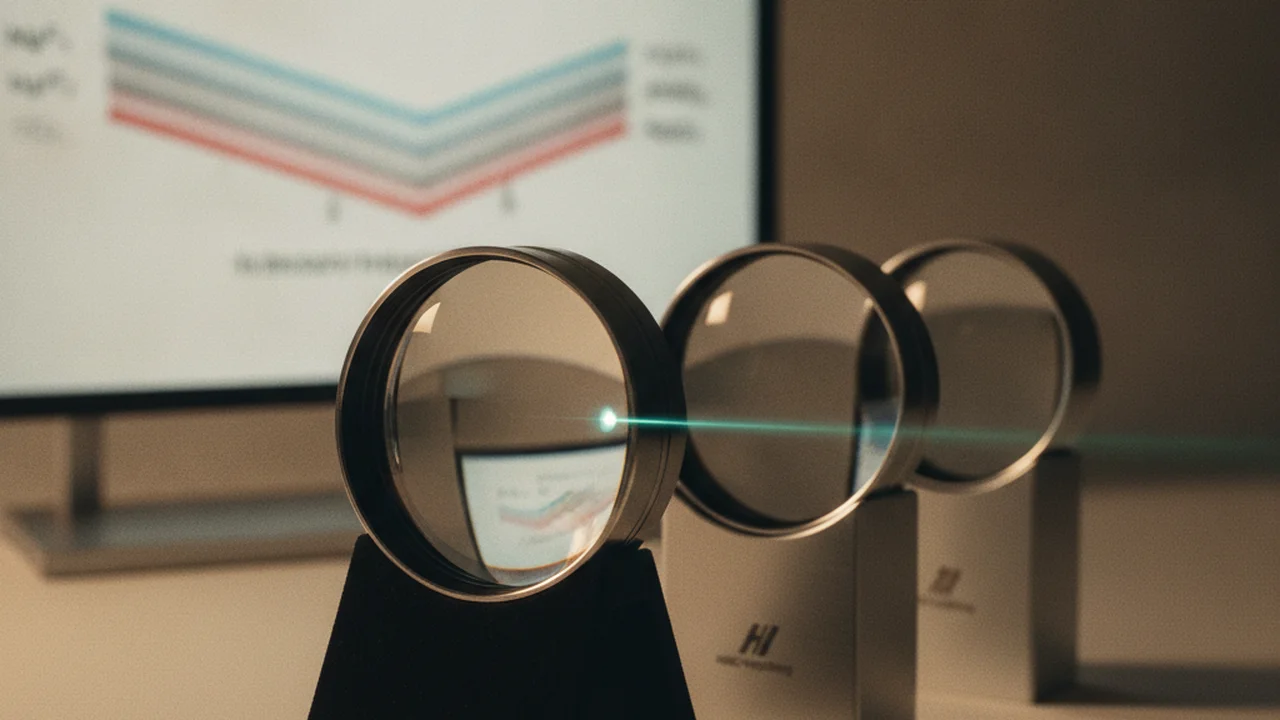
Multi-layer anti-reflective coating of magnesium fluoride, titanium oxide, and silicon oxide achieving 99.7–99.9% light transmission and eliminating ghosting.

Technical Details

HMC Coating consists of alternating layers of magnesium fluoride (MgF₂), titanium oxide (TiO₂), and silicon oxide (SiO₂) with refractive indices between 1.38 and 2.35. The outermost layer has a hardness of 6-7 on the Mohs scale and withstands mechanical stress up to 200 Newtons per square centimeter. Modern HMC systems transmit 99.7-99.9% of incident light in the spectral range of 400-700 nanometers. Special variants like Nano Crystal Coating (Nikon) or ASC (Canon) additionally integrate crystalline nanostructures that maintain reflections below 0.1% even at extreme angles of incidence above 60°.

History & Development

Zeiss introduced the first single-layer coating with magnesium fluoride in 1935. Canon developed the first practical HMC coating for their FD lenses in 1971, achieving transmission values of 98.5%. Nikon followed in 1977 with Integrated Coating (IC), which was specifically optimized for their AI lenses. From 1995 onwards, electron beam evaporation systems enabled the production of up to 15-layer coatings with tolerances below 2 nanometers. Since 2010, plasma-assisted processes have dominated, which also integrate organic polymer layers and achieve transmission values of 99.9%.

Practical Use in Film

For "Blade Runner" (1982), Ridley Scott exclusively used HMC-coated Zeiss lenses to avoid ghosting in complex night shots with multiple light sources. Roger Deakins consistently relies on modern HMC coatings for backlight shots, as demonstrated in the desert sequences of "Sicario" (2015). The coating enables contrast ratios of over 2000:1 without stray light artifacts. HMC coating is standard in IMAX productions, as the large sensor areas are particularly susceptible to reflections between the lens and protective glass. Digital Intermediate Colorists report 15-20% less effort in artifact removal for HMC-coated footage.

Comparison & Alternatives

Simple MC coatings (3-5 layers) only achieve 97-98% transmission and fail with LED light sources having narrow-band spectra. Pentax's Super Multi Coating (SMC) uses 11 layers and achieves similar values to HMC but focuses more on the UV range below 400nm. Modern nano-coatings like Fujifilm's EBC or Sigma's DG DN surpass classic HMC systems with hydrophobic properties and self-cleaning surfaces. For available light and low-key situations, HMC coating remains indispensable, while MC coatings can provide sufficient results in controlled studio conditions.
From the crafts

Perspectives

Cinematographer

Ich verlasse mich bei komplexen Beleuchtungssetups vollständig auf HMC-vergütete Objektive, da sie mir erlauben, auch bei direktem Gegenlicht oder praktischen LED-Quellen im Bild zu arbeiten, ohne dass Lens Flares meine Bildkomposition zerstören. Die zusätzlichen 1-2% Transmission sind besonders bei natürlichen Drehbedingungen spürbar und sparen mir oft eine ganze Blendenstufe. Bei Nachtaufnahmen mit mehreren Lichtquellen im Bild ist der Unterschied zwischen HMC und einfacher MC-Vergütung dramatisch sichtbar.

Director

Ich nutze HMC-Vergütung gezielt, um authentische Available-Light-Situationen zu schaffen, ohne dass technische Artefakte die Immersion brechen – besonders bei intimaten Dialogszenen mit Kerzenlicht oder Fensterlicht im Hintergrund. Die saubere Durchzeichnung ermöglicht mir subtilere visuelle Metaphern durch Licht-Schatten-Spiele, ohne dass Streulicht die emotionale Wirkung verwässert. Bei Thriller-Produktionen kann ich bewusst auf nicht-vergütete Objektive wechseln, um gezielt Unschärfe und Irritation zu erzeugen.

Producer

HMC-vergütete Objektive kosten 15-30% mehr als Standard-MC-Versionen, amortisieren sich aber durch deutlich reduzierte Post-Production-Zeiten bei der VFX-Arbeit und Color Correction. Ich kalkuliere pro Drehtag etwa 2-3 Stunden weniger Aufwand für Flare-Removal und Kontrast-Korrekturen, was bei längeren Produktionen erhebliche Einsparungen bedeutet. Der geringere Reinigungsaufwand und die höhere mechanische Widerstandsfähigkeit reduzieren außerdem Ausfallzeiten und Reparaturkosten während der Dreharbeiten.

More in the lexikon

Related terms

Test your knowledge

Quiz

1. Zu welchem Department gehört „HMC-Vergütung"?

2. Wie viele verschiedene Fachperspektiven bietet dieser Eintrag?

Report an error
From the Filmfarm ecosystem

Understand visual language, budget productions, connect crew.

The Lexikon is part of the Filmfarm ecosystem — alongside budgeting (FilmBalance), an industry magazine (FilmCircus) and crew networking (FilmCall, CrewMesh). One shared vocabulary for the whole production.

FilmFarm FilmRadarComing soonFilmPulseComing soonFilmNumbersComing soonFilmCapitalComing soonFilmLabComing soonFilmBalanceComing soonFilmCircusComing soon