Filmlexikon.
Support
HD-SDI
Camera · Terms

HD-SDI

Murnau AI illustration
2k 4k dci 4k 6k 8k dnxhd full hd hd

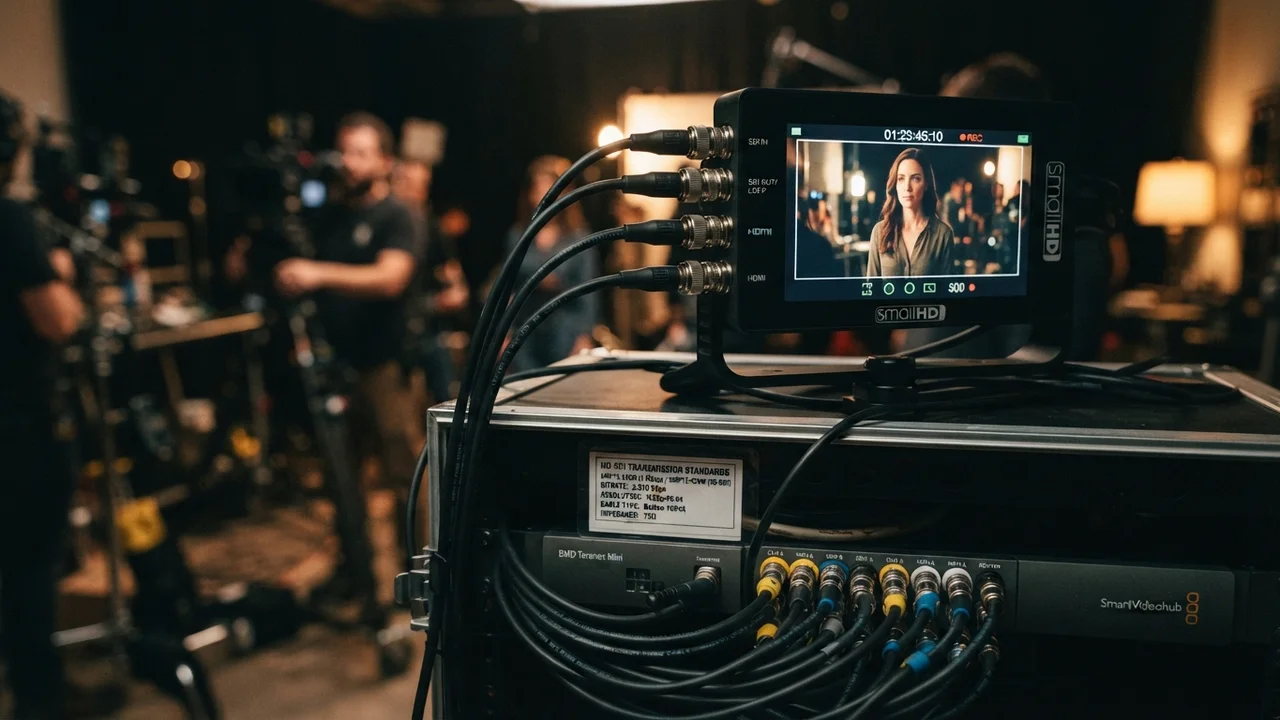
SMPTE digital video standard for professional HD transmission over coaxial cable, supporting 10-bit 4:2:2 signals, 16 audio channels, and timecode.

Technical Details

HD-SDI carries 10-bit 4:2:2 YCbCr video signals at 1920x1080 or 1280x720 pixels. Single Link HD-SDI supports 1080i50/59.94/60 and 720p50/59.94/60, while Dual Link HD-SDI (2x1.485 Gbit/s) enables 1080p23.98/24/25/29.97/30 and higher color sampling like 4:4:4. In addition to video data, the signal includes up to 16 channels of embedded audio (48 kHz/24 bit), timecode, and metadata. Scrambling technology prevents DC components and long zero sequences, ensuring stable transmission over standard coaxial cables.

History & Development

SMPTE introduced HD-SDI in 1998 as SMPTE-292M, developed by a consortium of Sony, Panasonic, and other manufacturers. In 2001, the Dual Link specification SMPTE-372M followed for progressive formats. In 2006, 3G-SDI (SMPTE-424M) expanded the standard to 2.97 Gbit/s for single-link 1080p transmission. Its successors, 6G-SDI (2015) and 12G-SDI (2016), enable 4K/UHD transmissions, while HD-SDI continues to be the standard for HD productions.

Practical Use in Film

HD-SDI dominated digital film production in the 2000s. Cameras like the Sony F900 ("Star Wars Episode II", 2002) or Red One ("The Social Network", 2010) used HD-SDI for live monitoring and recording to external recorders. Typical workflows connect the camera via HD-SDI to video village monitors, waveform monitors, and field recorders such as Sound Devices PIX or Atomos Ninja. HD-SDI offers latency-free, uncompressed transmission without quality loss, but requires complex cabling for intricate setups.

Comparison & Alternatives

HD-SDI differs from HDMI through its professional BNC connectors, longer transmission distances, and more reliable connections without HDCP copy protection. 3G-SDI and 6G-SDI offer higher bandwidth for 4K signals, while IP-based standards like SMPTE ST 2110 are increasingly replacing coaxial connections in studios. Wireless systems like Teradek or Hollyland are displacing wired HD-SDI solutions for monitoring applications. For short distances and consumer equipment, HDMI remains more cost-effective, but for professional productions with critical timing requirements, HD-SDI is still the preferred choice.
From the crafts

Perspectives

Cinematographer

Ich verlasse mich auf HD-SDI für saubere, latenzfreie Signalübertragung zu meinen externen Monitoren und dem Video Village, besonders bei kritischen Fokus-Operationen mit großen Optiken. Die unkomprimierte 10-Bit-Übertragung zeigt mir exakt das Bild, das die Kamera aufzeichnet, ohne HDMI-typische Farbraum-Konvertierungen oder Verzögerungen. Bei längeren Kabelwegen auf dem Set ist HD-SDI durch die robusteren BNC-Verbindungen deutlich zuverlässiger als HDMI.

Director

HD-SDI ermöglicht mir eine präzise Bildkontrolle am Video Village ohne Qualitätsverluste oder Verzögerungen, was bei der Bewertung von Schauspielleistungen und Bildkomposition entscheidend ist. Die Möglichkeit, mehrere Monitore gleichzeitig zu speisen, erlaubt es mir und meinem Team, parallel die Aufnahme zu beurteilen. Für Playback-Situationen oder wenn ich Script Supervisor und Continuity-Verantwortliche einbeziehen muss, ist die synchrone Übertragung unerlässlich.

Producer

HD-SDI-Infrastructure erfordert höhere Anfangsinvestitionen in professionelle Monitore und Kabel, amortisiert sich aber durch Zuverlässigkeit und reduzierte Ausfallzeiten am Set. Die Kompatibilität zwischen verschiedenen Kamera- und Monitorherstellern minimiert Risiken bei Equipment-Wechsel während der Produktion. Bei komplexen Multi-Kamera-Setups spare ich durch standardisierte HD-SDI-Workflows Zeit bei Setup und Troubleshooting gegenüber proprietären Lösungen.

More in the lexikon

Related terms

Test your knowledge

Quiz

1. Was beschreibt „HD-SDI" am besten?

2. Zu welchem Department gehört „HD-SDI"?

3. Wie viele verschiedene Fachperspektiven bietet dieser Eintrag?

Report an error
From the Filmfarm ecosystem

Understand visual language, budget productions, connect crew.

The Lexikon is part of the Filmfarm ecosystem — alongside budgeting (FilmBalance), an industry magazine (FilmCircus) and crew networking (FilmCall, CrewMesh). One shared vocabulary for the whole production.

FilmFarm FilmRadarComing soonFilmPulseComing soonFilmNumbersComing soonFilmCapitalComing soonFilmLabComing soonFilmBalanceComing soonFilmCircusComing soon