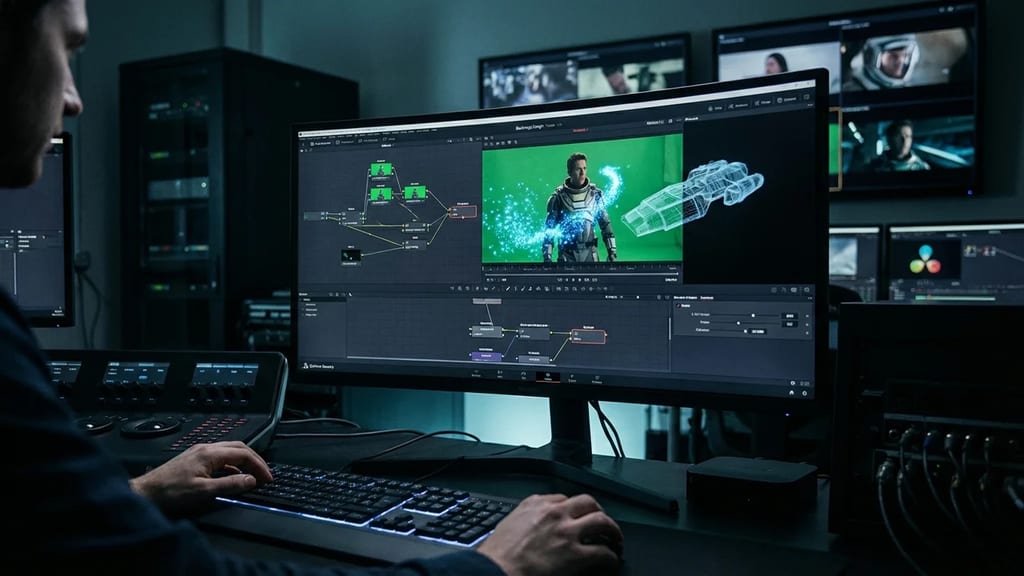
Overview
Fusion (full name: Blackmagic Fusion) is a professional, node-based compositing and visual effects software from Blackmagic Design. It is aimed at VFX artists, motion designers, and 3D animators and is used in post-production to combine image layers, perform greenscreen keying, set up tracking and rotoscoping, and integrate 2D and 3D elements.
Instead of the layer stack (layer system) familiar from programs like After Effects, Fusion works with a node graph: each processing step – such as a filter, a merge, or a keyer – is a node that is linked to other nodes via connection lines. This keeps even complex effect setups understandable and allows individual steps to be rewired as needed.
Origin and Versions
The software has a long history: it was originally developed in the late 1980s and later commercialized by the Canadian company eyeon Software. In September 2014, Blackmagic Design acquired eyeon and has continued Fusion under its own name ever since. Over the years, Fusion has been used in numerous film and TV productions for compositing and motion graphics tasks.
Fusion exists in two forms:
- Fusion Page in DaVinci Resolve – integrated into the editing, color, and audio program DaVinci Resolve and usable there for free.
- Fusion Studio – standalone application with an expanded feature set, including network rendering, as a paid version.
Features
Key tools according to the manufacturer include:
- Node-based compositing with keying and merge operations
- Motion tracking, camera stabilization, and point tracking
- Vector-based paint and rotoscoping for masks and mattes
- True 3D workspace including import of models from Maya, 3ds Max, and Cinema 4D
- 3D particle systems
- Tools for 360°/VR footage
- GPU acceleration via Metal, CUDA, and OpenCL
Placement on Set / in Post-Production
Fusion is purely software and not set equipment in the sense of lighting or grip gear. However, it directly impacts the image chain: plates shot on set in front of a greenscreen, with tracking markers, or for VFX extensions are further processed in Fusion. The integration into DaVinci Resolve allows compositing to be performed in the same environment as editing and color grading.