Cinematographer
Als DoP muss ich bereits beim Drehen an Compositing denken. Ich schalte die Plate so, dass später optimal komponiert werden kann. Beleuchtung und Farben müssen konsistent sein. Clean-Plates und Referenzmaterial sind essentiell.
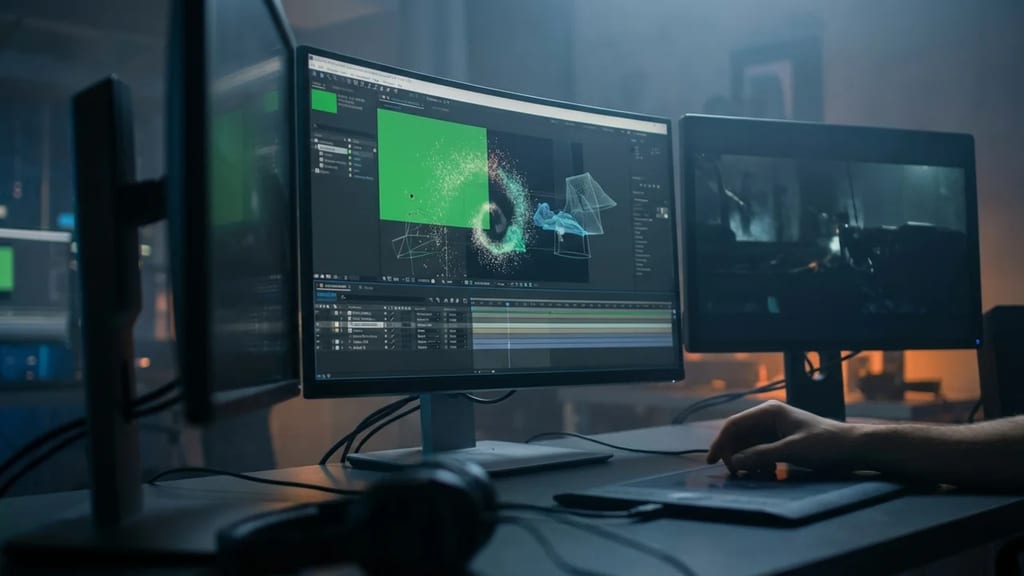
Compositing is the process of combining multiple image and video layers into a final shot using specialized software like Nuke or After Effects.
Compositing is the specialized process of combining multiple image and video layers, effects, and information in a digital environment into a single, final shot. This is typically accomplished using non-linear, node-based, or layer-based software systems.
Compositing is the interface between production, animation, effects simulation, and final color grading. No modern feature film, television series, or advertising spot can be conceived without compositing.
Nuke is the world's leading compositing software in the film and VFX industry:
Typical Nuke workflow:
Read (Plate) → Keylight → Roto → Tracker → Transform →
Merge (with CGI/BG) → ColorCorrect → VectorBlur → WriteAdobe After Effects is primarily used for:
For cinematic VFX, After Effects is less suitable because:
Blackmagic Fusion is node-based like Nuke:
Flat image layer work:
Spatial composition:
For 3D cinema:
Plate (RAW Footage)
├── Linearization (Log → Linear)
├── Metadata extraction
├── Proxies for faster working
└── Versioning & ArchivingRead_Plate (FG Keyed)
├── Read_Background (Matte Paint / CGI)
├── Read_DepthOfField (for depth of field)
├── Read_Particles (Effects)
├── Read_Glows & Light (Lights)
└── Merge Tree (with Screen/Overlay/Multiply)An experienced VFX Supervisor plans each shot with the following criteria:
A typical Nuke graph structurally looks like this:
[Read_Plate] ────┐
 ├──[Keylight]─────┬─[Merge]────[ColorCorrect]─[Write]
[Read_BG]────────┤ │
 └──[Roto]──────────┘

Or more complex:

[Plate] ──[Tracker] ──[MotionBlur]──┐
 ├──[Merge]──[Grade]──[Output]
[CGI] ──[DepthMerge]────────────────┘
Each node has properties that can be adjusted – completely non-destructive.
In 1977, Ed Catmull developed the alpha channel for Lucasfilm, first applied in "Star Trek II" (1982). Digital Domain established photorealistic CG integration in 1993 with "Jurassic Park." Nuke originated in 1993 at Digital Domain and became commercially available in 2007. In 2010, Foundry introduced Nuke X with 3D compositing. Since 2015, GPU-based engines like DaVinci Resolve enable real-time compositing at 4K resolution.
"Avengers: Endgame" (2019) used over 2500 compositing shots with an average of 47 layers per shot. Typical workflow: plate capture → rotoscoping → CG element integration → color matching → grain management → final render. Green-screen replacements require precise edge blending with 0.5–2 pixel soft edges.
Matte paintings are projected onto 3D geometry using projection mapping, sky replacements use luminance keys with tolerance ranges of 15–30%. Beauty work eliminates rig removals via clean plates or content-aware algorithms.
Compositing differs from color grading through image content manipulation rather than pure color correction and from 3D rendering through integration of existing elements rather than creation of new ones. On-set compositing via LED volumes (StageCraft) reduces post-production effort by 60–80%, but requires real-time engines like Unreal Engine.
VR compositing works with 360° projections and stereo disparity corrections. AI-based tools like RunwayML automate rotoscoping processes with 85–95% accuracy, but require manual refinement for final quality.
AI-powered tools have significantly expanded compositing capabilities since 2026. Programs like Sora 2 enable direct conversion of text descriptions into video-ready layers, while other AI applications provide real-time editing and advanced cinematographic controls. These developments automate traditionally labor-intensive compositing steps and democratize professional post-production.
Als DoP muss ich bereits beim Drehen an Compositing denken. Ich schalte die Plate so, dass später optimal komponiert werden kann. Beleuchtung und Farben müssen konsistent sein. Clean-Plates und Referenzmaterial sind essentiell.
Compositing ist zeitintensiv und erfordert spezialisierte Talente. Ich kalkuliere großzügig für diese Phase ein, da Fehler hier teuer werden. Eine Compositing-Heavy-Produktion kann 40-60% der Post-Budget verbrauchen.
1. Was beschreibt „Bildmontage/Compositing" am besten?
2. Zu welchem Department gehört „Bildmontage/Compositing"?
3. Wie viele verschiedene Fachperspektiven bietet dieser Eintrag?
The Lexikon is part of the Filmfarm ecosystem — alongside budgeting (FilmBalance), an industry magazine (FilmCircus) and crew networking (FilmCall, CrewMesh). One shared vocabulary for the whole production.