Overview
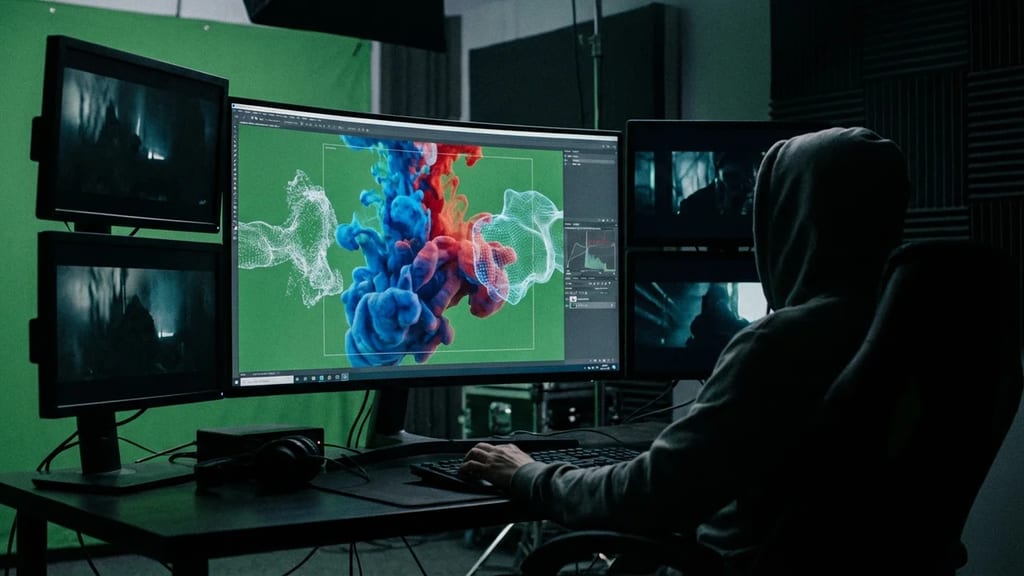
In the VFX context, Fluid Simulation (German: Fluidsimulation, Strömungssimulation) does not refer to physical set equipment, but to a computer graphics technique: the physically motivated calculation of the behavior of fluids – i.e., liquids and gases – on a computer. This is used to create effects such as water, oceans, splashes, smoke, fog, fire, and explosions that cannot be practically filmed on set or would be too large, too expensive, or too dangerous.
The simulation (approximately) solves the fundamental equations of fluid mechanics – the Navier-Stokes equations or the Euler equations. Unlike in scientific fluid simulation (CFD), the focus in film is not on exact physical correctness, but on visually convincing appearance. The result is then rendered and composited with the filmed live-action or CG sequence.
How it Works and Approaches
Several fundamental methods exist for simulation, differing in how the fluid is spatially represented:
- Grid-based (Eulerian): Space is divided into a voxel grid; properties such as velocity, density, and temperature are stored per cell. Typical for smoke and fire.
- Particle-based (Lagrangian): The fluid is represented by many movable particles (e.g., SPH – Smoothed Particle Hydrodynamics).
- Hybrid methods (PIC/FLIP): Combines particles and grids. FLIP (Fluid-Implicit Particle) is a common approach for high-resolution liquids, splashes, and water surfaces.
- Level-set methods: Implicitly describe the fluid surface; used for complex 3D water, smoke, and fire, among other things.
Historically influential were, among others, the 3D Navier-Stokes implementation by Foster and Metaxas (1996), the "Stable Fluids" method by Jos Stam (1999) with semi-Lagrangian advection, and the extensions by Ronald Fedkiw and co-authors (from 2001/2002) for smoke, fire, and water using level-set methods.
Software and Tools
Fluid simulation is a distinct discipline within the VFX department (FX Artists/TDs). Common tools include:
| Tool | Manufacturer | Focus |
|---|
| Houdini (FLIP, Pyro FX) | SideFX | Water/Liquids, Smoke, Fire, Explosions |
| Bifrost | Autodesk (Maya) | Fluids and 3D VFX |
| Phoenix (Chaos Phoenix) | Chaos | Fire, Smoke, Liquids, Ocean Waves |
| RealFlow | Next Limit | Liquids |
| Mantaflow | Open Source (in Blender, since 2020) | Smoke, Fire, Liquids |
Use in Production
Fluid simulations are used in post-production and are among the most computationally intensive VFX tasks; high-resolution sims are typically calculated on the render farm. Well-known application examples range from water and ocean effects to magical effects and large-scale fire and explosion scenes in blockbusters. On set, the physical counterparts to these effects correspond to practical atmosphere and SFX departments (e.g., fog machines, water rigs, pyrotechnic effects) – digital fluid simulation complements or replaces these when practical implementation is not possible or too risky.