Filmlexikon.
Support
Particle Effects
VFX · Technique

Particle Effects

Murnau AI illustration
particle system effects animation pleograph

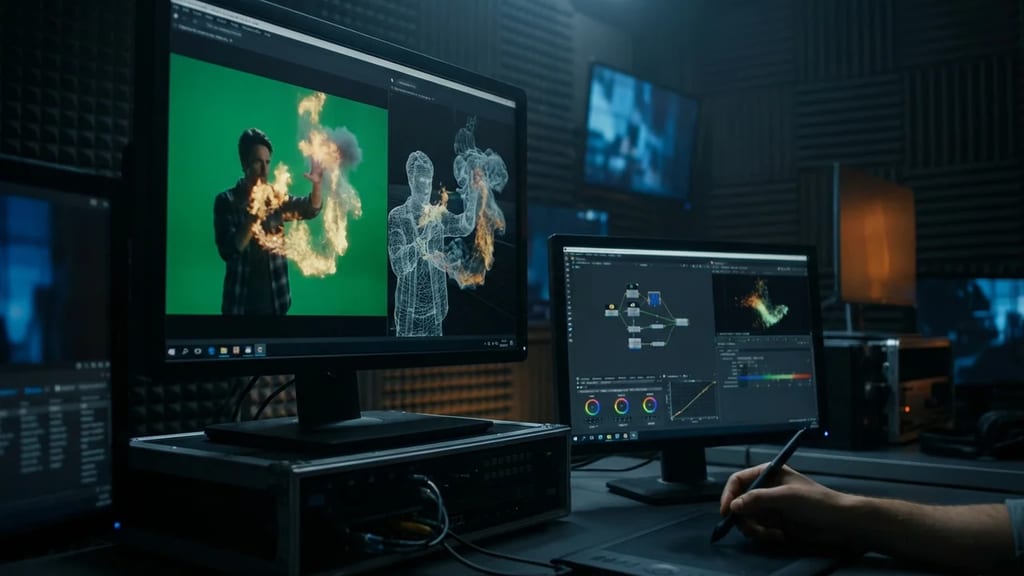
Computer-generated effects simulating diffuse phenomena like fire, smoke, sparks, dust, or rain using multiple individual particles.

Overview

Particle Effects (often translated as "Partikeleffekte" in German) in visual effects (VFX) technology refer to effects generated from a large number of individual, usually small elements – the particles. They are the visible result of so-called particle systems and are used to depict "blurry" or diffuse phenomena that are difficult to represent with classic geometric modeling.

Typical applications include fire, smoke, fog, dust, sparks, rain, snow, explosions, flowing water, as well as stylized effects like magic or energy discharges. Instead of animating each element by hand, the artist defines rules and forces that govern how the particles move over time.

Principle of Operation

A particle system typically goes through three phases:

  • Emission: An emitter continuously generates new particles and assigns them initial values (position, initial velocity, color, lifespan).
  • Simulation: The particles are updated per frame. Forces such as gravity, wind, friction, and collisions with scene objects change their velocity and position; particles whose lifespan expires are removed.
  • Rendering: The particles are displayed – often as camera-facing textured planes (billboards/sprites), alternatively as points, 3D models, or metaballs.

Distinction and History

Particle Effects are a digital VFX technique and thus clearly distinct from practical set effects: fog from a fog machine, haze, pyrotechnic sparks, or rain rigs on set are considered physical special effects (SFX), even if they produce visually similar phenomena.

The term "particle system" goes back to William T. Reeves, who used the technique in 1982 at Lucasfilm for the "Genesis Effect" in Star Trek II: The Wrath of Khan and described it in his 1983 SIGGRAPH paper "Particle Systems – A Technique for Modeling a Class of Fuzzy Objects."

Software

Particle systems are now an integral part of common 3D and VFX programs. Among the widely used are SideFX Houdini, Autodesk Maya, Blender, and – for real-time applications – game engines like Unreal Engine and Unity.
From the crafts

Perspectives

Cinematographer

Bei Hero-Shots mit Partikeleffekten muss ich die Kamera-Bewegung mit der VFX-Abteilung abstimmen, da komplexe Particle-Sims nur in einem 15-Grad-Winkelbereich gerendert werden. Meine Beleuchtung bestimmt das Scattering-Verhalten – bei volumetrischen Partikeln wie Rauch brauche ich starke Rückbeleuchtung für Sichtbarkeit, was meine Standard-Drei-Punkt-Beleuchtung komplett verändert. Tracking-Marker im Set sind essentiell, da Partikelsysteme exakte Kamera-Daten für Motion Blur und Depth-of-Field-Integration benötigen.

Director

Partikeleffekte setze ich gezielt für emotionale Wendepunkte ein – fallende Blütenblätter verstärken Melancholie, wirbelnde Asche unterstreicht Zerstörung. Ich lasse bewusst 30% der Partikeldichte in der Postproduktion variabel, um im Schnitt die narrative Intensität anpassen zu können. Bei Dialogszenen vermeide ich komplexe Particle-Sims, da sie vom Schauspiel ablenken – stattdessen nutze ich subtile atmosphärische Partikel wie Staub oder Pollen für organische Lebendigkeit ohne narrative Konkurrenz.

Producer

Partikeleffekte plane ich mit 40-60 Stunden Rechenzeit pro finaler Sekunde bei Hero-Shots, was bei 200 CPU-Cores etwa 50.000€ Render-Farm-Kosten entspricht. Ich teile Particle-heavy Sequences früh auf verschiedene VFX-Vendors auf, da die technischen Anforderungen extrem vendor-spezifisch sind – Weta arbeitet mit proprietären Tools, ILM mit Houdini-Pipeline. Mein VFX-Budget kalkuliert 15% Buffer für Partikel-Iterations, da Directors oft erst beim Final-Composite die gewünschte Dichte definieren können.

More in the lexikon

Related terms

Test your knowledge

Quiz

1. Zu welchem Department gehört „Partikeleffekte"?

2. Wie viele verschiedene Fachperspektiven bietet dieser Eintrag?

Report an error
From the Filmfarm ecosystem

Understand visual language, budget productions, connect crew.

The Lexikon is part of the Filmfarm ecosystem — alongside budgeting (FilmBalance), an industry magazine (FilmCircus) and crew networking (FilmCall, CrewMesh). One shared vocabulary for the whole production.

FilmFarm FilmRadarComing soonFilmPulseComing soonFilmNumbersComing soonFilmCapitalComing soonFilmLabComing soonFilmBalanceComing soonFilmCircusComing soon