Technical Details
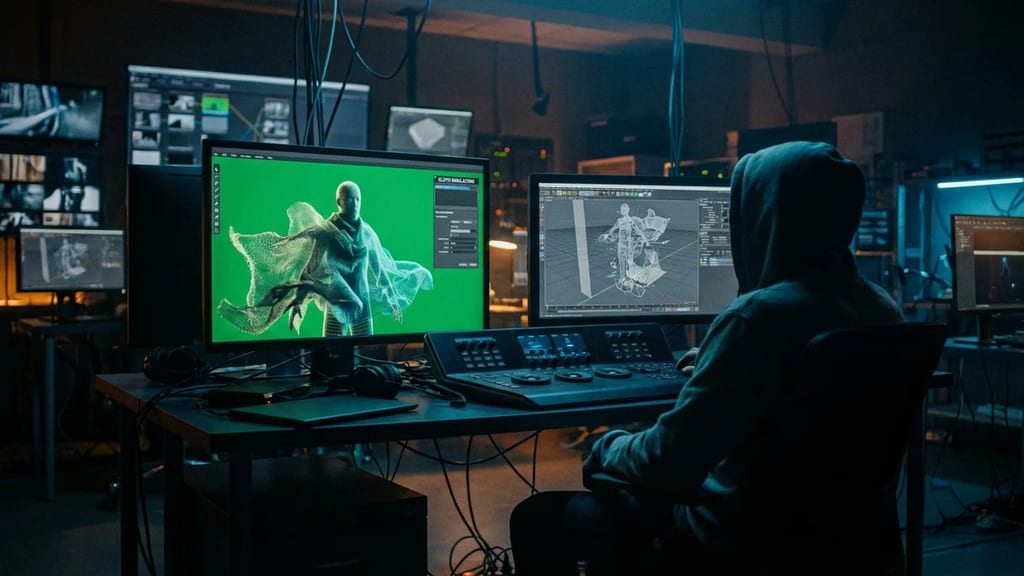
Modern cloth solvers operate with resolutions between 1,000-50,000 vertices per square meter of fabric, with density and elasticity defined by parameters such as Stretch Stiffness (0.1-1.0), Bend Resistance (0.01-0.5), and Damping Values (0.1-0.9). Verlet integration and Position Based Dynamics (PBD) form the mathematical basis for stable calculations. Constraint-based systems perform up to 20 iterations per frame to achieve realistic wrinkle formation. Specialized solvers like Marvelous Designer work with anisotropic material models that simulate warp and weft threads separately.
History & Development
Jerry Weil developed initial approaches to cloth simulation at Pixar in 1986 for the short film "Red's Dream." Xavier Provot established stable numerical methods in 1995 that prevented explosions in mass-spring systems. "Shrek" (2001) was the first animated film to utilize large-scale garment simulations, while "Pirates of the Caribbean: Dead Man's Chest" (2006) realized maritime cloth physics underwater. Nvidia PhysX (2008) and Qualoth (2010) democratized complex calculations through GPU acceleration, achieving up to a 10-fold speed increase.
Practical Application in Film
"The Matrix Reloaded" (2003) simulated Neo's coat with 40,000 polygons over 300 frames for the Burly Brawl sequence. Superhero costumes in Marvel productions use hybrid approaches: static hero costumes for close-ups, fully simulated doubles for wide shots. "Blade Runner 2049" (2017) combined practical costumes with simulated elements for consistency in wind and weather effects. In terms of workflow, cloth caches typically render at 0.5-2 GB per second for complex scenes, requiring precise advance planning of storage capacities.
Comparison & Alternatives
Cloth simulation differs from hair simulations through bidirectional force transfer between adjacent vertices, as opposed to one-dimensional follicle systems. Blend shapes offer cost-effective alternatives for simple flag movements but do not achieve physically correct mass distribution. Procedural animation using expression-based deformers replaces simulation in stylized productions like "Spider-Man: Into the Spider-Verse" (2018), where deliberately non-photorealistic movements were desired.