Filmlexikon.
Support
Fade Out
Editing · Terms

Fade Out

Murnau AI illustration
dissolve fade in fade to black fade to white quasar x crossfade wipe iris gear

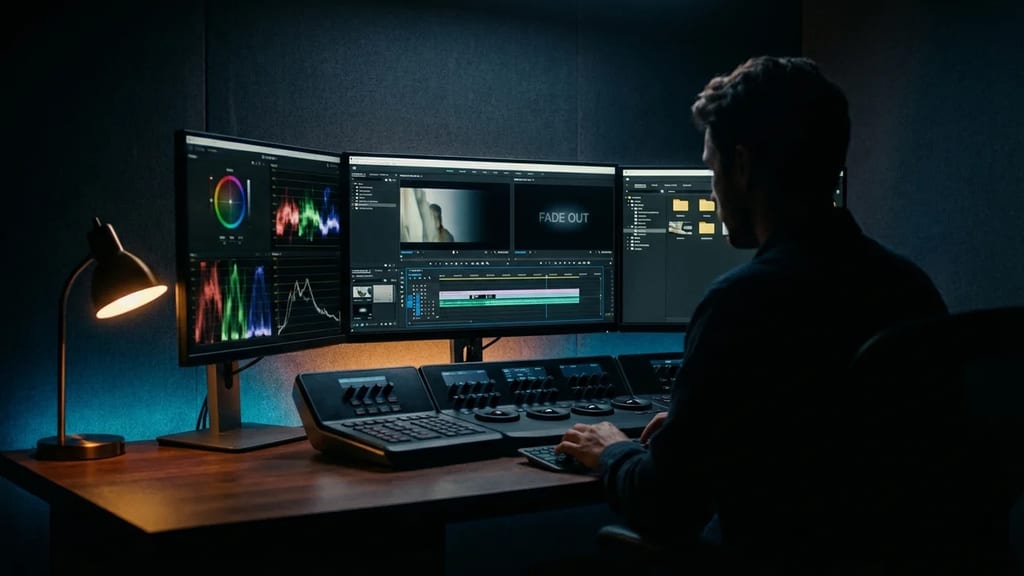
Fade Out: gradual darkening of the image to black by reducing luminance from 100% to 0%, typically over 24 frames (1 sec) in Avid or 30 frames in Premiere Pro.

Technical Details

In digital editing systems, the fade out is realized by multiplying the RGB values with a factor between 1.0 and 0.0. Avid Media Composer uses a standard 24-frame fade out (1 second at 24fps) for this, while Adobe Premiere Pro prefers a 30-frame standard (1.25 seconds). The mathematical curve typically follows an ease-out function with the formula f(t) = 1 - (t/d)², where t represents the elapsed time and d the total duration. Variants include Fade to White and Fade to Color (transition to defined color values).

History & Development

Georges Méliès first used manual fade effects in 1896 by covering the camera lens. D.W. Griffith established the fade out as a narrative transition in 1908 in "The Adventures of Dollie." Mitchell Camera Corporation developed the first mechanical fade device for film cameras in 1917. In the 1920s, optical printers with precise fade mechanisms emerged, remaining standard until the 1990s before digital post-production replaced them.

Practical Use in Film

Akira Kurosawa used 3-second fade outs between life stages in "Ikiru" (1952). Stanley Kubrick exclusively used hard cuts in "2001: A Space Odyssey," deliberately avoiding fade outs to enhance the cool aesthetic. Modern blockbusters like Marvel productions employ 0.5-second micro-fades between action sequences. In post-production, fade outs are typically applied as the last correction layer to avoid affecting color corrections.

Comparison & Alternatives

The fade in is the technical counterpart with reversed luminance progression. Crossfades combine simultaneous fade outs and fade ins of two image sources. Hard cuts are increasingly replacing classic fade outs in contemporary productions – Christopher Nolan exclusively uses direct cuts in "Dunkirk." Digital alternatives include iris wipes and morphing masks, which allow for more complex transition geometries.

From the crafts

Perspectives

Cinematographer

Ich plane Abblenden bereits beim Dreh mit, indem ich zwei Sekunden zusätzliches Material nach dem geplanten Schnitt aufnehme. Bei Available-Light-Szenen verwende ich mechanische ND-Filter am Set für organische Fade-Effekte, die authentischer wirken als digitale Post-Abblenden. Die Belichtung muss am Fade-Ende exakt auf 0 IRE kalibriert sein, sonst entstehen unschöne Grauschleier.

Director

Ich setze Abblenden sparsam als emotionale Interpunktion ein – maximal drei pro Film, meist vor dramatischen Wendepunkten oder Zeitsprüngen. Eine 2-Sekunden-Abblende schafft Nachdenkpausen beim Zuschauer, während 0,5-Sekunden-Fades nur technische Übergänge markieren. In Dialogen vermeide ich sie komplett, da sie den Rhythmus zerstören.

Producer

Abblenden kosten in der DI-Suite zusätzliche Renderzeit – bei 4K-Material etwa 30% mehr Rechenaufwand pro Übergang. Ich plane zwei Stunden extra Colorgrading-Zeit pro zehn Abblenden ein. Archive-Shoots benötigen 10% mehr Rohfilm-Buffer für Fade-Handles, was bei 35mm-Produktionen schnell 5.000 Euro zusätzliche Materialkosten bedeutet.

More in the lexikon

Related terms

Test your knowledge

Quiz

1. Was beschreibt „Abblende" am besten?

2. Zu welchem Department gehört „Abblende"?

3. Wie viele verschiedene Fachperspektiven bietet dieser Eintrag?

Report an error
From the Filmfarm ecosystem

Understand visual language, budget productions, connect crew.

The Lexikon is part of the Filmfarm ecosystem — alongside budgeting (FilmBalance), an industry magazine (FilmCircus) and crew networking (FilmCall, CrewMesh). One shared vocabulary for the whole production.

FilmFarm FilmRadarComing soonFilmPulseComing soonFilmNumbersComing soonFilmCapitalComing soonFilmLabComing soonFilmBalanceComing soonFilmCircusComing soon