Filmlexikon.
Support
Iris Gear
Camera · Terms

Iris Gear

Murnau AI illustration
dissolve fade in fade out fade to black fade to white quasar x crossfade wipe

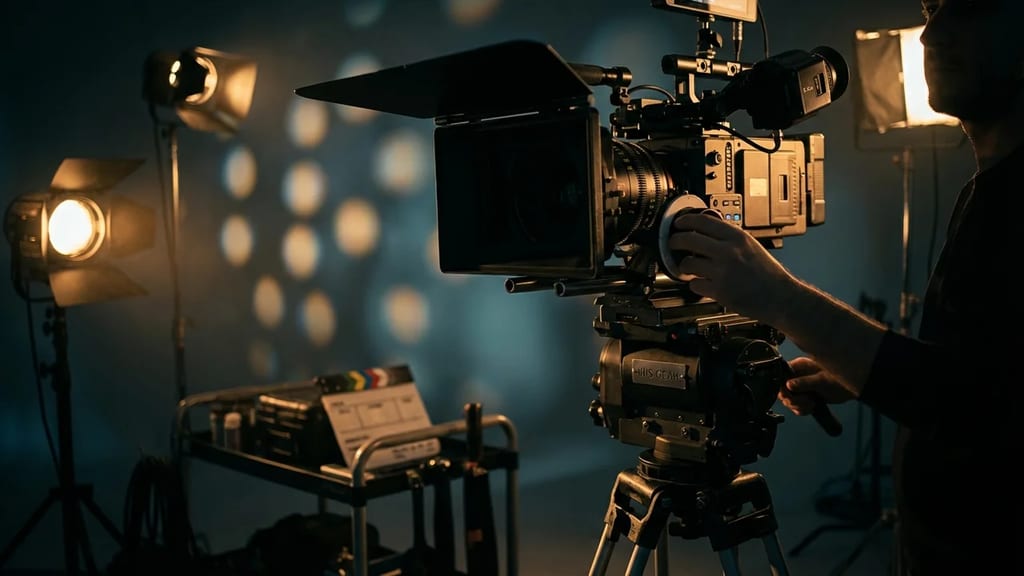
Gear ring on a lens for mechanical iris control via follow focus. Standard on cine lenses.

Technical Details

Standard iris gears feature a pitch of 0.8mm with a diameter between 54-95mm, depending on the lens type. The gearing is usually done in the 32-pitch system (32 teeth per inch of circumference) with an engagement depth of 0.25-0.4mm. In follow focus systems, an intermediate gear with gear ratios of 1:2 to 1:4 transmits the rotational movement to the gear ring. High-quality versions use hardened steel with a surface hardness of 58-62 HRC to minimize wear during frequent remote control.

History & Development

The first iris gears appeared in 1923 on Bell & Howell cinema lenses for the new generation of remote-controlled cameras. Arriflex introduced the 0.8mm pitch system, still used today, in 1937, which was ratified by the SMPTE as standard TE-30 in 1952. Zeiss developed the first electronically coupled iris control using stepper motors on the gear ring in 1976. Modern digital systems like Preston or Ambient have been using brushless servo motors with 0.001-stop resolution since 2003.

Practical Use in Film

In "Blade Runner 2049" (2017), DoP Roger Deakins used motorized gear ring systems for precise depth-of-field ramps during complex camera movements. The iris pulls were performed via the Preston MDR4 system with programmed curves from f/1.4 to f/5.6 within 2.5 seconds. Documentary filmmakers appreciate manual gear ring operation for responsive exposure adjustments without motor noise. In Steadicam shots, wireless gear ring controls allow for aperture changes without direct lens access.

Comparison & Alternatives

In contrast to electronic fly-by-wire systems, the mechanical iris gear offers tactile feedback and functions without a power supply. Video lenses often use servo zoom grips instead of separate gear rings but only achieve ±0.1 stop accuracy. Modern cine lenses integrate encoders directly into the gear ring for metadata recording and automatic lens mapping. At extreme temperatures below -20°C, electronic systems fail, while mechanical iris gears with special grease can function down to -40°C.

From the crafts

Perspectives

Cinematographer

Ich verlasse mich bei kritischen Schärfeverlagerungen auf die 0,8mm-Pitch-Verzahnung, die mir reproduzierbare Iris-Pulls mit meinem Preston-System ermöglicht. Der mechanische Widerstand des Zahnkranzes gibt mir sofortiges Feedback über die Blendenposition, selbst wenn ich das Display nicht sehen kann. Bei Nachtdrehs stelle ich die Blende oft blind über den Zahnkranz ein, da ich nach Jahren die Drehwinkel für Standardblenden auswendig kenne.

Director

Ich nutze programmierte Zahnkranz-Sequenzen für emotionale Übergänge, bei denen sich die Tiefenschärfe synchron zur Handlung verändert - von der isolierenden f/1.4 in Nahaufnahmen bis zur kontextuellen f/5.6 in Totalen. Die Präzision des Zahnkranzes ermöglicht mir wiederholbare Takes mit identischen Schärfeverläufen, was besonders bei mehreren Kameraperspektiven derselben Szene entscheidend ist.

Producer

Mechanische Zahnkranz-Systeme reduzieren meine Technikkosten um 30% gegenüber vollständig elektronischen Lösungen und eliminieren Ausfallzeiten durch Batterieprobleme oder Software-Updates. Die Standardisierung auf 0,8mm-Pitch bedeutet, dass sämtliche Follow-Focus-Equipment zwischen verschiedenen Objektivherstellern kompatibel bleibt, was meine Mietkosten senkt und logistische Komplexität reduziert.

More in the lexikon

Related terms

Test your knowledge

Quiz

1. Was beschreibt „Blendenzahnkranz" am besten?

2. Zu welchem Department gehört „Blendenzahnkranz"?

3. Wie viele verschiedene Fachperspektiven bietet dieser Eintrag?

Report an error
From the Filmfarm ecosystem

Understand visual language, budget productions, connect crew.

The Lexikon is part of the Filmfarm ecosystem — alongside budgeting (FilmBalance), an industry magazine (FilmCircus) and crew networking (FilmCall, CrewMesh). One shared vocabulary for the whole production.

FilmFarm FilmRadarComing soonFilmPulseComing soonFilmNumbersComing soonFilmCapitalComing soonFilmLabComing soonFilmBalanceComing soonFilmCircusComing soon