Definition
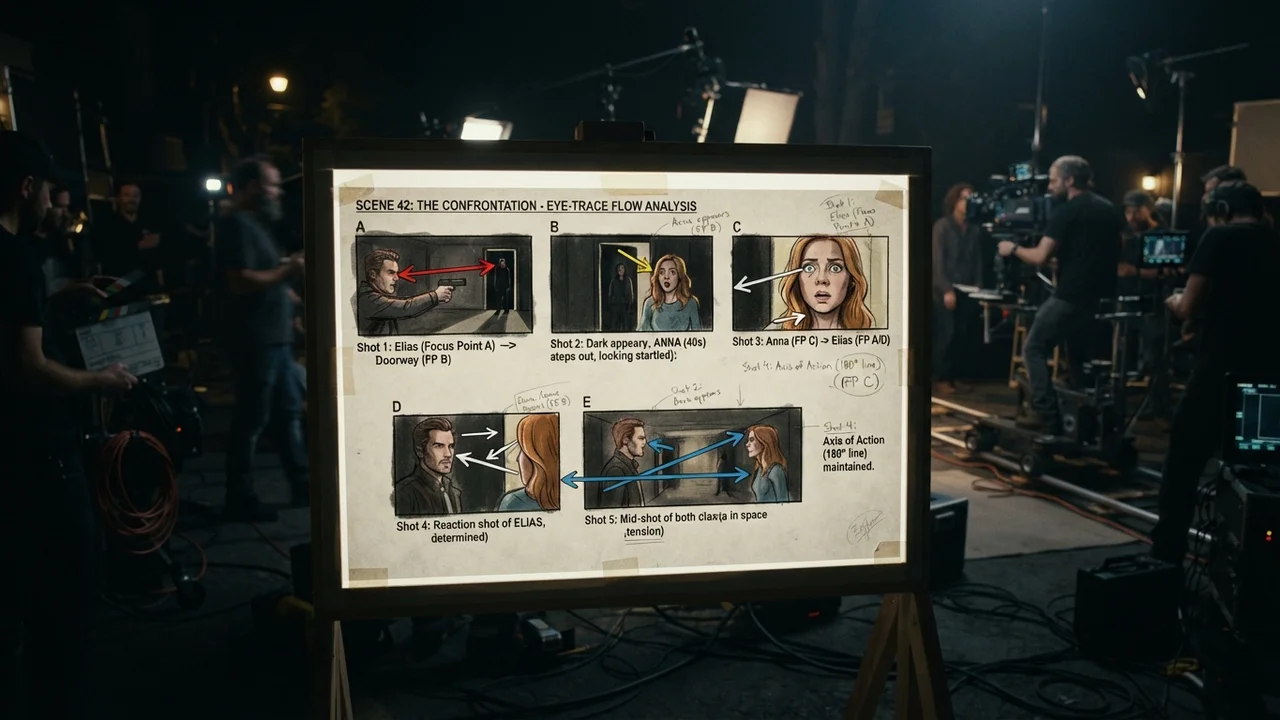
Eye Trace refers to the deliberate design of editing sequences, where the viewer's natural eye movements between successive shots are analyzed and guided. The method is based on the physiological fact that the human eye jumps to new visual focal points within 0.2-0.4 seconds during cuts. The term evolved from early montage theories of the 1920s and has been refined by modern eye-tracking studies.
Technical Details
Eye-tracking measurements show that viewers primarily look at faces (68% of fixations), moving objects (23%), and bright image areas (9%) during cuts. The saccade speed is 300-900°/second. In post-production, these findings are implemented through heat map analyses, where cut points are chosen so that the visual focus flows uninterrupted from the exit point of the first to the entry point of the second shot. Modern Avid and Premiere plugins like "Eye Flow Analyzer" visualize these motion lines directly in the timeline window.
History & Development
Sergei Eisenstein first formulated theories on visual guidance through montage in 1925, without, however, knowing the physiological basis. Walter Murch coined the term "Eye Trace" in 1969 and developed practical editing rules for "The Conversation." Since 2003, Tobii eye trackers have enabled precise measurements of viewer eye movements with a sampling rate of 120-1200 Hz. Marvel Studios began systematically integrating eye-tracking tests into their action sequences in 2008, leading to measurable improvements in viewer orientation in complex VFX shots.
Practical Application in Film
In "Mad Max: Fury Road" (2015), Margaret Sixel designed every cut according to Eye Trace principles: explosions and vehicle movements deliberately lead the eye to character faces in the following shot. Christopher Nolan uses deliberate Eye Trace breaks in "Dunkirk" (2017) to create disorientation. Modern action films like "John Wick" (2014) only break the 180° rule when the Eye Trace continuum is maintained. The technique demonstrably reduces motion sickness in VR productions by up to 40%.
Comparison & Alternatives
Eye Trace differs from the classic 180° rule through its flexible, physiologically based approach rather than rigid geometric rules. While match cuts primarily create object continuity, Eye Trace focuses on attention continuity. AI-based tools like "Cognitive Cut" have been automatically analyzing optimal cut points based on eye-tracking databases since 2019. For static dialogue scenes, traditional shot-reverse-shot editing remains more efficient, while complex action and VFX sequences benefit significantly from Eye Trace optimization.