Overview
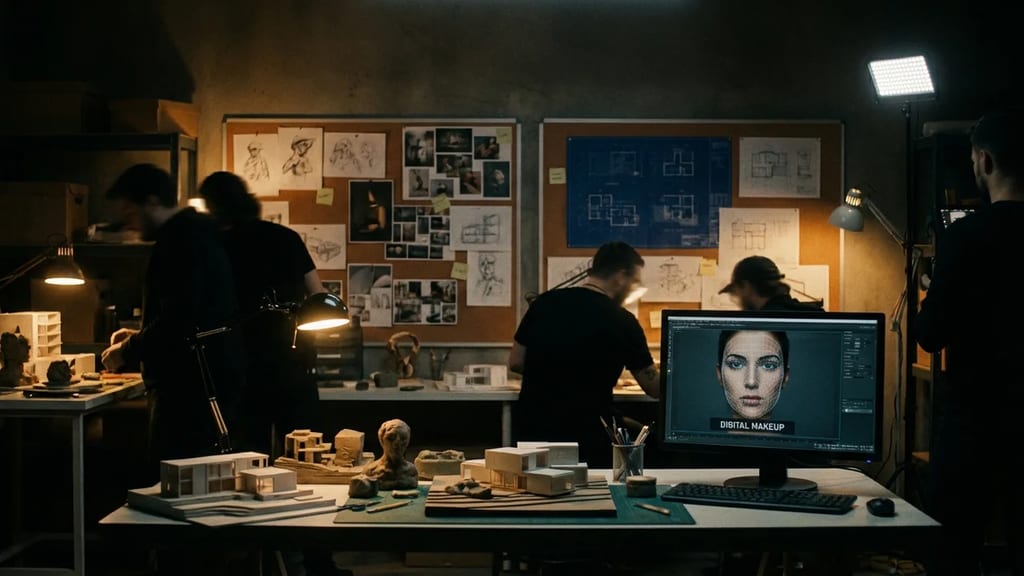
Digital Makeup (also known as "digital cosmetics") is not lighting or grip equipment, but a discipline of visual effects (VFX) in compositing. Instead of applying physical makeup on set, cosmetic and creative adjustments to the face or body of performers are carried out digitally in post-production. This allows for corrections and transformations that are difficult or impossible to achieve with practical makeup.
The spectrum ranges from subtle beauty work to complete facial alteration. The goal is for the result to remain invisible to the audience – the interventions should seamlessly integrate with skin tones, light, shadow, and skin texture.
Typical Applications
- Beauty Work: Removal of blemishes, wrinkles, or dark circles, skin smoothing
- Removal / Addition of Details: Tattoos, moles, scars, or wounds
- De-Aging and Aging: digitally making characters younger or older
- Color Changes: Eye or hair color
- Replacement / Enhancement: Replacing a stunt double's face with the lead actor's, or transforming into creatures
Technique and Tools
Digital makeup relies on classic compositing techniques. Commonly mentioned techniques include:
- Tracking / Motion Capture for capturing facial and body movement
- Rotoscoping (frame-by-frame isolation)
- Keying for isolating image areas
Common compositing and image editing software such as Nuke, Adobe After Effects, Blackmagic Fusion, Autodesk Flame, and Photoshop are used; specialized beauty tools include Boris FX Beauty Studio (Continuum) or Digital Anarchy Beauty Box. Artists must consider skin tone, light, shadow, and texture to achieve a believable result.
Distinction from Practical Makeup
In contrast to physical makeup, digital makeup is applied only in post-production and therefore does not cost any shooting time. It can be adjusted retrospectively as needed. Practical makeup, on the other hand, offers immediate physical presence and realism on set. In current practice, both approaches are often combined.