Overview
Face Replacement is a digital image manipulation process in post-production. In this process, the face of a person filmed in the image is replaced with another face, while the head position, facial expressions, gaze direction, and lighting and shadow conditions of the original shot are intended to be preserved. It is not a set or grip device, but a pure VFX/compositing technique.
Typical reasons for use include:
- Stunt and Body Doubles: The double's face is replaced with that of the lead actor, making risky or physically demanding shots credibly attributable to the star.
- Posthumous Completion: Scenes of deceased actors can be completed using doubles and face replacement.
- Multiple Roles and Clone Effects: An actor plays multiple characters or appears multiple times in the same shot.
- Performance Correction: Facial expressions or expressions can be adjusted in post-production.
Technical Procedures
Several approaches are used for face replacement, which can also be combined:
- Rotoscoping & 2D Compositing: The replacement face is isolated, tracked, and composited over the original face (keying, match-move, matte painting).
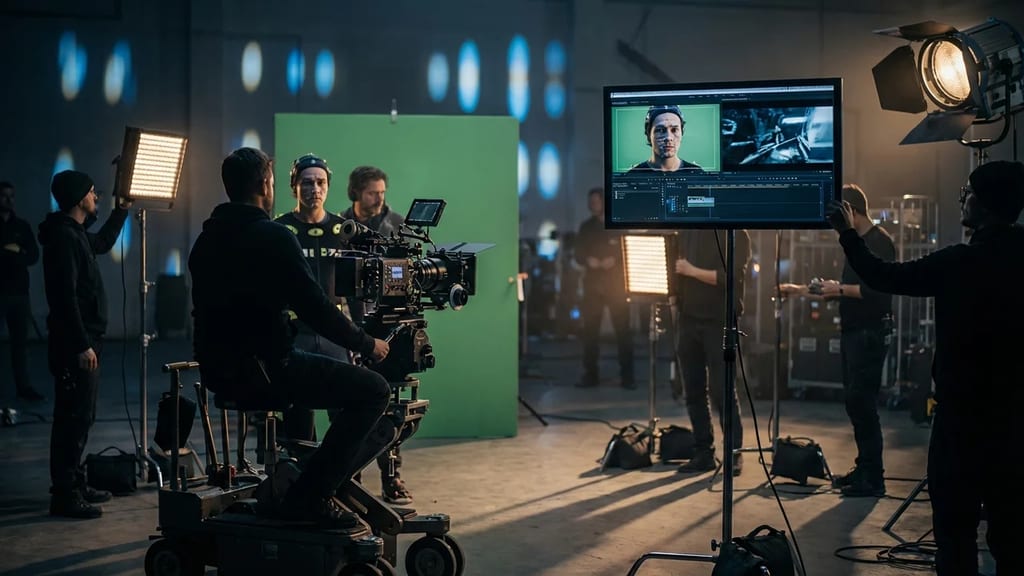
- 3D Reconstruction: A digital model of the face is created and adapted to the movement and expression of the original shot, often supported by facial motion capture (marker-based tracking of facial movement).
- AI/Deepfake Techniques: Newer approaches use machine learning (including Generative Adversarial Networks, GAN) to reconstruct and insert faces from existing footage.
Crucial for a convincing result is the clean adaptation to the lighting, shadows, image sharpness, film grain, and camera movement of the original plate.
History and Notable Examples
| Film | Year | Reason / Remark |
|---|
| Jurassic Park | 1993 | Considered one of the earliest digital face replacements; Industrial Light & Magic composited the actress's face over that of a stunt double. |
| The Crow | 1994 | Posthumous completion of Brandon Lee's role after his death during filming. |
| Gladiator | 2000 | Completion of scenes for Oliver Reed, who died during production. |
On-Set Usage
Although face replacement takes place in post-production, preparation begins during the shoot. Consistent lighting and camera perspective between the actor and the double, documented lighting data, and, if necessary, separate "clean plates" and reference shots of the original face under the same conditions are helpful. The more precisely the lighting, lens, and camera movement are documented, the more seamlessly the replacement face can be integrated into the shot later.