Overview
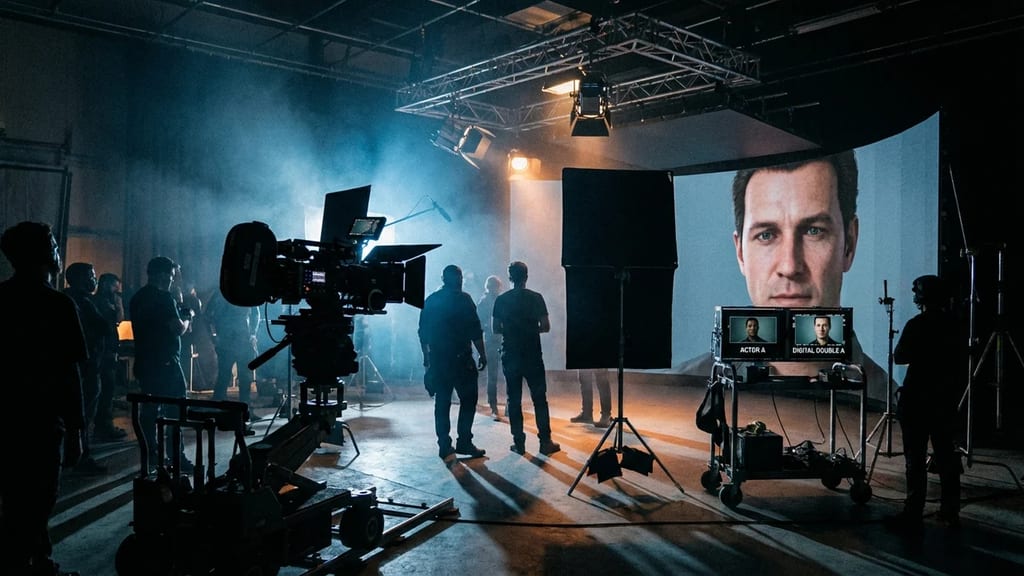
A Digital Double is not a lighting or grip device, but a term from the field of Visual Effects (VFX): it refers to a computer-generated 3D model that replicates a real actor, stunt performer, creature, or object as accurately as possible. It is used for shots that would be too dangerous, too expensive, or physically impossible with the real person, such as falls, large crowd scenes, extreme camera moves, or the de-aging or recreation of performers.
The term appears in a lexicon of lighting and grip because a Digital Double can only be credibly integrated into a real shot (the "plate") if the lighting situation on set has been precisely documented. The lighting and camera departments provide the reference data for this, which the VFX team then uses to light the model identically.
Creation and Set Reference
For a convincing Digital Double, several datasets are typically captured on set:
- HDRI / Light Reference: 360-degree captures of the set lighting as High-Dynamic-Range Images, often with a mirrored sphere (Chrome Ball) and a matte grey sphere (Grey Ball) to record light direction, color, and reflection behavior.
- Photogrammetry: Numerous overlapping photos from which geometry and textures are reconstructed.
- LiDAR / 3D Scan: Laser scans of the person, set, or object to capture exact dimensions and geometry.
- Witness Cameras and Reference Photos: additional angles as well as notes on focal length, height, and lighting setup.
These reality capture data allow the digital model to be rendered with the same lighting, shadows, and reflections as the filmed material, so that the transition between the real shot and CGI becomes invisible.
Distinction
A Digital Double must be distinguished from related terms: A Stunt Double is a real substitute performer, a Body Double is a real body substitute for individual shots. The Digital Double replaces these entirely digitally. It is a CGI asset that is created and processed within a VFX pipeline, but builds upon practical references from the shoot.
Examples
Well-known applications range from the digital recreation of Peter Cushing and a young Carrie Fisher in Rogue One: A Star Wars Story (2016) to the Luke Skywalker reconstruction in The Mandalorian (2020). Even earlier productions like Terminator 2 (1991) used computer models of actor faces.