Filmlexikon.
Support
Declicked Aperture
Camera · Terms

Declicked Aperture

Murnau AI illustration
aperture flow para roll take

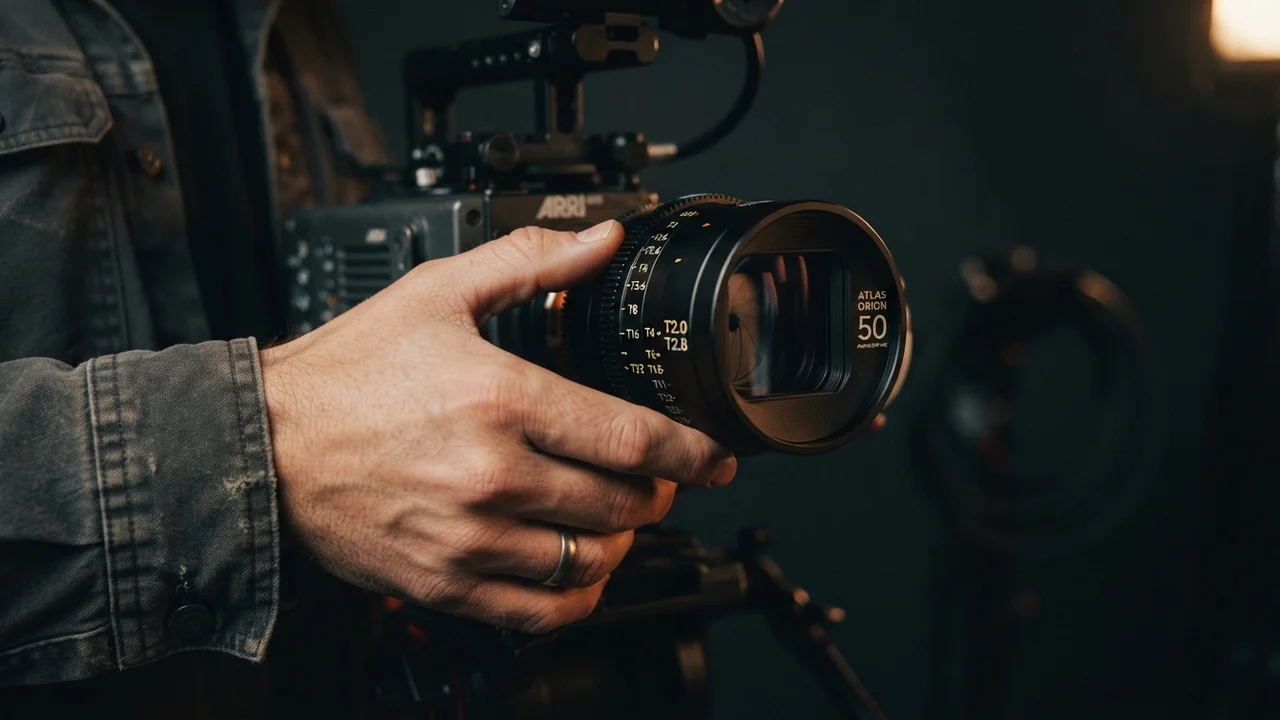
Aperture mechanism without detent clicks, allowing smooth stepless adjustment across 270–300° rotation for seamless exposure transitions during shooting.

Technical Details

Declicked apertures operate with a continuously adjustable iris ring, typically covering a working range from T/1.3 to T/22. The adjustment range usually spans 270° to 300° of rotation on the lens ring. Modern systems like the Zeiss Master Prime series offer precision down to 1/100th of a stop. The mechanical construction foregoes spring mechanisms and detents in favor of a uniformly damped friction resistance of 0.8 to 1.2 Nm torque. Electromotive variants (such as Preston FIZ systems) allow for adjustment speeds between 0.1 and 15 seconds for the complete aperture range.

History & Development

Carl Zeiss developed the first declicked aperture in 1962 for the Distagon 25mm T/2.1, originally designed for the Arriflex 35 IIC. Panavision followed in 1967 with the Primo series, introducing the 0.8-module gear ring that is now standard. In the 1980s, the declicked aperture became established as the standard for all professional cinema lenses. The digital revolution from 2005 onwards brought forth electronically controlled iris systems, with RED introducing fully automatic aperture control based on live histogram analysis for the first time in 2018 with the DSMC3 system.

Practical Use in Film

Roger Deakins systematically used declicked apertures in "Blade Runner 2049" for seamless exposure transitions during camera movements through differently lit spaces. Typical applications include dolly shots from interiors to exteriors, where continuous aperture correction of 3-5 stops is required. The declicked adjustment allows for precise depth-of-field manipulation during recording without visible brightness jumps. Disadvantages arise from the lack of tactile reference points – camera assistants must apply markings to the follow-focus ring or use digital display systems.

Comparison & Alternatives

Compared to clicked apertures, the declicked system offers 128 times higher setting precision but requires more precise operation and marking. Modern alternatives include electronically controlled iris systems (like Fujinon Cabrio with /i Technology) or LDS lenses (Lens Data System) with automatic metadata transmission. Variable ND filters (like Tiffen Variable ND) partially replace aperture adjustment but offer only a 2-8 stop working range compared to the 6-10 stops of declicked apertures. For documentary work, clicked systems remain relevant as they allow for quick, reproducible settings without direct visual contact with the lens.

From the crafts

Perspectives

Cinematographer

Ich setze rastlose Blenden primär für komplexe Kamerafahrten ein, wo sich die Lichtsituation kontinuierlich ändert - etwa bei Steadicam-Aufnahmen durch verschiedene Räume. Die fehlenden Rastpunkte erfordern präzise Markierungen am Follow-Focus, aber dafür kann ich während der Fahrt nahtlos 4-5 Stops korrigieren ohne sichtbare Helligkeitssprünge. Bei kritischen Aufnahmen arbeite ich mit einem zweiten Assistenten nur für die Blendensteuerung.

Director

Rastlose Blenden ermöglichen mir dramaturgische Effekte durch fließende Schärfentiefe-Veränderungen während einer Einstellung - etwa um den emotionalen Fokus von einem Charakter zum anderen zu verschieben. Besonders in Dialogszenen kann ich durch kontinuierliche Blendenöffnung die Aufmerksamkeit subtil lenken, ohne einen Cut zu benötigen. Das schafft organischere Übergänge als traditionelle Schärfeverlagerungen.

Producer

Rastlose Blenden reduzieren die Anzahl der Wiederholungen bei komplexen Kamerafahrten erheblich, da Belichtungsfehler seltener auftreten - das spart mir durchschnittlich 2-3 Takes pro Setup. Die höheren Objektivkosten (ca. 30% Aufschlag gegenüber gerasterter Variante) amortisieren sich durch reduzierten Zeitaufwand. Allerdings benötige ich erfahrenere Kameraassistenten, was die Personalkosten um etwa 15% erhöht.

More in the lexikon

Related terms

Test your knowledge

Quiz

1. Was beschreibt „Rastlose Blende" am besten?

2. Zu welchem Department gehört „Rastlose Blende"?

3. Wie viele verschiedene Fachperspektiven bietet dieser Eintrag?

Report an error
From the Filmfarm ecosystem

Understand visual language, budget productions, connect crew.

The Lexikon is part of the Filmfarm ecosystem — alongside budgeting (FilmBalance), an industry magazine (FilmCircus) and crew networking (FilmCall, CrewMesh). One shared vocabulary for the whole production.

FilmFarm FilmRadarComing soonFilmPulseComing soonFilmNumbersComing soonFilmCapitalComing soonFilmLabComing soonFilmBalanceComing soonFilmCircusComing soon