Overview
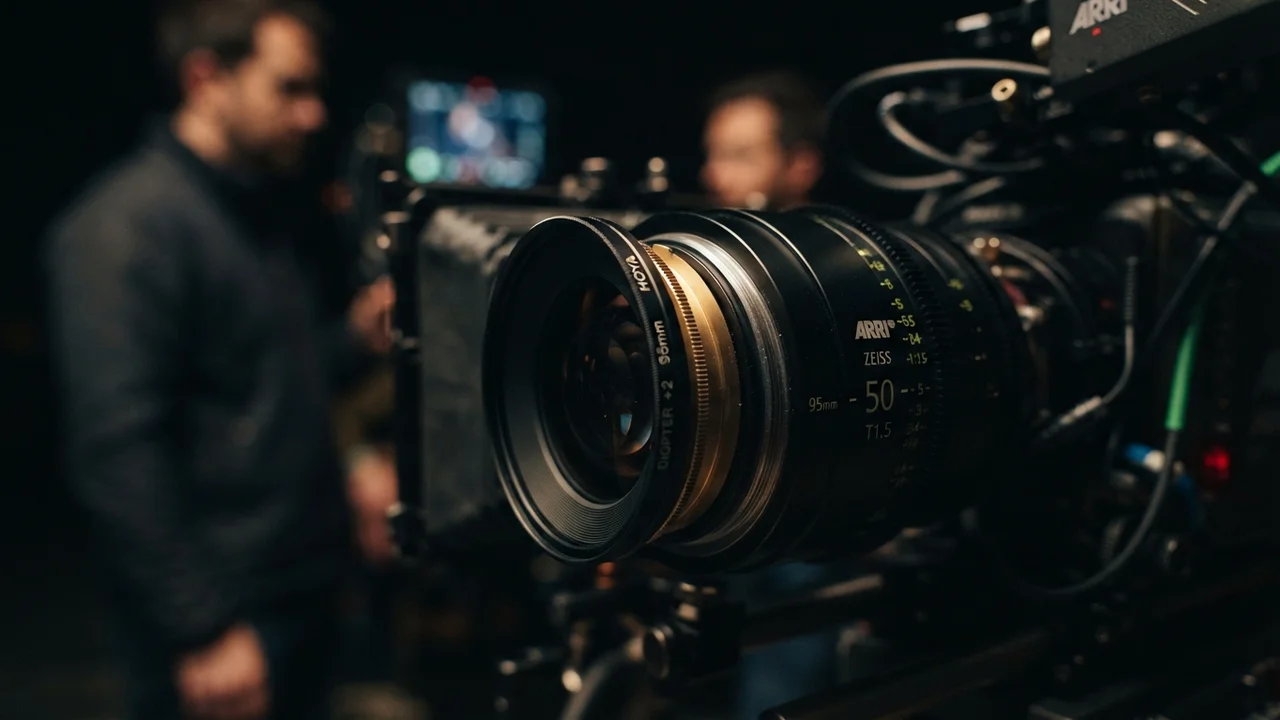
A diopter (also known as a "close-up lens," "attachment lens," or historically by Zeiss as "Proxar") is a convex attachment lens that is screwed onto the lens like a magnifying glass or inserted into a matte box. It shortens the lens's minimum focus distance, allowing the camera to get much closer to the subject and produce a magnified image – without the need for a dedicated macro lens.
Strictly speaking, the term "diopter" is imprecise: "dioptrie" is actually the optical unit of refractive power. However, in the practical context of sets, rentals, and equipment lists, "diopter" refers to the finished close-up attachment lens itself.
The full diopter discussed here (Full-Field, covering the entire image area) should be distinguished from the split diopter (Split-Field), where only half of the lens is ground to show foreground and background in focus simultaneously.
Function and Strengths
Diopters are specified by their refractive power in diopters, with integer strengths such as +1, +2, +3 up to +10 being common. Multiple diopters can be stacked, with their strengths adding up (e.g., +3 plus +4 effectively results in +7). For fine adjustments without sacrificing too much of the far focus range, Schneider Optics also offers fractional strengths in 1/8, 1/4, 1/2, and 3/4, according to ASC.
With the lens set to infinity, the resulting focal plane is approximately at the focal point of the attachment lens. It is calculated by dividing 1000 mm by the diopter strength:
| Diopter Strength | Focus Distance with Lens at Infinity (approx.) |
|---|
| +1 | 1000 mm (1.0 m) |
| +2 | 500 mm (0.5 m) |
| +4 | 250 mm (0.25 m) |
| +8 | 125 mm (0.125 m) |
A stronger diopter thus brings the subject closer, but it cuts into the usable focus range towards the rear: with an attachment lens, the lens can no longer focus to infinity.
Set Usage
Diopters are the simplest and most affordable means of shortening a lens's minimum focus distance. They are particularly useful with zoom lenses and older anamorphic optics, which often have a relatively large minimum distance; even weak strengths bring the minimum focus distance into a practical range. They are suitable for insert and detail shots (hands, products, eyes, beauty/food) as well as for macro effects.
Unlike an extension tube, which sits behind the lens and increases the distance to the sensor, a diopter is mounted at the front. In cinema practice, mounted, round attachment lenses in standard filter diameters like 138 mm are common, allowing them to be inserted directly into the matte box.
Optical compromises should be anticipated: high-quality, well-corrected attachment lenses deliver better results, while simple filters can lose sharpness towards the edges of the image. The choice of strength is therefore always a trade-off between the desired magnification and the usable focus range.