Cinematographer
Aus DoP-Perspektive ist dieses Element essentiell für die visuelle Gestaltung. Es ermöglicht mir die gewünschte Farbstimmung und das ästhetische Bild konsistent umzusetzen.
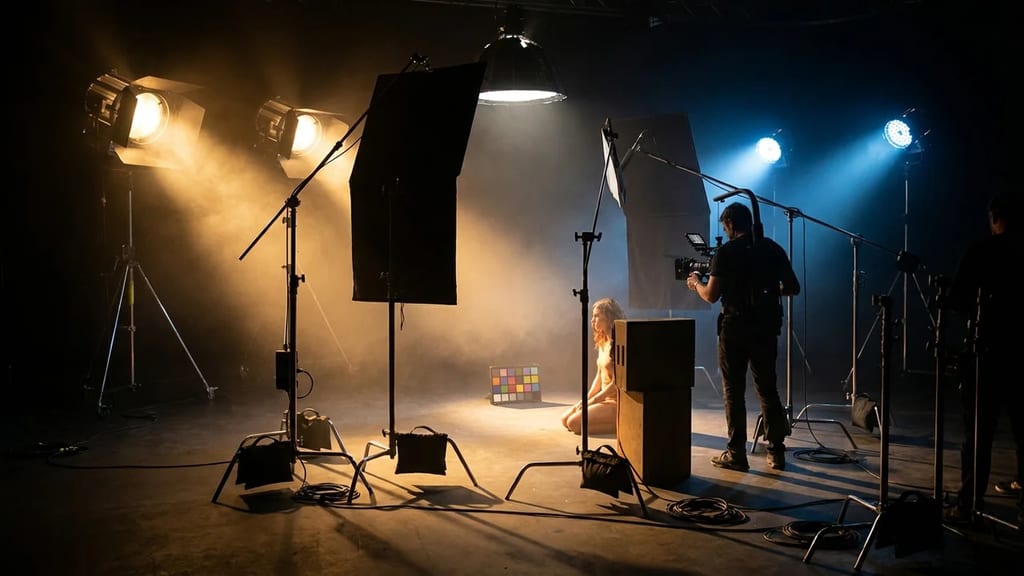
CRI 90+ denotes light sources with a general Color Rendering Index (Ra) of at least 90 out of 100—the quality threshold for professional film and studio lighting.
"CRI 90+" is not a device or product designation, but a quality indicator for light sources. CRI stands for Color Rendering Index, a metric introduced by the CIE in 1965 that describes how faithfully an artificial light source renders colors compared to a reference light source. The scale ranges from 0 to 100, where 100 represents rendering that matches the reference (daylight or a blackbody radiator).
The value indicated is the Ra (general index), calculated as the average of the first eight test colors R1–R8. "90+" marks the threshold above which color rendering is considered suitable for demanding visual applications. In film and studio environments, CRI 90+ is therefore the usual minimum criterion when purchasing LED lights, as lower values produce visible color casts that are difficult to correct in post-production.
To determine the CRI, the light source is compared to a reference of the same color temperature: for color temperatures below 5000 K, a blackbody radiator serves as the reference; above 5000 K, a calculated daylight spectrum is used. The measurement assesses how much defined test colors differ under test and reference light.
CRI 90+ is considered the entry-level threshold for professional lighting; higher-quality cinema lights achieve Ra values of 95 and above. However, a high Ra alone is not a guarantee of accurate skin tones: since the Ra only averages R1–R8, a light with Ra 90+ may still have a weak R9 value (saturated red). Red is the most difficult color for LEDs to produce, and the proportion of red is crucial for vibrant skin tones – human skin increasingly reflects light above approximately 600 nm, due to the blood beneath the skin.
For this reason, lighting technicians and DoPs check R9 and other metrics in addition to Ra. Complementary or competing metrics include:
Since the CRI is a comparatively coarse measure, high-quality lights use multi-channel color engines (often six or more emitters, for example with an additional deep red and mint green channel) to achieve a broadband spectrum and thus simultaneously high CRI, R9, and TLCI values.
Aus DoP-Perspektive ist dieses Element essentiell für die visuelle Gestaltung. Es ermöglicht mir die gewünschte Farbstimmung und das ästhetische Bild konsistent umzusetzen.
Diese professionelle Lösung erhöht die Produktionseffizienz und reduziert Post-Production-Anforderungen. Sie ermöglicht flexible, schnelle Anpassungen während des Drehs.
Als Gaffer ist dies ein unverzichtbares Werkzeug meines täglichen Handwerkszeugs. Es ermöglicht mir professionelle Lichtkontrolle und schnelle Anpassungen auf Set, was Zeit spart und Qualität sichert.
1. Zu welchem Department gehört „CRI 90+"?
2. Wie viele verschiedene Fachperspektiven bietet dieser Eintrag?
The Lexikon is part of the Filmfarm ecosystem — alongside budgeting (FilmBalance), an industry magazine (FilmCircus) and crew networking (FilmCall, CrewMesh). One shared vocabulary for the whole production.