Filmlexikon.
Support
Close-Up Lens
Camera · Equipment

Close-Up Lens

Murnau AI illustration
anamorphic lens anamorphic projection lens angenieux optimo prime arri master prime arri signature prime arri ultra prime arri zeiss variable prime atlas lens co

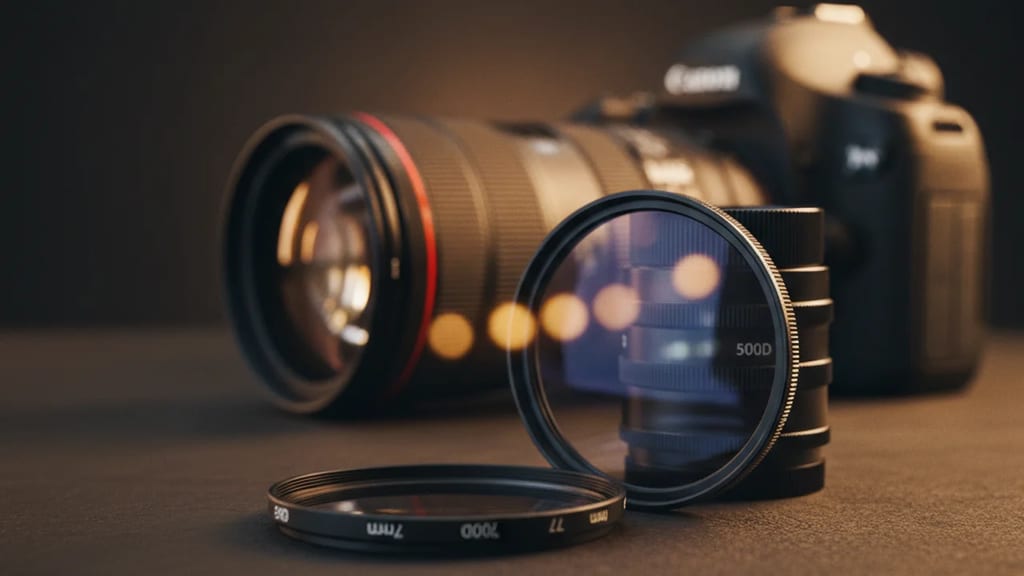
Close-up lens attachment that reduces minimum focus distance, available in +0.5 to +10 diopters. A +1 diopter lens halves the lens's focusing distance.

Technical Details

Close-up lenses are offered in diopter strengths from +0.5 to +10, with +1, +2, +4, and +10 diopters being the standard values. A +1 diopter lens, for example, halves the focusing distance of a 50mm lens from 45cm to 22.5cm. The lenses consist of single or multi-element systems, with achromatic doublets reducing chromatic aberration. Filter diameters range from 37mm to 127mm. Combinations of multiple close-up lenses add their diopter values but disproportionately amplify aberrations.

History & Development

Close-up lenses emerged in the 1920s alongside the development of 35mm film. Leitz introduced the first standardized close-up lenses for Leica lenses in 1930. Kodak established the diopter system for film cameras in 1935. In the 1960s, Canon and Nikon developed achromatic close-up lenses for professional film productions. Tiffen and Schneider-Kreuznach shaped the standards for broadcast and cinema cameras from the 1970s onwards. Today, digital macro lenses dominate the market, but close-up lenses remain relevant for specialized applications.

Practical Use in Film

Douglas Trumbull used +4 diopter lenses on Zeiss lenses for extreme close-ups of the HAL 9000 camera in "2001: A Space Odyssey" (1968). Ridley Scott employed close-up lenses for detailed shots of the Alien creature to maximize available depth of field. In documentaries, +1 or +2 diopters allow for spontaneous macro shots without changing lenses. Close-up lenses noticeably reduce depth of field and can cause edge softness (vignetting), especially with wide-angle lenses under 35mm focal length.

Comparison & Alternatives

Macro lenses offer higher optical quality but require lens changes and cost 10-20 times more. Extension tubes mechanically increase the flange distance but reduce the light intensity by 1-3 stops. Bellows devices allow for stepless magnification but are unsuitable for handheld shots. Close-up lenses remain the fastest solution for moderate close-ups without light loss, while macro lenses are essential for the highest quality demands and magnifications beyond 1:2.
From the crafts

Perspectives

Cinematographer

Ich nutze +2 Dioptrienlinsen hauptsächlich an 85mm-Objektiven für Porträtdetails, weil sie die natürliche Perspektive erhalten und die Schärfentiefe kontrollierbar bleibt. Bei Steadicam-Fahrten sind sie unersetzlich, da ein Objektivwechsel den Gimbal-Ausgleich zerstören würde. Wichtig ist die Positionierung am äußersten Rand der Mattebox, um Reflexionen zu minimieren.

Director

Vorsatzlinsen geben mir die Spontaneität, emotional wichtige Details zu isolieren, ohne die Szene für einen Objektivwechsel zu unterbrechen – besonders bei Schauspielern, die in einem fragilen emotionalen Moment sind. Die leichte Randunschärfe nutze ich bewusst für traumähnliche Sequenzen oder Erinnerungsszenen.

Producer

Ein Vorsatzlinsen-Set kostet 200-800 Euro versus 15.000 Euro für ein Makroobjektiv – bei 90% identischer Bildqualität für Standard-Nahaufnahmen. Sie sparen täglich 10-15 Minuten Setup-Zeit pro Nahaufnahme und reduzieren das Risiko von Objektivwechseln in staubigen Außenumgebungen erheblich.

More in the lexikon

Related terms

Test your knowledge

Quiz

1. Was beschreibt „Vorsatzlinse" am besten?

2. Zu welchem Department gehört „Vorsatzlinse"?

3. Wie viele verschiedene Fachperspektiven bietet dieser Eintrag?

Report an error
From the Filmfarm ecosystem

Understand visual language, budget productions, connect crew.

The Lexikon is part of the Filmfarm ecosystem — alongside budgeting (FilmBalance), an industry magazine (FilmCircus) and crew networking (FilmCall, CrewMesh). One shared vocabulary for the whole production.

FilmFarm FilmRadarComing soonFilmPulseComing soonFilmNumbersComing soonFilmCapitalComing soonFilmLabComing soonFilmBalanceComing soonFilmCircusComing soon