Filmlexikon.
Support
Cine Lens
Camera · Equipment

Cine Lens

Murnau AI illustration
anamorphic lens anamorphic projection lens angenieux optimo prime arri master prime arri signature prime arri ultra prime arri zeiss variable prime atlas lens co

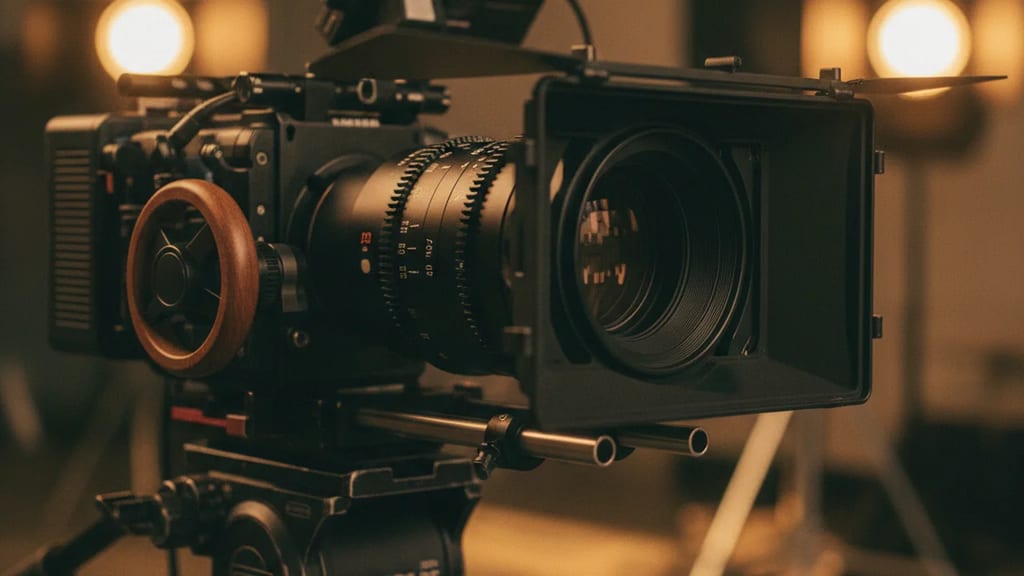
Cinema lens featuring gear rings for follow-focus, continuous iris control, and minimal focus breathing. Optimized for professional film production.

Technical Details

Cine lenses consistently use T-stops (Transmission Stop) instead of F-stops, which measure actual light transmission. Typical wide apertures range from T1.3 to T2.8. The focus ring has a throw of at least 270°, with premium lenses reaching up to 330°. Standard mounts are PL-Mount (Positive Lock) with a 52mm diameter or LPL-Mount with 62mm. The front thread is usually 114mm or 136mm for matte box systems. Cine lenses feature a constant front lens position (Non-Breathing) and uniform 110mm housing diameters for uncomplicated lens changes.

History & Development

The first cine lenses emerged in the 1920s when Cooke developed optics specifically optimized for film cameras with the Speed Panchro series. In 1971, ARRI introduced the PL-Mount as an industry standard. Zeiss revolutionized low-light cinematography in 1975 with the Super Speed T1.3 lenses. In the 1990s, zoom lenses like the Angenieux Optimo 24-290mm became established. Since 2018, the LPL-Mount has been gaining traction for large format sensors, while modern Master Prime and Signature Prime series cover focal lengths from 12mm to 200mm.

Practical Use in Film

Roger Deakins used Zeiss Master Primes for "1917" (2019) to achieve continuous camera movements with precise focus. The Cooke S7/i series was used on "Dune" (2021), producing the characteristic "Cooke Look" with soft bokeh. Anamorphic lenses like the ARRI Master Anamorphic create the 2.39:1 aspect ratio with typical lens flares. Lens changes are facilitated by standardized Lens Data Systems (LDS), which automatically transfer metadata to the camera. Follow focus systems like the ARRI cforce mini enable precise focus pulls during shooting.

Comparison & Alternatives

Cine lenses differ from still photography lenses through mechanical precision and continuous adjustment without click stops. While still lenses are optimized for fast autofocus, cine lenses offer manual control with repeatable settings. Canon CN-E and Sony CineAlta represent entry-level options starting from €3,000, while ARRI Signature Primes can cost up to €45,000. Modern alternatives include rehoused still lenses from Duclos Lenses or Sigma Cine versions of existing Art lenses with added gear rings and T-stop calibration.
From the crafts

Perspectives

Cinematographer

Ich bevorzuge Kinoobjektive wegen ihrer mechanischen Präzision – der 300°-Fokusring meiner ARRI Signature Primes ermöglicht millimetergenaue Schärfeverlagerungen, die mit Standard-Fotoobjektiven unmöglich wären. Die einheitlichen Gehäusedurchmesser und T-Blenden-Kalibrierung sparen mir täglich Stunden beim Rigging und garantieren konsistente Belichtung über alle Brennweiten.

Director

Kinoobjektive geben mir die kreative Kontrolle, die ich für komplexe Sequenzen brauche – beispielsweise kann ich mit anamorphen Master Anamorphics gezielt emotionale Intimität durch shallow focus erzeugen oder mit dem charakteristischen Cooke-Look die Hautfarben meiner Darsteller wärmer gestalten. Die präzise Fokusführung ermöglicht mir dramaturgisch motivierte Schärfeverlagerungen zwischen Dialogpartnern.

Producer

Ein Kinoobjektiv-Set kostet 150.000-400.000€, aber die Zeitersparnis am Set rechtfertigt die Investition – keine Nachjustierungen zwischen Takes, standardisierte Workflows und weniger technische Probleme bedeuten zwei zusätzliche Setup-Durchgänge pro Drehtag. Mietkosten liegen bei 800-2.000€ pro Woche je nach Serie.

More in the lexikon

Related terms

Test your knowledge

Quiz

1. Was beschreibt „Kinoobjektiv" am besten?

2. Zu welchem Department gehört „Kinoobjektiv"?

3. Wie viele verschiedene Fachperspektiven bietet dieser Eintrag?

Report an error
From the Filmfarm ecosystem

Understand visual language, budget productions, connect crew.

The Lexikon is part of the Filmfarm ecosystem — alongside budgeting (FilmBalance), an industry magazine (FilmCircus) and crew networking (FilmCall, CrewMesh). One shared vocabulary for the whole production.

FilmFarm FilmRadarComing soonFilmPulseComing soonFilmNumbersComing soonFilmCapitalComing soonFilmLabComing soonFilmBalanceComing soonFilmCircusComing soon