Filmlexikon.
Support
Book Light
Lighting · Terms

Book Light

Murnau AI illustration
color temperature flow roll take

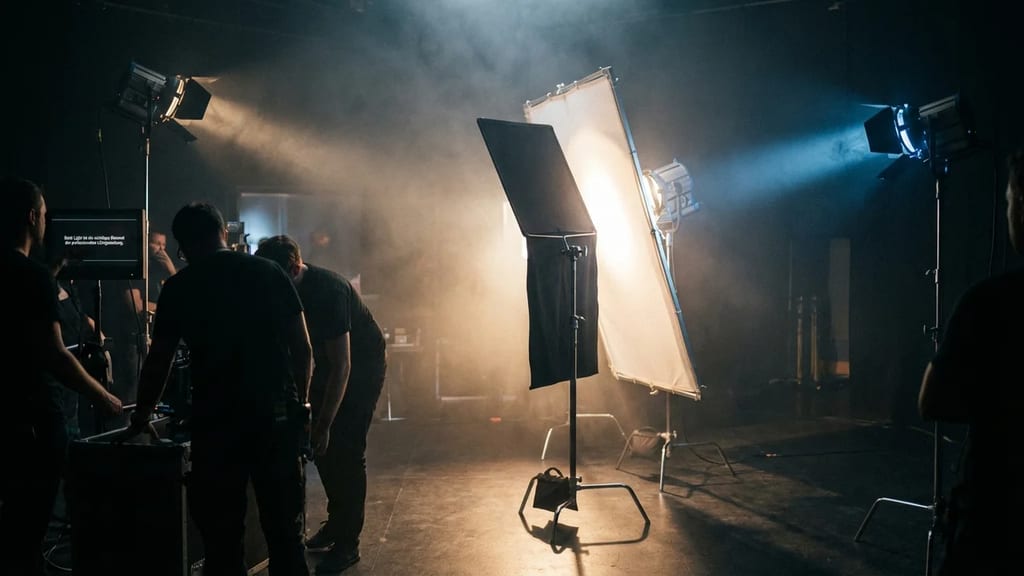
Foldable LED light panel with V-shaped reflector wings enabling variable light quality from hard spot to soft fill.

Technical Details

Modern book lights use LED arrays with a color temperature of 3200K-5600K and CRI values over 95. The reflector panels are made of anodized aluminum or specially coated plastic surfaces. Typical models like the Kino Flo Diva-Lite 400 weigh 4.2 kg and require 230V mains power or 24V battery operation. Light distribution follows a cosine characteristic with a 120° beam angle when fully open. High-quality systems offer DMX control and dimming functions from 0-100%.

History & Development

In 1987, Frieder Hochheim developed the first commercial book light for the German company Dedolight. The inspiration came from improvised fill lights made from folded reflector screens. In 1992, Kino Flo established the concept with fluorescent tubes in Hollywood. The breakthrough came in 2001 with the introduction of daylight-compatible light sources. Since 2015, LED-based systems with app control and battery operation have dominated the market.

Practical Use in Film

Cinematographer Emmanuel Lubezki extensively used book lights in "The Revenant" (2015) for natural-looking facial fill in available light scenes. The variable light characteristic is suitable for close-ups (closed, hard light) and group shots (open, soft area light). Standard workflow: position at 45° to the camera axis, adjust opening angle for desired shadow rendering. Disadvantage: visible double shadows at medium opening angles due to the split light source.

Comparison & Alternatives

Unlike softboxes, the book light's V-shape creates a characteristic gradient in light fall-off. LED panels offer similar portability but less control over light quality. Modern alternatives like the Aputure Nova P300c combine book light functionality with pixel mapping and effect modes. For budget productions, foldable reflectors with separate light sources replace the book light but do not achieve its precise controllability.

From the crafts

Perspectives

Cinematographer

Ich schätze die präzise Kontrolle über Kontrast und Schattenzeichnung durch den variablen Öffnungswinkel – geschlossen für dramatische Portraitbeleuchtung mit 4:1 Kontrast, geöffnet für sanfte 2:1 Aufhellung bei Dialogszenen. Die kompakte Bauform ermöglicht mir auch in beengten Innenräumen eine professionelle Lichtführung ohne aufwendige Stativ-Konstruktionen.

Director

Das Buchlicht unterstützt meine emotionale Bildsprache durch die stufenlose Härte-Regulierung – für Verhörszenen nutze ich die geschlossene Position um Charaktere zu isolieren, während Familienszenen die geöffnete, warme Ausleuchtung bekommen. Die schnelle Anpassung zwischen den Takes hält den Dreh-Rhythmus aufrecht.

Producer

Ein hochwertiges LED-Buchlicht kostet 2.800-4.500 Euro, rentiert sich aber durch Zeitersparnis und reduzierten Stromverbrauch gegenüber Tungsten-Alternativen. Der Akkubetrieb eliminiert Generatorkosten bei Außendrehs, die kompakte Bauform reduziert Transport- und Lagerkosten um etwa 40% im Vergleich zu konventionellen Softbox-Sets.

More in the lexikon

Related terms

Test your knowledge

Quiz

1. Zu welchem Department gehört „Buchlicht"?

2. Wie viele verschiedene Fachperspektiven bietet dieser Eintrag?

Report an error
From the Filmfarm ecosystem

Understand visual language, budget productions, connect crew.

The Lexikon is part of the Filmfarm ecosystem — alongside budgeting (FilmBalance), an industry magazine (FilmCircus) and crew networking (FilmCall, CrewMesh). One shared vocabulary for the whole production.

FilmFarm FilmRadarComing soonFilmPulseComing soonFilmNumbersComing soonFilmCapitalComing soonFilmLabComing soonFilmBalanceComing soonFilmCircusComing soon