Filmlexikon.
Support
Bottom Chop
Lighting · Terms

Bottom Chop

Murnau AI illustration
color temperature flow roll take

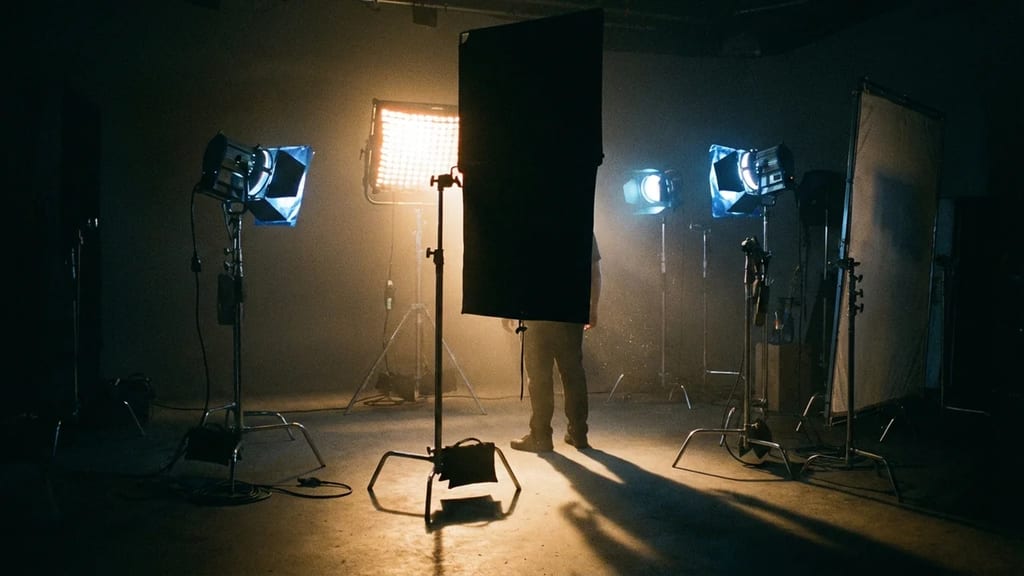
Blocking the lower light spill with barndoors or flags to eliminate floor reflections and direct viewer attention to the subject's face.

Technical Details

Bottom chop is primarily achieved using 4-leaf barndoors with a bottom leaf measuring 15-25 cm in length, or specialized bottom choppers with beam angles between 30° and 90°. Modern LED panels utilize digital zone control with up to 16 individually controllable segments for more precise bottom chop effects. Flag-based systems employ black silks in standard sizes from 24"x36" to 48"x48", positioned 0.5-2 meters from the light source. HMI lights from 1.2 kW upwards require heat-resistant aluminum barndoors with a temperature resistance of up to 200°C.

History & Development

The technique evolved in the 1940s in Hollywood studios, where cinematographer Gregg Toland systematically used barndoors for selective light control. In 1952, Mole-Richardson introduced the first standardized bottom choppers for studio lights. The digital revolution brought programmable LED arrays in 2010 with pixel-level bottom chop control. Modern systems like the Arri SkyPanel have offered software-based beam-shaping functions with 256 brightness levels per zone since 2015.

Practical Application in Film

Roger Deakins extensively used bottom chop in "Blade Runner 2049" for the neon scenes, to eliminate floor reflections and enhance the floating atmosphere. Emmanuel Lubezki employed the technique in "The Revenant" to simulate natural daylight without casting distracting shadows on snow. In dialogue scenes, bottom chop prevents unnatural illumination of tabletops and directs attention to faces. Night scenes benefit from reduced floor reflection and increased contrast between characters and the background.

Comparison & Alternatives

Top chop eliminates upper light components, while side chop controls lateral spill – bottom chop exclusively focuses on the lower image areas. Modern alternatives include projection lights with gobo masks or DMX-controlled LED matrices with individual pixel control. Fresnel lenses offer natural bottom chop characteristics through focusing, but do not achieve the precision of mechanical systems. Soft bottom chop using diffusion gels creates more gradual transitions, while hard barndoors produce sharp cut-off edges.

From the crafts

Perspectives

Cinematographer

Ich verwende Bottom Chop hauptsächlich bei Personenaufnahmen, um störende Schatten auf Tischen oder dem Boden zu vermeiden, die das Gesicht konkurrieren würden. Bei 35mm-Objektiven und Schärfentiefe von f/2.8 wird der Effekt besonders sichtbar, da ungewollte Bodenreflexionen die Hauttonwiedergabe beeinträchtigen können. Die Technik spart mir zusätzliche Flags und gibt mir präzise Kontrolle über die Lichtverteilung, ohne die Hauptbeleuchtung zu schwächen.

Director

Bottom Chop hilft mir, die emotionale Hierarchie einer Szene zu steuern, indem ich die Aufmerksamkeit vom Boden weg und auf die Charaktere lenke. In Verhörszenen schaffe ich durch gezieltes Abschatten des unteren Bildbereichs eine schwebende, unheimliche Atmosphäre, da die Figuren vom dunklen Boden abgehoben erscheinen. Diese Technik verstärkt psychologische Spannung, ohne dass das Publikum bewusst registriert, warum die Szene bedrohlicher wirkt.

Producer

Bottom Chop reduziert unseren Grip-Bedarf um 20-30%, da weniger zusätzliche Flags und C-Stands für die Schattierung benötigt werden. Die Technik beschleunigt das Lighting-Setup um durchschnittlich 15 Minuten pro Kameraposition, was bei 12-Stunden-Drehtagen kostenrelevant ist. Moderne LED-Panels mit integriertem Bottom Chop kosten zwar 40% mehr, amortisieren sich aber durch reduzierten Personalaufwand und Mietequipment bereits nach drei Produktionen.

More in the lexikon

Related terms

Test your knowledge

Quiz

1. Zu welchem Department gehört „Bottom Chop"?

2. Wie viele verschiedene Fachperspektiven bietet dieser Eintrag?

Report an error
From the Filmfarm ecosystem

Understand visual language, budget productions, connect crew.

The Lexikon is part of the Filmfarm ecosystem — alongside budgeting (FilmBalance), an industry magazine (FilmCircus) and crew networking (FilmCall, CrewMesh). One shared vocabulary for the whole production.

FilmFarm FilmRadarComing soonFilmPulseComing soonFilmNumbersComing soonFilmCapitalComing soonFilmLabComing soonFilmBalanceComing soonFilmCircusComing soon