


Filmlexikon.
Support
Academy Sound Ratio / 1.37:1
Camera · Technique

Academy Sound Ratio / 1.37:1

Murnau AI illustration
1331 1661 1781 cinemascope

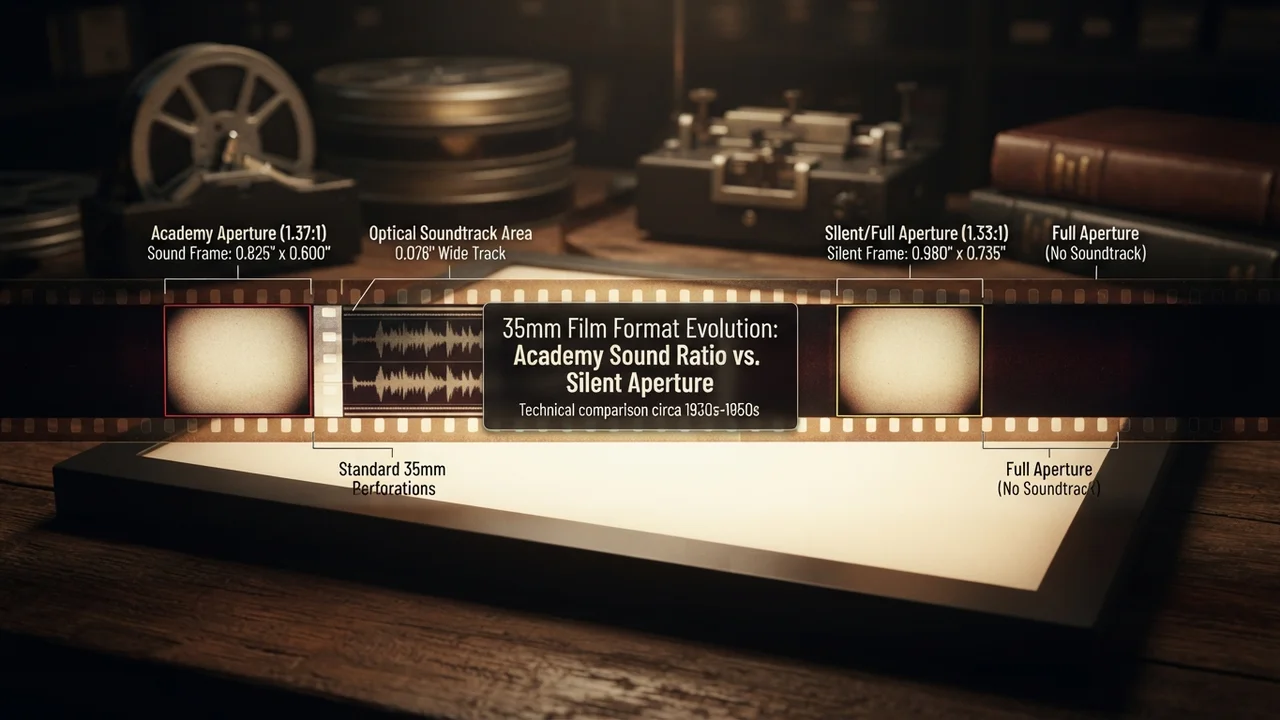
1.37:1 aspect ratio (Academy Sound Ratio), developed in the 1930s for 35mm sound film with optical soundtrack. Slightly wider than 1.33:1, optimized for acoustic space in film perforation patterns.

In film history

Famous examples · Academy Sound Ratio / 1.37:1

Curated examples across cinema history that illustrate the term — from compositional principle to deliberate refusal.
01 / THE FORMAT OF THE CLASSICAL ERA

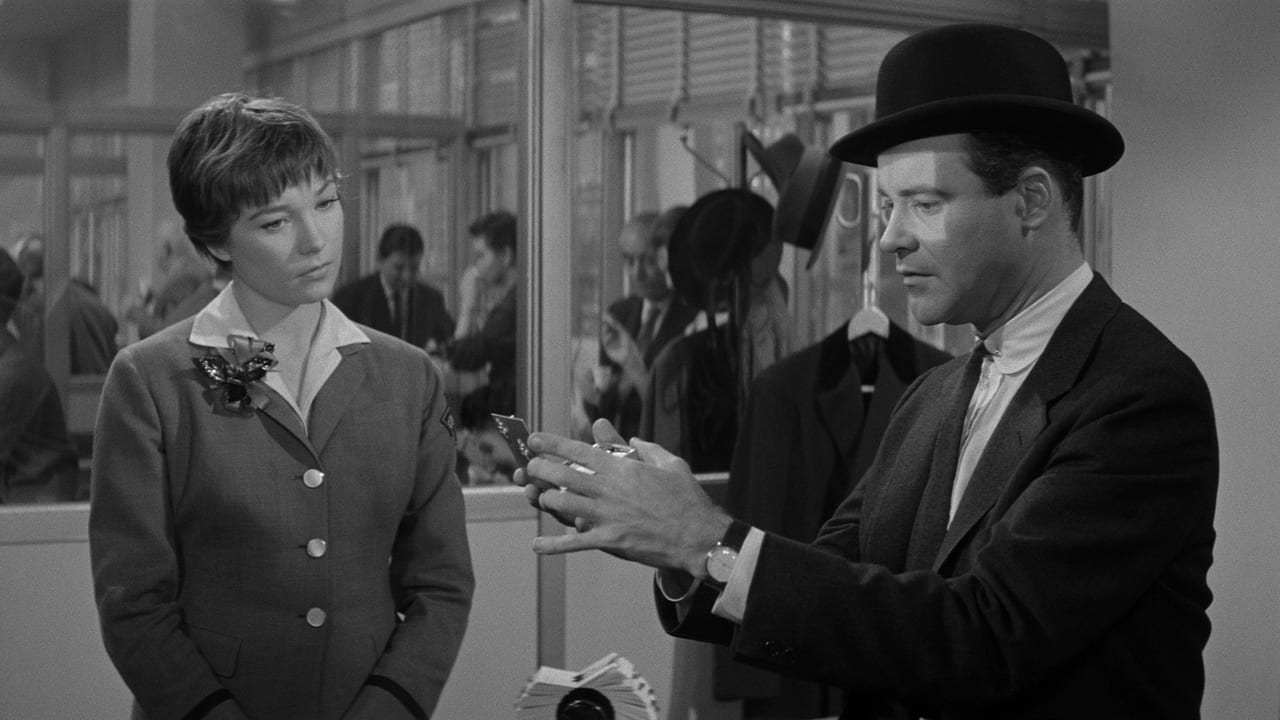
The Apartment

Billy Wilder · 1960 · Joseph LaShelle

Billy Wilder's comedy was shot in the waning days of the Academy ratio, demonstrating how 1.37:1 enabled the intimate, character-focused compositions of classical Hollywood. LaShelle's framings exploit the near-square ratio for precise, theatrically resonant shots.

The Apartment · sample frame
02 / NOSTALGIC RETURN TO THE CLASSICAL RATIO

The Artist

Michel Hazanavicius · 2011 · Guillaume Schiffman

Michel Hazanavicius deliberately shot this silent-film homage in 1.37:1 to authentically reconstruct the aesthetic of the early sound era. The ratio here is not a technical relic but a dramaturgical instrument for time travel.

The Artist · sample frame
03 / 1.37:1 AS DELIBERATE STYLISTIC DEVICE

The Grand Budapest Hotel

Wes Anderson · 2014 · Robert D. Yeoman

Wes Anderson explicitly used the 1.37:1 ratio for the film's 1930s-set sequences to visually encode the era. The shift between aspect ratios across different time periods turns the Academy format into a narrative signifier.

The Grand Budapest Hotel · sample frame
04 / CONTEMPORARY INTIMACY IN A HISTORICAL FORMAT

First Cow

Kelly Reichardt · 2019 · Christopher Blauvelt

Kelly Reichardt chose the 1.37:1 ratio for this quiet frontier drama to create an intimacy with characters and landscape that wider formats cannot provide. Blauvelt uses the near-square image for meditative, essentialist compositions.

First Cow · sample frame

Film stills sourced via the TMDB API. This product uses the TMDB API but is not endorsed or certified by TMDB. themoviedb.org ›

History

The 1.37:1 aspect ratio was defined in the early 1930s in response to the introduction of sound film. Unlike the pure 1.33:1 format, sound film required space for an optical soundtrack on the physical film strip.

Developmental Steps:

  • 1929-1931: Transition from silent film to sound film (Great Transition)
  • 1930: Academy Standards are specified
  • 1932: Official adoption of the Academy Sound Ratio (1.37:1) as the new standard
  • 1932-1950s: Widespread use for all sound films on 35mm
  • 1950s: Widescreen movement enabled a move away from this format
  • 1960s: Only occasional use remained

Why this Value?

  • 35mm film strip: 21 perforations per foot (for sound and image)
  • Soundtrack required specific vertical space
  • Image area was optimized for sound quality
  • 1.37:1 was the mathematical compromise between image width and sound space

Technical Details

Aspect Ratio Specifications:

  • Aspect Ratio: 1.37:1 (exact: 1.3703:1)
  • Film Standard: 35mm film strip
  • Image Area: 18 × 13.1mm (on 35mm)
  • Perforation: 21 perforations per foot
  • Soundtrack Position: Mono, optical, at the edges of the film strip
  • Standard Resolution (digital): ~1452 × 1058 pixels

35mm Film Strip Layout:

[Perforation] [Image Area 18×13.1mm] [Soundtrack - Optical]

Sound Quality:

  • Optical mono soundtrack
  • Frequency range: 50-8000 Hz (early standards)
  • Signal-to-noise ratio: ~40dB
  • Track width: ~2-3mm depending on standard

Usage Today

The 1.37:1 format is practically obsolete and is only used in special cases:

Archival / Restoration:

  • Restored Classics: Some film classics (Chaplin, Keaton, etc.) in original 1.37:1
  • Documentaries: about historical film production
  • Archives: Original films in digital restoration

Rare in New Productions:

  • Only for absolute historical authenticity
  • Academic or artistic experiments
  • Not for commercial cinema use

Digital Equivalents:

  • 1.37:1 is mathematically between 4:3 (1.33:1) and 16:9 (1.78:1)
  • Can be generated by cropping 16:9 material
  • Occasionally used for television remasters of old content

Technical Differences to Other Standards

Aspect1.33:1 Academy1.37:1 Sound1.66:1 European1.85:1 Standard
SoundtrackVariableOptical monoNone (or external)Digital or Dolby
Image Area4:3 Square21-Perf StandardOptimizedWidescreen
Cinema Era1932-19501930-19501960-19901970-Present
Width Relative100%102%125%140%
Height Relative75%73%60%54%
Sound QualityFullCompromiseFullFull (Stereo+)

Comparative Analysis

1.37:1 vs. 1.33:1:

  • Only ~4% wider
  • Minimal more side image
  • Identical for visual composition
  • Difference due to sound space requirements

1.37:1 vs. Modern Formats:

  • Significantly more square than 1.85:1 (140% relative width)
  • Less wide than 1.66:1 (125% relative width)
  • Means less landscape space
  • More headroom in portraits

Historical Examples

Major Productions in 1.37:1:

  • "Citizen Kane" (1941) - Orson Welles
  • "The Great Dictator" (1940) - Charlie Chaplin
  • "Singin' in the Rain" (1952) - Gene Kelly
  • "A Streetcar Named Desire" (1951) - Elia Kazan

(Note: Some of these films were later re-mastered in different formats)

Further Information

Relevant Standards:

  • SMPTE RP 431-2: Academy Standards
  • DCI Standard: Digitized Standards
  • ISO Standards: Film Strip Specifications

Related Formats:

  • Academy Ratio (1.33:1) - pure image format
  • European Widescreen (1.66:1) - subsequent
  • Cinemascope (2.35:1) - parallel widescreen development
From the crafts

Perspectives

Cinematographer

The 1.37:1 aspect ratio offers minimally more horizontal width than 1.33:1, but less than modern widescreen formats. For my cinematography, this means only slightly more side space in group scenes. The differences from the pure Academy standard are subtle and hardly influence my composition.

Director

From a director's perspective, the 1.37:1 aspect ratio is practically identical to 1.33:1. The minimal difference – about 4% more width – is insignificant for storytelling purposes. I would only choose this format for absolute historical authenticity in sound documentaries or archaeological restorations.

More in the lexikon

Related terms

Test your knowledge

Quiz

1. Zu welchem Department gehört „Academy-Sound-Verhältnis / 1.37:1"?

2. Wie viele verschiedene Fachperspektiven bietet dieser Eintrag?

Report an error
From the Filmfarm ecosystem

Understand visual language, budget productions, connect crew.

The Lexikon is part of the Filmfarm ecosystem — alongside budgeting (FilmBalance), an industry magazine (FilmCircus) and crew networking (FilmCall, CrewMesh). One shared vocabulary for the whole production.

FilmFarm FilmRadarComing soonFilmPulseComing soonFilmNumbersComing soonFilmCapitalComing soonFilmLabComing soonFilmBalanceComing soonFilmCircusComing soon