


Filmlexikon.
Support
Academy Ratio / 1.33:1
Camera · Technique

Academy Ratio / 1.33:1

Murnau AI illustration
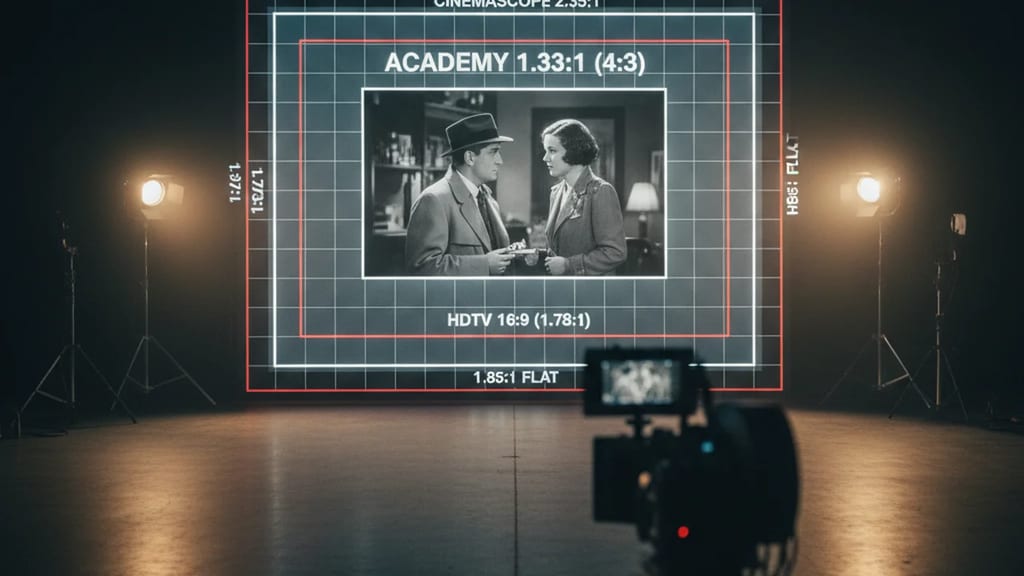
1371 1661 1781 cinemascope anamorphic

The classic 1.33:1 aspect ratio (Academy Standard), established in 1932 as sound film standard. The original cinema standard with 4:3 screen aspect ratio dominant for decades.

In film history

Famous examples · Academy Ratio / 1.33:1

Curated examples across cinema history that illustrate the term — from compositional principle to deliberate refusal.
01 / THE FORMAT AS CANVAS OF POWER

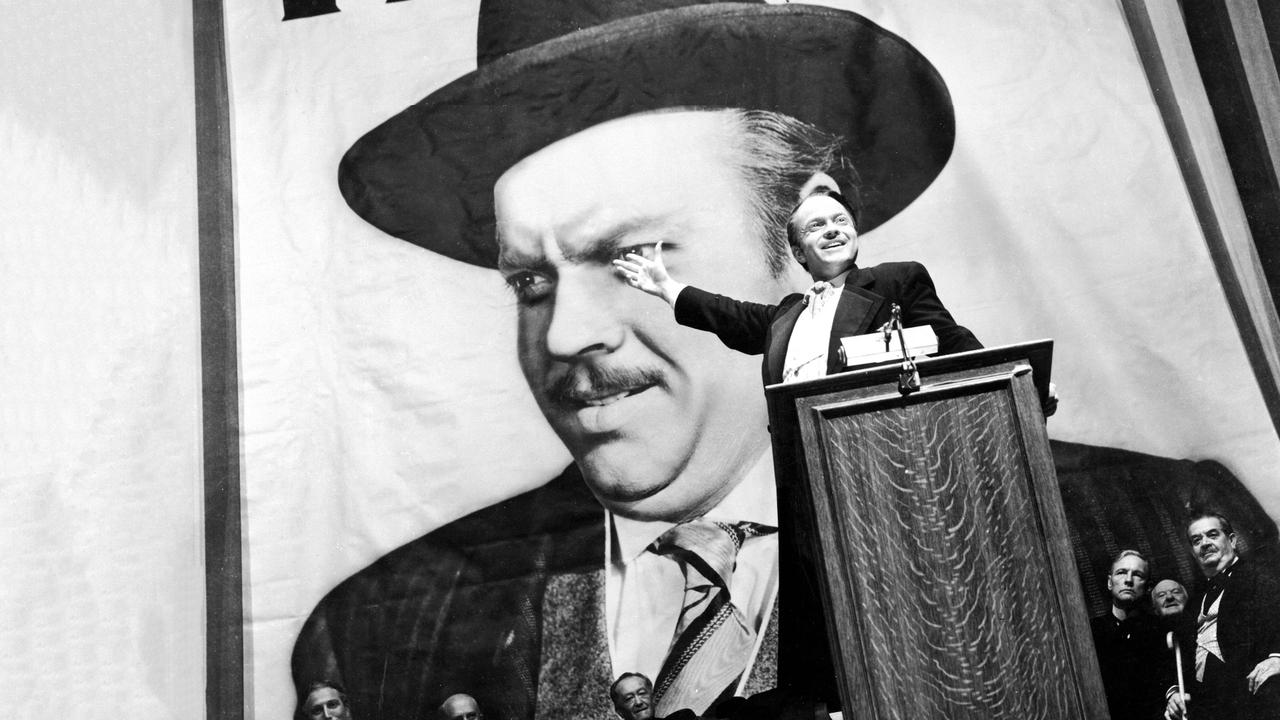
Citizen Kane

Orson Welles · 1941 · Gregg Toland

Citizen Kane exploits the 1.33:1 frame with extreme deep focus and vertical compositions that visually encode power dynamics – a masterwork of the Academy ratio in its classical era.

Citizen Kane · sample frame
02 / WIDESCREEN ERA VERSUS CLASSICAL LEGACY

2001: A Space Odyssey

Stanley Kubrick · 1968 · Geoffrey Unsworth

Though shot in Super Panavision 70, Kubrick's film highlights by contrast the historical rupture: the Academy ratio had by this point already been supplanted by widescreen formats in mainstream cinema.

2001: A Space Odyssey · sample frame
03 / NOSTALGIC RETURN TO THE SQUARE FRAME

The Artist

Michel Hazanavicius · 2011 · Guillaume Schiffman

The Artist was deliberately shot in 1.33:1 to evoke the silent film era – one of the rare modern productions to deploy the Academy ratio as an explicit artistic statement.

The Artist · sample frame
04 / THE NARROW FRAME AS POETIC CHOICE

First Cow

Kelly Reichardt · 2019 · Christopher Blauvelt

Kelly Reichardt chose the 1.33:1 ratio for First Cow to create intimacy and historical texture – a contemporary example of the Academy format being rediscovered as a deliberate aesthetic gesture.

First Cow · sample frame

Film stills sourced via the TMDB API. This product uses the TMDB API but is not endorsed or certified by TMDB. themoviedb.org ›

History

The 1.33:1 aspect ratio was established as the standard for sound film by the American Academy of Motion Picture Arts and Sciences (AMPAS) in 1932. At this time, the film industry was undergoing a transformation: the introduction of sound film necessitated adjustments, and AMPAS defined clear technical standards. The 4:3 aspect ratio (1.33:1) was recognized as an international standard and remained the dominant cinematic format for over 50 years.

Historical Significance:

  • 1932: Academy Standard officially introduced
  • 1940s-1950s: Peak of 1.33:1 usage in cinema
  • 1950s: Widescreen formats (Cinemascope 2.35:1, VistaVision) emerge
  • 1960s-1980s: Gradual shift towards widescreen standards
  • 1990s: Almost complete replacement by widescreen formats

Technical Details

Aspect Ratio Specifications:

  • Aspect Ratio: 1.33:1 or 4:3
  • Also known as: Academy Standard, Academy Ratio, Full Frame
  • Celluloid Width Standard: 35mm film (with sound tracks)
  • Effective Image Height on 35mm: 18mm × 24mm (image area)
  • Standard Resolution (interpolated): ~1024 × 768 pixels (SVGA)
  • HD Equivalent: 1440 × 1080 pixels

Camera Sensor Equivalents:

  • 4/3 Sensor: Native 1.33:1 format (e.g., older MFT cameras)
  • Cropped 16:9 Sensors: Achievable with cropping to 4:3
  • 35mm Full Frame: Via pillarboxing (vertical black bars)

Projection:

  • Academy screens dimensioned for 1.33:1
  • Typical cinema halls: Screen width 6.1-12.2m with corresponding height ratio
  • Projector Standard: 4:3 image projectors

Usage Today

The 1.33:1 format is virtually extinct in modern cinema but is used intentionally in the following contexts:

Artistic / Retrospective Usage:

  • "Nomadland" (Chloé Zhao, 2020): Partially in 1.33:1 for specific scenes
  • Arthouse Films: Some independent filmmakers consciously use the format for visual purism
  • Documentaries: Occasionally for archival material or a nostalgic look

Technical Usage:

  • Television (analog): 1.33:1 was standard until digitization
  • Video Archiving: Old television and film content in this format
  • Academic / Artistic Projects: Conscious evocation of classic aesthetics

Why the Replacement:

  • Modern cinema halls are optimized for 1.85:1 or 2.35:1
  • The more square format appears dated to modern audience tastes
  • Digital cameras are standardized for 16:9 or Cinemascope
  • Economical: Wider aspect ratios allow for more seating in cinema halls

Comparison with Other Formats

FormatRatioWidth (relative)Height (relative)EraUsage
1.33:1 Academy1.33:1100%75%1930-1980Classic
1.37:1 Academy Sound1.37:1100%73%1930-1950Early Sound Film
1.66:1 European1.66:1100%60%1960-1980Europe
1.85:1 American1.85:1100%54%1970-PresentStandard Cinema
2.35:1 Cinemascope2.35:1100%43%1953-PresentEpic Films
16:9 / 1.78:11.78:1100%56%1990-PresentHD/Digital

Advantages and Disadvantages:

Advantages:

  • Natural composition for portraits and dialogue
  • More headroom in shots
  • Historical authenticity for older content
  • Familiar on old displays and televisions

Disadvantages:

  • Less horizontal space for landscapes
  • Perceived as "antiquated" today
  • Less immersive in modern large-format cinemas
  • Not standardized for current equipment

Further Information

Relevant Files in the System:

  • Comparisons: Academy Sound Ratio (1.37:1), European Widescreen (1.66:1)
  • Related Formats: Cinemascope (2.35:1), 16:9 HD (1.78:1)
  • Historical Context: Sound Film Standardization 1930s
From the crafts

Perspectives

Cinematographer

The 1.33:1 aspect ratio is important for my composition: I work with a more square frame that offers more height than modern widescreen formats. The format requires a different lighting design, focusing on frontal and top-bottom axes.

Director

As a director, I choose 1.33:1 for classic storytelling or when I'm consciously aiming for a timeless, retrospective look. It's particularly suited for psychological dramas and character-driven stories.

More in the lexikon

Related terms

Test your knowledge

Quiz

1. Was beschreibt „Academy-Format / 1.33:1" am besten?

2. Zu welchem Department gehört „Academy-Format / 1.33:1"?

3. Wie viele verschiedene Fachperspektiven bietet dieser Eintrag?

Report an error
From the Filmfarm ecosystem

Understand visual language, budget productions, connect crew.

The Lexikon is part of the Filmfarm ecosystem — alongside budgeting (FilmBalance), an industry magazine (FilmCircus) and crew networking (FilmCall, CrewMesh). One shared vocabulary for the whole production.

FilmFarm FilmRadarComing soonFilmPulseComing soonFilmNumbersComing soonFilmCapitalComing soonFilmLabComing soonFilmBalanceComing soonFilmCircusComing soon