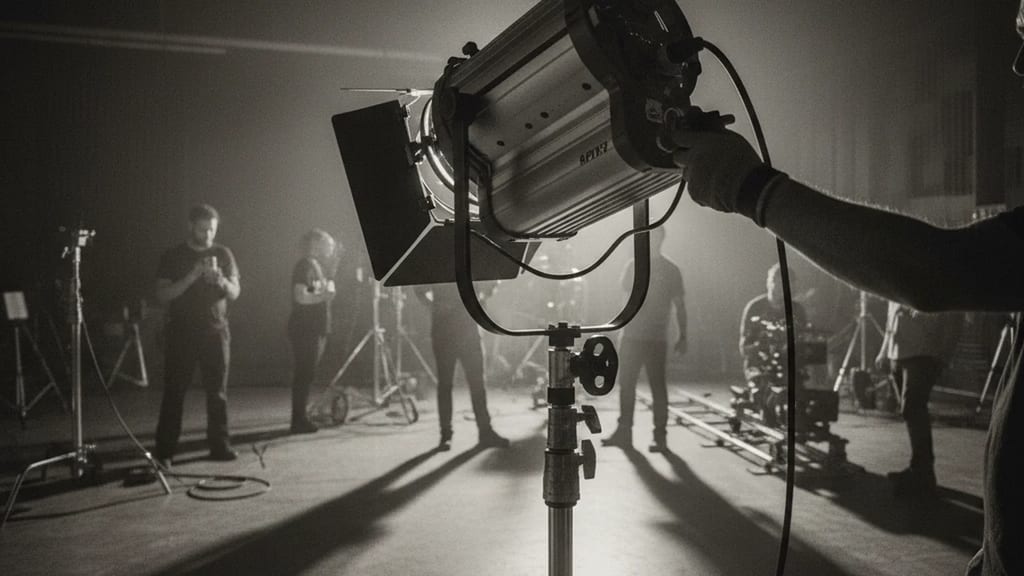
Technical Details
Standard yokes are made of 16-20mm thick steel or aluminum and allow tilt angles from -90° to +90°. The yoke is equipped with friction brakes or gear drives capable of handling torques up to 200 Nm. For Fresnel lights from 5kW upwards, the yokes are reinforced and weigh between 2-8 kg. Moving light systems use motorized yokes with stepper motors (typically 1.8° step angle) and encoders for precise positioning. Bearings are either ball bearings or maintenance-free plain bearings made of bronze alloys.
History & Development
The first film lights of the 1910s still used simple clamping systems without movable suspension. The standardized yoke system developed in the 1920s at Mole-Richardson in Hollywood, parallel to the introduction of the Fresnel lens. In 1935, Strand Electric introduced the first yokes with gear drives, enabling precise angle adjustments. The 1980s saw the creation of the first computer-controlled yokes for moving heads, while modern LED panels today often work with carbon yokes, which are 40% lighter than steel versions.
Practical Use in Film
Cinematographer Roger Deakins used modified yokes on ARRI SkyPanel S360-C in "Blade Runner 2049" (2017) to create the characteristic vertical light streaks. The precise tilt adjustment allowed for millimeter-accurate shadow positioning. In "1917" (2019), motorized yokes were used, controlled synchronously with the camera's movement during long tracking shots. The yoke determines the speed of light changes – while manual systems require 2-3 seconds for a 45° rotation, motorized variants achieve the same movement in 0.8 seconds.
Comparison & Alternatives
Compared to fixed mounts, the yoke offers 180° freedom of movement on one axis, while cardanic suspensions (pan-tilt heads) cover both planes of rotation. Modern gimbal systems are increasingly replacing mechanical yokes with brushless motors offering 16-bit resolution. Track systems with linear motors are more precise than yoke systems for large LED walls but cost 3-4 times as much. For weights under 5kg, quick-release yokes are becoming more common, reducing setup and breakdown times from 45 to 12 seconds.