Filmlexikon.
Support
Zip Light
Lighting · Terms

Zip Light

Murnau AI illustration
color temperature flow roll take

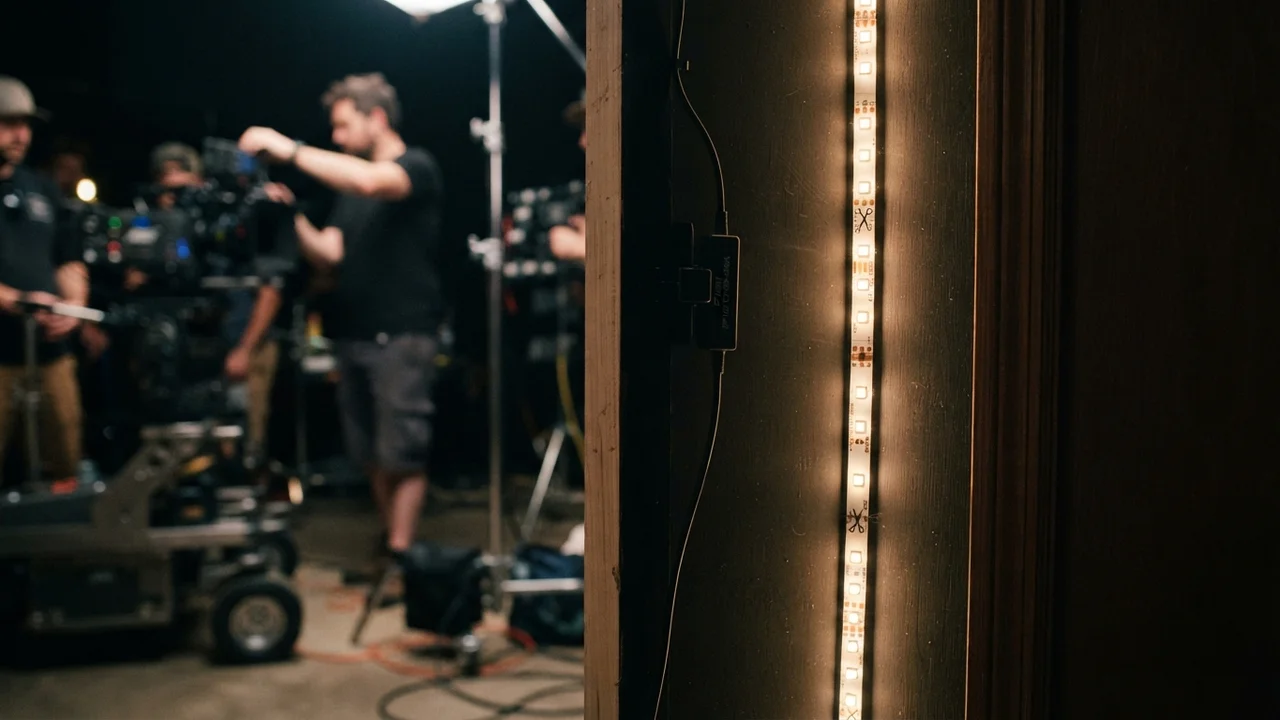
Flexible LED strip (12–60 LEDs/m) for hidden fill and edge lighting. Color temperature 2700K–6500K, cuttable every 50–100 mm.

Technical Details

Zip Lights consist of flexible printed circuit boards with soldered SMD LEDs spaced 16.7-83.3mm apart (60-12 LEDs per meter). Standard color temperatures range from 2700K to 6500K, with RGB variants enabling 16.7 million color combinations. Protection ratings vary from IP20 (indoor) to IP67 (waterproof). Typical power consumption is 4.8-28.8 watts per meter, depending on LED density and brightness. Cutting marks every 50-100mm allow for precise length adjustment.

History & Development

The first commercially viable LED strip was developed in 2005 by the Taiwanese company Epistar. The breakthrough in filmmaking occurred in 2009 with Aputure's "Light Storm" series, which achieved cinematic color rendering (CRI 95+) for the first time. In 2012, Quasar Science revolutionized the market with the "Q-LED X" through high-frequency PWM control without flicker effects. Since 2018, RGBW chips have enabled stepless color temperature adjustment without loss of brightness.

Practical Use in Film

Christopher Nolan used over 2000 meters of Zip Lights for "Tenet" (2020) for invisible illumination in vehicles and confined spaces. Denis Villeneuve integrated them into "Blade Runner 2049" (2017) as practical light sources in set decoration. Zip Lights are suitable for edge lighting on objects, hidden ambient lighting, and uniform surface illumination of coves. Disadvantages include limited light output, visible LED dots upon direct viewing, and heat generation at high power density.

Comparison & Alternatives

Unlike neon tubes, Zip Lights offer greater flexibility but less homogeneous light. LED panels provide higher light output but are rigid and bulkier. Tube lights (Astera Titan, Quasar Q-LED) combine the flexibility of Zip Lights with higher light output but cost 10-15 times more. For concealed mounting and accent lighting, Zip Lights remain the first choice; for key lighting, dedicated LED panels or Fresnel luminaires are better suited.
From the crafts

Perspectives

Cinematographer

Zip Lights sind mein Geheimtipp für komplizierte Lichtsituationen – ich klebe sie hinter Monitore für sauberes Backlight oder unter Armaturenbretter für gleichmäßige Gesichtsausleuchtung in Fahrszenen. Die geringe Bauhöhe rettet mich oft bei extremen Weitwinkeleinstellungen, wo jeder andere Scheinwerfer im Bild wäre. Bei High-Speed-Aufnahmen achte ich auf flicker-freie Modelle mit mindestens 25kHz PWM-Frequenz.

Director

Ich nutze Zip Lights gerne als praktische Lichtquellen, die gleichzeitig die Szenografie unterstützen – entlang von Treppenstufen für mysteriöse Atmosphäre oder als futuristische Raumbeleuchtung. Die RGB-Fähigkeiten erlauben mir subtile Farbübergänge für emotionale Akzente, ohne dass das Publikum die Lichtquelle bewusst wahrnimmt. Besonders schätze ich die Möglichkeit, sie per DMX in Echtzeit zu steuern und so dynamische Lichtchoreographien zu kreieren.

Producer

Ein 5-Meter-Set kostet mich 200-800 Euro statt 3000 Euro für vergleichbare Tube-Lights, bei deutlich geringerem Transportvolumen und Aufbauzeit. Die Installation durch den Kameraassistenten dauert Minuten statt Stunden, was mir bei knappen Drehtagen entscheidende Zeit spart. Allerdings plane ich bei intensiver Nutzung 20% Verschleiß ein, da die dünnen Kabel bei häufigem Auf- und Abbau brechen können.

More in the lexikon

Related terms

Test your knowledge

Quiz

1. Zu welchem Department gehört „Zip Light"?

2. Wie viele verschiedene Fachperspektiven bietet dieser Eintrag?

Report an error
From the Filmfarm ecosystem

Understand visual language, budget productions, connect crew.

The Lexikon is part of the Filmfarm ecosystem — alongside budgeting (FilmBalance), an industry magazine (FilmCircus) and crew networking (FilmCall, CrewMesh). One shared vocabulary for the whole production.

FilmFarm FilmRadarComing soonFilmPulseComing soonFilmNumbersComing soonFilmCapitalComing soonFilmLabComing soonFilmBalanceComing soonFilmCircusComing soon