Filmlexikon.
Support
Wrap
Set · Kommunikation

Wrap

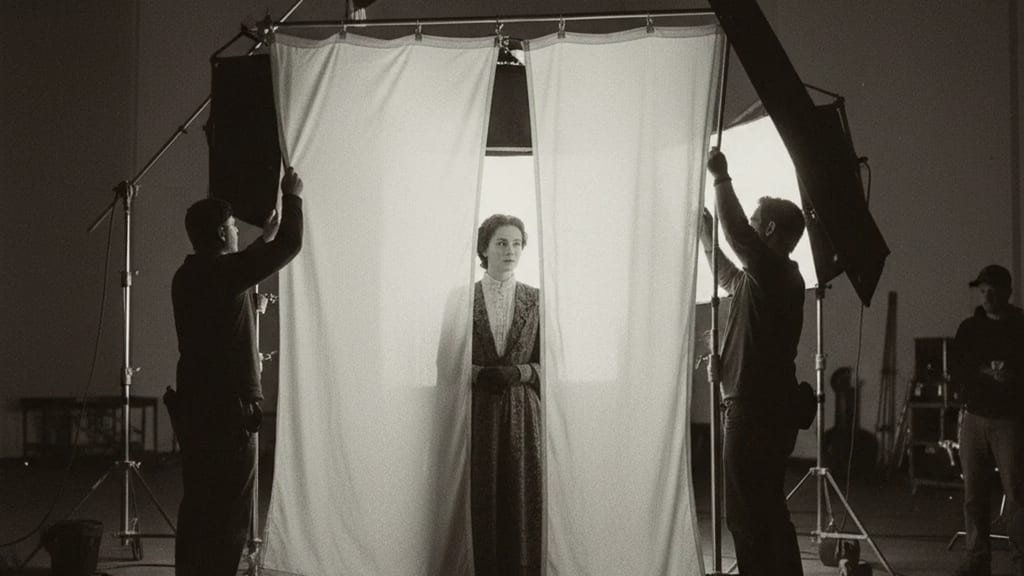
Murnau AI illustration
10 1 10 2 10 4 copy that stand by martini shot color temperature flow

Light wrap occurs when bright light flows around the contours of an object, creating soft, glowing edges.

Technical Details

Wrap is created by large light sources with a light source width to subject distance ratio of at least 1:2. Softboxes ranging in size from 120x180 cm to 200x200 cm produce optimal wrap characteristics at a distance of 1-2 meters. Octaboxes from 150 cm in diameter enhance the effect due to their round shape. China balls (paper lanterns) of 90-120 cm diameter with 2K-5K Tungsten lamps create omnidirectional wrap light. Modern LED panels such as the Arri SkyPanel S360-C (120x30 cm) are mounted in arrays of 3x3 units to create wrap areas of 360x90 cm.

History & Development

The term "wrap light" became established in the 1940s in Hollywood studios, where photographers like George Hurrell stretched large silk diffusion material in front of Fresnel spotlights. In 1952, Mole-Richardson developed the first commercial softboxes for film productions. The technique gained importance in the 1970s through cinematographers like Vilmos Zsigmond ("Close Encounters," 1977), who used 20x20 foot silk diffusion for full-body wrap light. Digital color grading since the 1990s has enabled more precise control of wrap intensity in post-production.

Practical Application in Film

Emmanuel Lubezki used 12x12 foot softboxes in "Her" (2013) for continuous wrap light in Joaquin Phoenix's close-ups. Roger Deakins created wrap effects in "Blade Runner 2049" (2017) using LED walls as practical light sources. For portraits, a 150 cm octabox at a distance of 80 cm creates the characteristic "beauty wrap" with soft transitions between light and shadow. Studio productions use light tents made of white molton fabric measuring 4x4 meters for complete 360° wrap in product shots.

Comparison & Alternatives

In contrast to hard light with defined shadow edges produced by small, point-like light sources such as HMIs-Fresnels or open LED panels. Bounce light from white walls or polyboards creates similar softness, but without direct control over the light direction. Book-light setups (two opposing softboxes) provide even illumination without wrap characteristics. Modern virtual production with LED walls (e.g., ROE Black Pearl) replaces classic wrap light with programmable lighting environments that have natural wrap properties with 360° coverage.

From the crafts

Perspectives

Cinematographer

Ich setze Lichtwrap gezielt für natürlich wirkende Porträts ein, besonders wenn ich raue Hautstrukturen weichzeichnen oder tief liegende Augen aufhellen muss. Eine 180cm Octabox in 1,2m Abstand gibt mir den perfekten Gradationsbereich zwischen den Lichtzonen, ohne dass das Bild flach wird. Bei Zeitdruck nehme ich lieber drei China Balls als Setup für schnelles, omnidirektionales Wrap.

Director

Wrap-Licht unterstützt mich dabei, emotionale Nähe und Verletzlichkeit zu visualisieren – die weichen Übergänge lassen Charaktere zugänglicher wirken als hartes Licht. In intimen Dialogszenen verwende ich bewusst starkes Wrap, um die psychologischen Barrieren zwischen den Figuren optisch aufzulösen. Für kältere, distanziertere Momente wechsle ich zu härteren Lichtquellen mit definierten Schatten.

Producer

Wrap-Setups brauchen 40% mehr Stellfläche als konventionelle Beleuchtung und verlängern die Umbaupausen um durchschnittlich 15 Minuten pro Setup. Bei Außenaufnahmen rechne ich zusätzliche Grip-Kosten für 12x12 Frames und Windschutz ein. Der Mehraufwand amortisiert sich aber durch reduzierte Postproduktionszeit, da weniger Digital Beauty Work nötig ist.

More in the lexikon

Related terms

Test your knowledge

Quiz

1. Was beschreibt „Lichtwrap" am besten?

2. Zu welchem Department gehört „Lichtwrap"?

3. Wie viele verschiedene Fachperspektiven bietet dieser Eintrag?

Report an error
From the Filmfarm ecosystem

Understand visual language, budget productions, connect crew.

The Lexikon is part of the Filmfarm ecosystem — alongside budgeting (FilmBalance), an industry magazine (FilmCircus) and crew networking (FilmCall, CrewMesh). One shared vocabulary for the whole production.

FilmFarm FilmRadarComing soonFilmPulseComing soonFilmNumbersComing soonFilmCapitalComing soonFilmLabComing soonFilmBalanceComing soonFilmCircusComing soon