Filmlexikon.
Support
Voigtländer Nokton 50mm f/1.1
Camera · Terms

Voigtländer Nokton 50mm f/1.1

Murnau AI illustration
15lb sandbag 20 c stand 216 diffusion 250 diffusion 251 diffusion 25lb sandbag 35lb sandbag 40 c stand

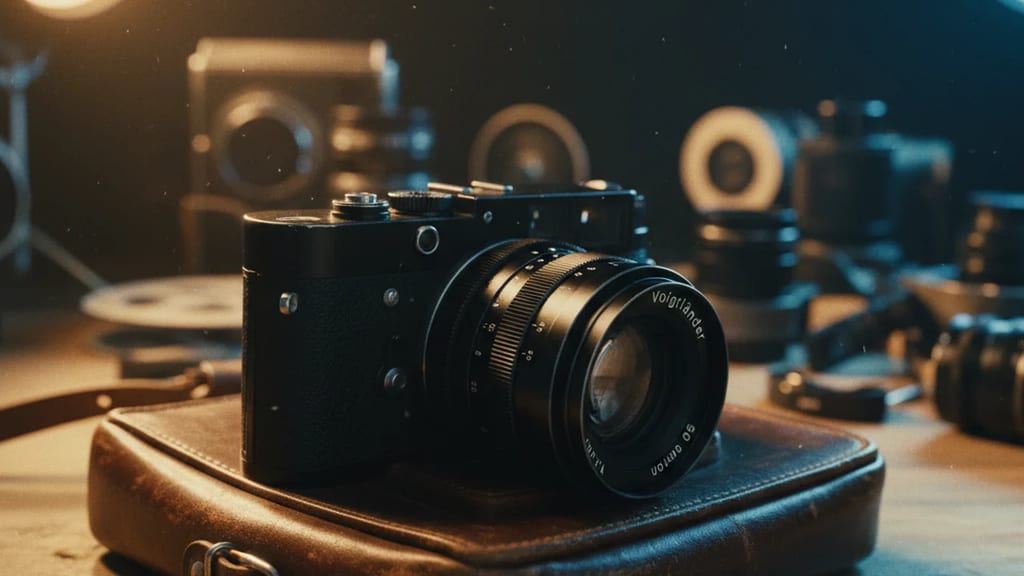
Voigtländer Nokton 50mm f/1.1 lens with extreme f/1.1 aperture, 7-element/5-group design producing characteristic soft bokeh at wide open.

Technical Details

The optical construction comprises seven elements in five groups with a minimum focusing distance of 0.45m. The aperture range extends from f/1.1 to f/16 with ten aperture blades for smooth bokeh. The 52mm filter thread allows for standard accessories. Variants are available for Leica M-Mount, Sony E-Mount, and Micro Four Thirds. Special coatings reduce flares and ghosting in backlight.

History & Development

Voigtländer introduced the first Nokton version in 1950 as an f/1.5 lens. The modern f/1.1 variant appeared in 2000 as part of the revived brand under Cosina license. The Aspherical version, with improved corner sharpness, followed in 2011. The VM-mount variant for digital Leica cameras established itself in film production from 2004 onwards as an alternative to significantly more expensive Leica lenses.

Practical Use in Film

Cinematographer Christopher Doyle used the Nokton for intimate close-ups in Wong Kar-wai's "In the Mood for Love" (2000). The extreme wide aperture creates characteristic bokeh with smooth transitions, while manual focusing allows for precise focus shifts. At f/1.1, the lens exhibits noticeable vignetting and soft rendering, which transitions to crisp sharpness from f/2.8 onwards. Documentary filmmakers appreciate its low-light performance in available light without additional illumination.

Comparison & Alternatives

Compared to the Leica Summilux 50mm f/1.4, the Nokton offers one stop more light gathering capability at one-fifth of the price. The Canon 50mm f/1.2L surpasses it in autofocus speed but does not achieve the same light intensity. Modern alternatives like the Sony FE 50mm f/1.2 GM offer autofocus and image stabilization but lose the characteristic "analog" look of the Nokton due to digital corrections.

From the crafts

Perspectives

Cinematographer

Ich verwende das Nokton hauptsächlich für emotionale Nahaufnahmen, wo das extreme Bokeh die Protagonisten vom Hintergrund isoliert. Die manuelle Fokussierung erfordert Übung, aber die Schärfentiefe bei f/1.1 ist so minimal, dass ich mit Follow-Focus präzise arbeiten muss - das zwingt zu bewusster Bildgestaltung.

Director

Das Nokton gibt mir ein Werkzeug für Intimität - bei f/1.1 verschwimmt alles außer dem Gesicht meines Darstellers, was perfekt für emotionale Wendepunkte funktioniert. Der weiche Look bei Offenblende erzeugt eine träumerische Atmosphäre, die sich deutlich von der klinischen Schärfe moderner Objektive unterscheidet.

Producer

Mit 800 Euro kostet das Nokton einen Bruchteil vergleichbarer Objektive und liefert dennoch professionelle Ergebnisse für Low-Budget-Produktionen. Der manuelle Fokus bedeutet zwar mehr Zeit am Set, aber die Vielseitigkeit durch verschiedene Mount-Varianten macht es zu einem kostengünstigen Standard-Tool unseres Objektivparks.

More in the lexikon

Related terms

Test your knowledge

Quiz

1. Was beschreibt „Voigtländer Nokton 50mm f/1.1" am besten?

2. Zu welchem Department gehört „Voigtländer Nokton 50mm f/1.1"?

3. Wie viele verschiedene Fachperspektiven bietet dieser Eintrag?

Report an error
From the Filmfarm ecosystem

Understand visual language, budget productions, connect crew.

The Lexikon is part of the Filmfarm ecosystem — alongside budgeting (FilmBalance), an industry magazine (FilmCircus) and crew networking (FilmCall, CrewMesh). One shared vocabulary for the whole production.

FilmFarm FilmRadarComing soonFilmPulseComing soonFilmNumbersComing soonFilmCapitalComing soonFilmLabComing soonFilmBalanceComing soonFilmCircusComing soon