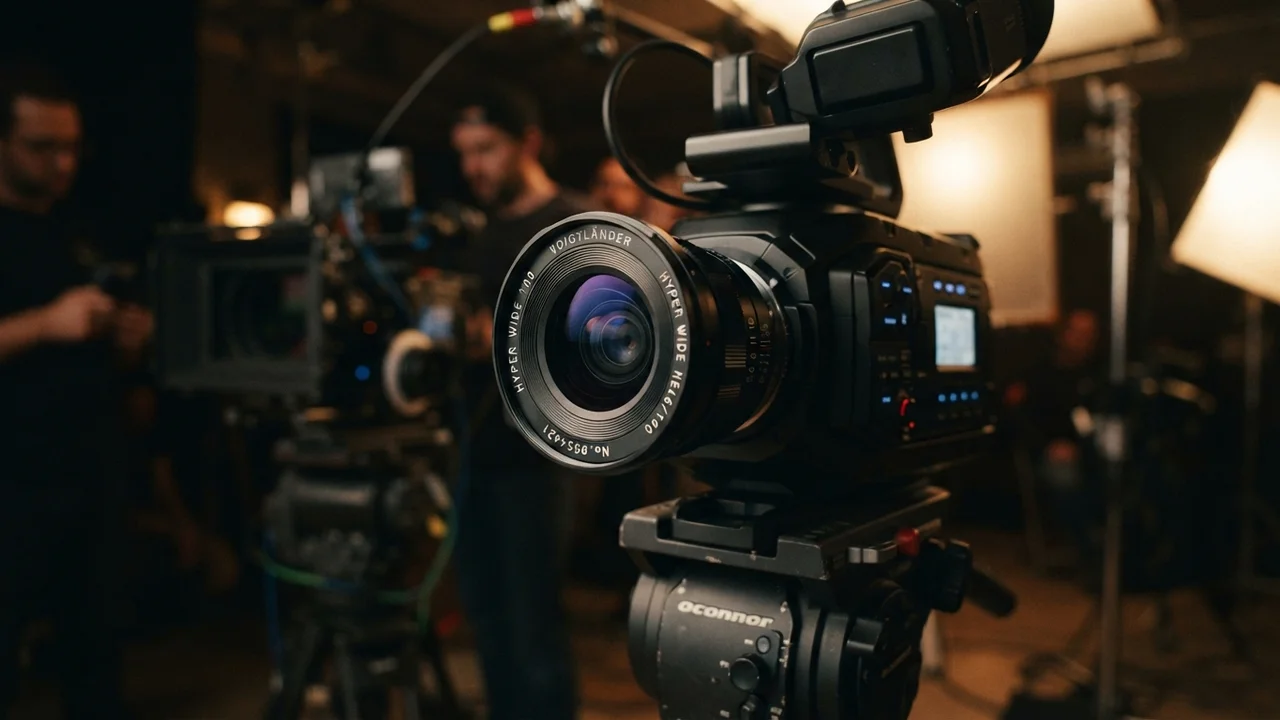
Rectilinear 10 mm super-wide with a 130-degree angle of view at 312 grams — a stills lens used in cinema work wherever cine wide-angles are simply too large. Not a fisheye, and no filter thread.
The Voigtlaender Hyper Wide Heliar 10mm f/5.6 Aspherical is a manually focused super wide-angle lens for 35mm format. In cinematography, it appears because it offers a combination that doesn't exist elsewhere: 130-degree angle of view at around 312 grams.
Rectilinear, Not Fisheye
This is the crucial point and the reason for the complex design. A fisheye lens distorts straight lines, achieving its angle of view cheaply. The 10mm lens is designed to be rectilinear: straight lines remain straight, all the way to the corners. In interiors, with architecture, and anywhere edges are present in the frame, this isn't just an aesthetic detail but a condition for the space to remain legible.
Optics
13 elements in 10 groups, ten aperture blades, aperture range f/5.6 to f/22, minimum focus distance 30 centimeters. The number of aspherical elements varies by mount and is often incorrectly stated in lists: the VM version (Leica M) has two, the Sony E-mount version has one. These are two different optical designs, not the same optics with a different mount.
No Filter Thread
The strongly curved front element does not allow for screw-in filters. With a maximum aperture of f/5.6, this is a limitation in bright daylight that must be accounted for: ND filtration is handled via the camera—internal filters, shutter angle, or sensitivity—or via a matte box positioned in front of the lens, which does not crop its angle of view. The latter is not trivial at 130 degrees.
Sunstars
On sharp, point-like light sources, the ten-blade aperture produces pronounced, clearly defined sunstars. This is a significant creative choice—those who don't want it should avoid direct light sources in the frame; those who do want it have a subject that cannot be convincingly replicated in post-production.
Comparison with Cine Wide-Angle Lenses
In practice, it is compared with the short focal lengths of major cine lens series. Optically, it doesn't win these comparisons—cine wide-angle lenses have focus gears, a longer focus throw, filter threads, and consistent front diameters. It wins on form factor and weight: where the camera lies flat on the ground, sits flush against a wall, or is mounted on a gimbal, a 312-gram lens is not a compromise solution but the only one that fits.
Related terms
Quiz
1. Was beschreibt „Voigtlaender Hyper Wide Heliar 10mm f/5.6" am besten?
2. Zu welchem Department gehört „Voigtlaender Hyper Wide Heliar 10mm f/5.6"?