Filmlexikon.
Support
Leica M Mount
Camera · Equipment

Leica M Mount

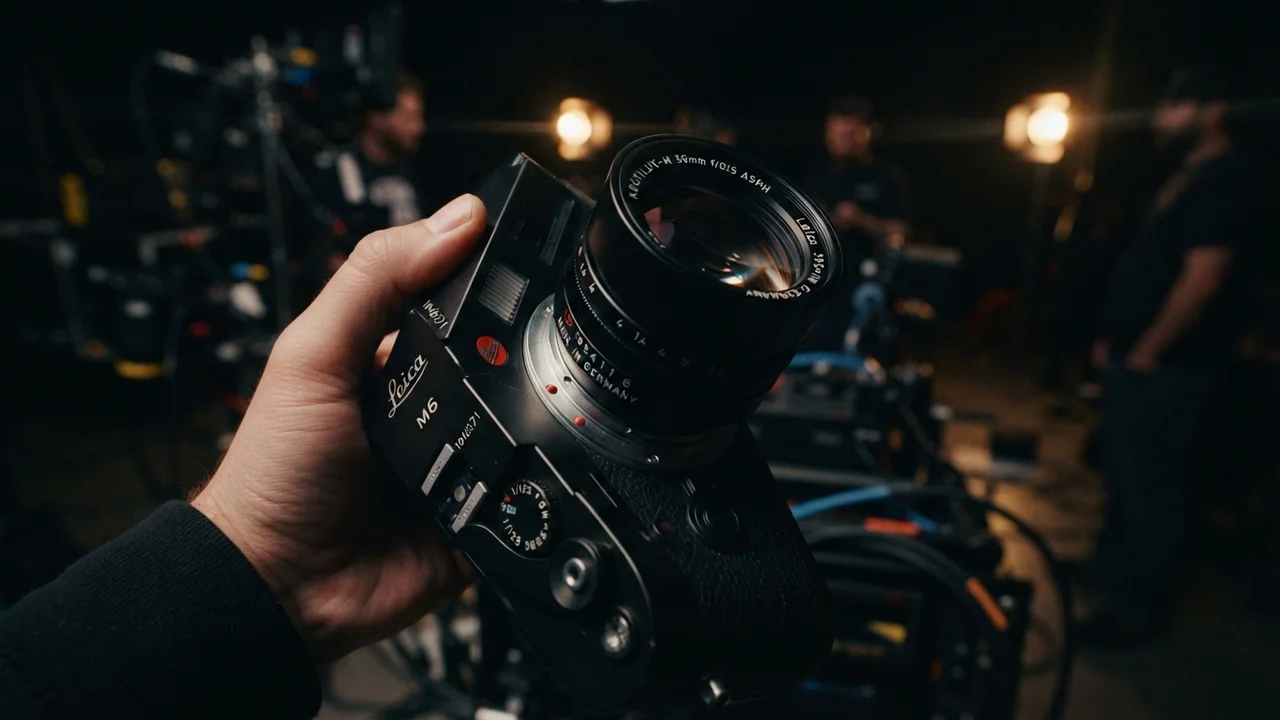
Murnau AI illustration
flow leica para roll take

Leica M Mount: 44mm bayonet with 28mm flange focal distance, standard since 1954. Compact M-mount lenses suit documentary work on mirrorless cameras.

Technical Details

The M Mount has an internal diameter of 44mm and features six sensors for lens recognition on digital M cameras. The flange focal distance of 27.8mm is significantly shorter than that of SLR cameras (Canon EF: 44mm, Nikon F: 46.5mm). Modern M Mount lenses transmit focal length and aperture data via electrical contacts to the camera body. The system supports focal lengths from 16mm to 280mm, with lenses from 28mm onwards usable without viewfinder issues.

History & Development

Leica introduced the M Mount in 1954 with the Leica M3, replacing the L39 screw mount used since 1930. The designer was Willy Kütter, who aimed to enable faster lens changes. In 1984, Leica expanded the system with 6-bit coding for automatic lens recognition. Electronic contacts were added with the digital Leica M8 (2006). Today, besides Leica, Zeiss, Voigtländer, and Cosina also produce lenses for the M Mount.

Practical Use in Film

Cinematographers appreciate M Mount lenses on mirrorless cameras for documentary work and Steadicam shots due to their compact design and low weight. The Leica Summicron-M 50mm f/2.0 weighs only 240g compared to comparable cine optics weighing 800-1200g. Filmmakers like Sean Baker used M Mount lenses on Sony cameras for "Tangerine" (2015). The continuous aperture ring mechanism allows for smooth aperture transitions during recording.

Comparison & Alternatives

Compared to cine mounts (PL, EF), the M Mount does not offer parfocality or focus gearing for follow focus systems. Sony E Mount (18mm flange focal distance) and Micro Four Thirds (19.25mm) allow the use of M Mount lenses with infinity focus via adapters. Canon RF Mount and Nikon Z Mount are modern alternatives with electronic communication and larger diameters. For high-end productions, specialized cine lenses remain the first choice, while M Mount optics excel in mobile setups and available light situations.
From the crafts

Perspectives

Cinematographer

Ich setze M-Mount-Objektive hauptsächlich an spiegellosen Kameras für handheld Work ein, da das geringe Gewicht längere Drehtage ermöglicht. Die charakteristische Bokeh-Qualität der Leica Summilux-Objektive verleiht meinen Bildern eine unverwechselbare cinematographische Anmutung, die besonders bei Available-Light-Szenen zur Geltung kommt.

Director

M-Mount-Objektive helfen mir dabei, eine intimere Atmosphäre zwischen Schauspielern und Kamera zu schaffen, da die kompakte Bauweise weniger aufdringlich wirkt. Besonders bei emotional sensiblen Szenen ermöglicht mir das geringe Setup authentischere Reaktionen, weil sich die Darsteller weniger von der Technik abgelenkt fühlen.

Producer

Die Investition in M-Mount-Objektive rechnet sich durch deren Wertstabilität und die Einsparung bei Steadicam-Operator-Kosten, da leichtere Setups schnellere Umbauten ermöglichen. Allerdings muss ich bei der Kalkulation berücksichtigen, dass Focus-Puller für M-Mount-Objektive ohne Cine-Mod deutlich mehr Zeit für präzise Schärfenführung benötigen.

More in the lexikon

Related terms

Test your knowledge

Quiz

1. Was beschreibt „Leica M-Mount" am besten?

2. Zu welchem Department gehört „Leica M-Mount"?

3. Wie viele verschiedene Fachperspektiven bietet dieser Eintrag?

Report an error
From the Filmfarm ecosystem

Understand visual language, budget productions, connect crew.

The Lexikon is part of the Filmfarm ecosystem — alongside budgeting (FilmBalance), an industry magazine (FilmCircus) and crew networking (FilmCall, CrewMesh). One shared vocabulary for the whole production.

FilmFarm FilmRadarComing soonFilmPulseComing soonFilmNumbersComing soonFilmCapitalComing soonFilmLabComing soonFilmBalanceComing soonFilmCircusComing soon