Technical Details
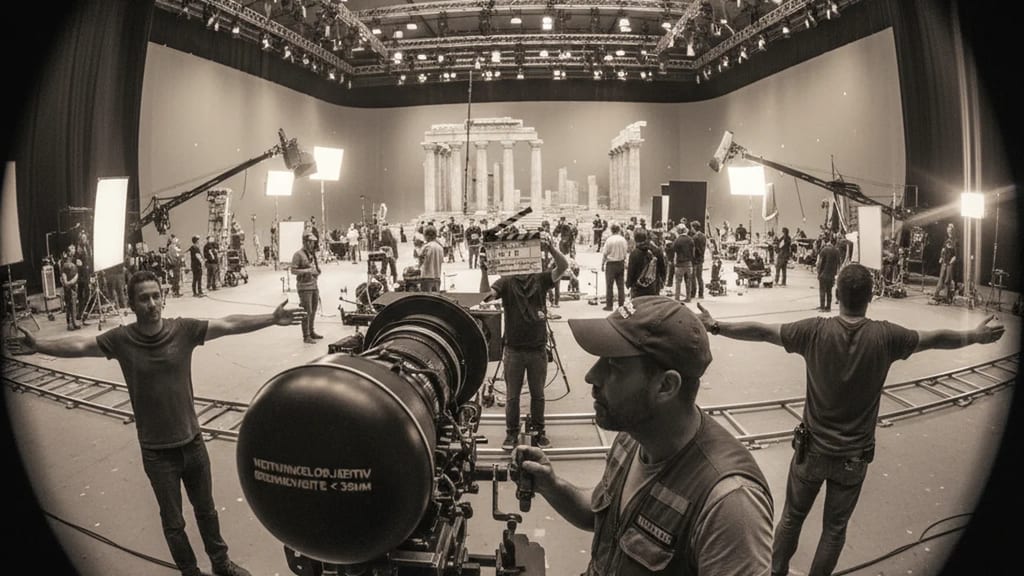
Standard wide-angle lenses encompass focal lengths from 14mm to 35mm on full-frame. A 14mm lens achieves a diagonal field of view of 114°, while 24mm still covers 84°. Fisheye lenses, as an extreme form, reach 180° or more with characteristic barrel distortion. The construction requires complex lens systems with 12-20 individual elements to correct distortion, chromatic aberrations, and fall-off (vignetting). Modern cine wide-angles like the Zeiss Supreme Prime 18mm T1.5 or Cooke S7/i 25mm T2.0 offer consistently high sharpness performance right into the image corners.
History & Development
The first usable wide-angle lens was developed in 1935 by Willy Merté at Zeiss with the 35mm Biogon. In 1951, Pierre Angénieux revolutionized the film industry with his 17-68mm Zoom. Significant milestones included the distortion-free Zeiss Hologon 15mm in 1962 and Canon's first aspherical wide-angle in 1973. Stanley Kubrick used extreme wide-angles as a dramatic tool, such as the Kinoptik Tegea 9.8mm in "A Clockwork Orange" (1971). Today, highly corrected cine optics with T-stops below 2.0 and minimal distortion dominate.
Practical Use in Film
Wide-angles significantly enhance spatial depth and motion dynamics. Emmanuel Lubezki shot "The Revenant" (2015) mostly on wide-angles between 12mm and 21mm, most often a 14mm, and moved in close to the actors. Horror directors like Stanley Kubrick ("The Shining") employ extreme wide-angles to create menacing spatial distortions. The large depth of field allows focus from foreground to infinity at f/5.6. Disadvantages include edge distortion on faces, difficult lighting due to the large captured area, and higher demands on set design.
Comparison & Alternatives
Normal focal lengths (40-60mm) render natural perspectives without spatial distortion, while telephoto lenses (over 85mm), from the distance they require, create compressed, flat image effects. Modern alternatives include variable wide-angle zooms like the Angenieux Optimo 15-40mm T2.6 or prime sets with consistent color characteristics. Anamorphic wide-angles like the Hawk V-Lite 16mm combine a wide field of view with a 2.39:1 aspect ratio. Full-frame cameras significantly expand wide-angle possibilities compared to Super35mm.