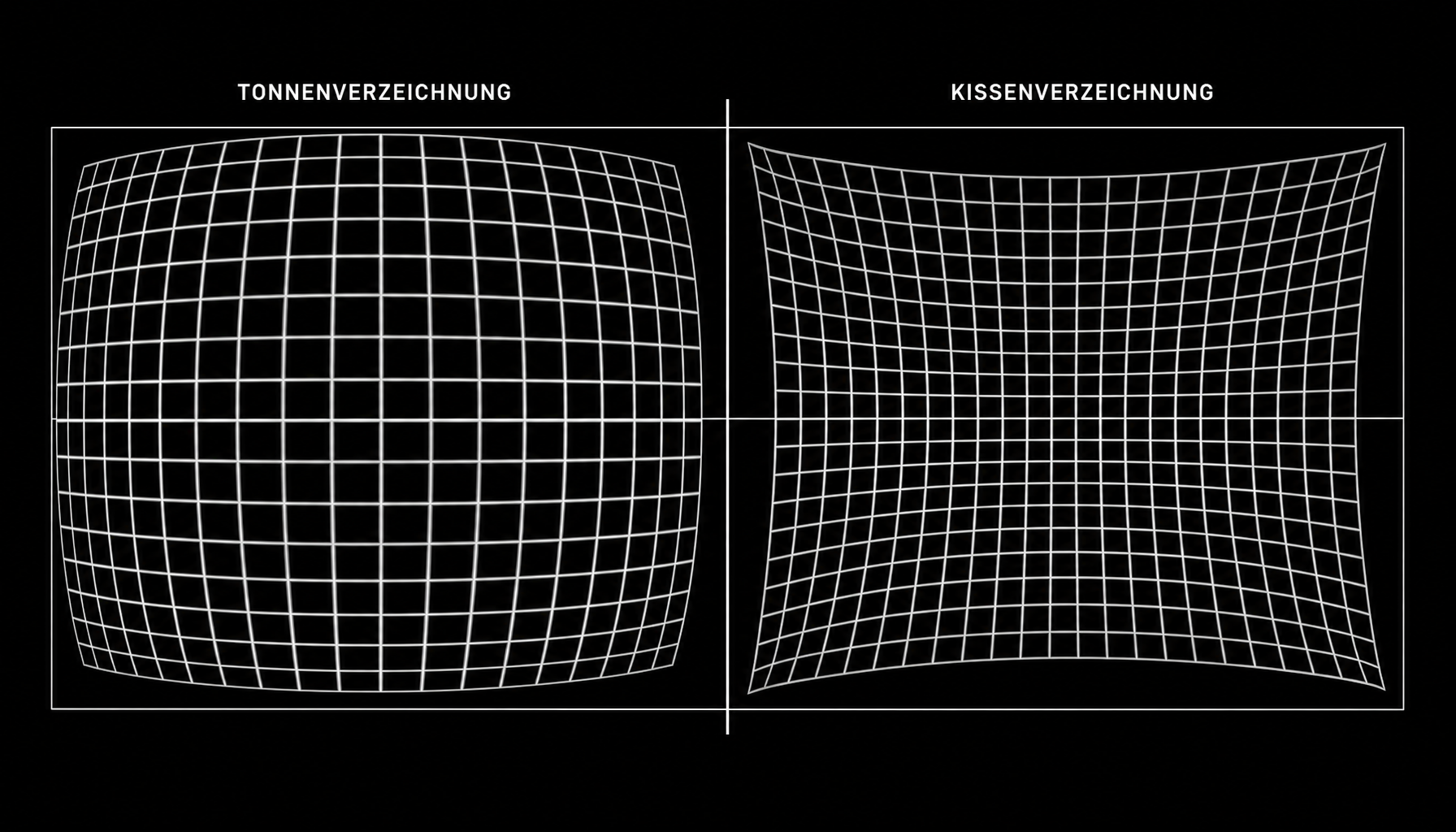
Geometric lens error that renders straight lines as curves: barrel (outward), pincushion (inward), or wavy (moustache). Typical of wide-angle lenses; deliberately embraced in fisheye looks.
Distortion is the geometric aberration of a lens: straight lines in the subject appear curved in the image. In barrel distortion, lines at the edge of the frame bulge outwards—typical for wide-angle lenses. In pincushion distortion, they curve inwards, which is more common with telephoto lenses and at the long end of zooms. The third type is mustache or wave distortion: a hybrid form where the line first curves outwards and then inwards again towards the edge. It is the most problematic of the three because it cannot be cleanly corrected with simple correction models.
Where it's noticeable — and where it isn't
Distortion is hardly noticeable in nature because there are very few straight lines. It becomes critical with architecture, interiors, door frames, shelves, horizon lines—anywhere the eye knows something should be straight. A pan exacerbates the problem: the curvature moves with the lines through the frame and becomes visible as a wavering effect. During location scouting, it's worth considering how many straight edges the framing will later contain.
Stylistic device or correction case
Distortion is not inherently a flaw. The fisheye lens deliberately pushes barrel distortion to the extreme—for skate videos, music videos, subjective distortion, or the view through a peephole. Even subtle barrel distortion can give an image organic warmth; many vintage lenses are valued precisely for this. If you don't want it, you correct it in post-production: modern tools reliably correct distortion using lens profiles. However, correcting distortion costs edge resolution and slightly crops the image because stretched areas are pulled apart. The decision should be made at the beginning of the pipeline, not at the end.
- Before shooting, film a test chart or brick wall—this documents the distortion characteristics of each lens.
- For VFX shots, capture the distortion (rotate grids): compositing requires undistorted plates, and the final image gets the distortion back.
- Undistortion in post costs edge sharpness and slightly reduces the field of view—for critical framing, frame slightly wider from the outset.
Related terms
Quiz
1. Was beschreibt „Verzeichnung" am besten?
2. Zu welchem Department gehört „Verzeichnung"?