Technical Details
Visual weight is influenced by measurable parameters: contrast differences of more than 3:1 significantly increase weight, warm colors (red, orange) appear 1.3 times heavier than cool colors of equal saturation. Objects in the upper part of the frame require 20% less area for the same visual weight as in the lower area. The rule of thirds is based on this principle – objects at the four intersection points automatically receive 40% more visual weight. Textured surfaces with more than 50% detail contrast appear heavier than smooth surfaces of identical size.
History & Development
Rudolf Arnheim established the foundations of visual weight in "Film als Kunst" (Film as Art) in 1928. Sergei Eisenstein first systematically applied these findings in "Battleship Potemkin" in 1925. In the 1940s, Gregg Toland developed deep focus composition, which distributed visual weight across planes of focus. With the introduction of the CinemaScope format in 1953, cinematographers had to develop new weighting strategies for the 2.35:1 format. Digital color correction since the 1990s allows for precise manipulation of visual weight in post-production.
Practical Application in Film
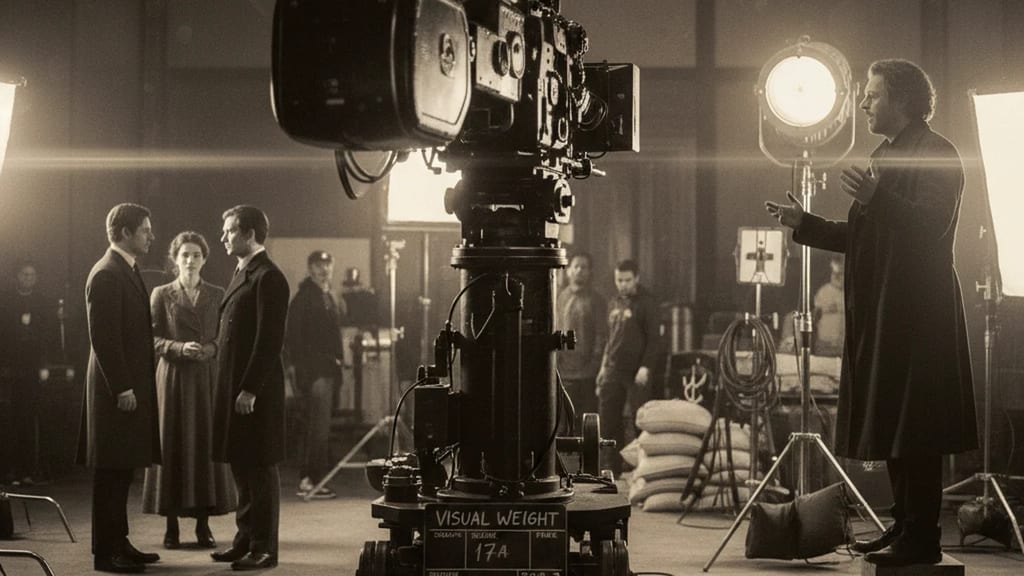
In "The Grand Budapest Hotel" (2014), Wes Anderson uses symmetrical weight distribution to create visual harmony. Stanley Kubrick consistently positioned the monolith in "2001: A Space Odyssey" (1968) in visually weighty positions. Roger Deakins shifts visual weight through color temperature in "Blade Runner 2049" (2017) – warm skin tones against cold neon lighting. In dialogue scenes, weight is controlled by selective lighting: the speaker receives 2-3 stops more light than the listener.
Comparison & Alternatives
Visual weight differs from image balance due to its psychological component – balance is geometrically measurable, weight is perceived subjectively. Visual hierarchy arranges elements by importance, while visual weight measures their attraction. Modern eye-tracking software analyzes gaze patterns and confirms theoretical weighting principles. CGI compositing uses digital weighting through particle systems and depth-of-field effects. In HDR image processing, visual weight is precisely controllable via luminance values from 0.1 to 10,000 nits.