Filmlexikon.
Support
Vectorscope
Camera · Technique

Vectorscope

Murnau AI illustration
daylight 5600k tungsten 3200k 1 2 ctb 1 4 ctb ctb full ctb 1 2 cto

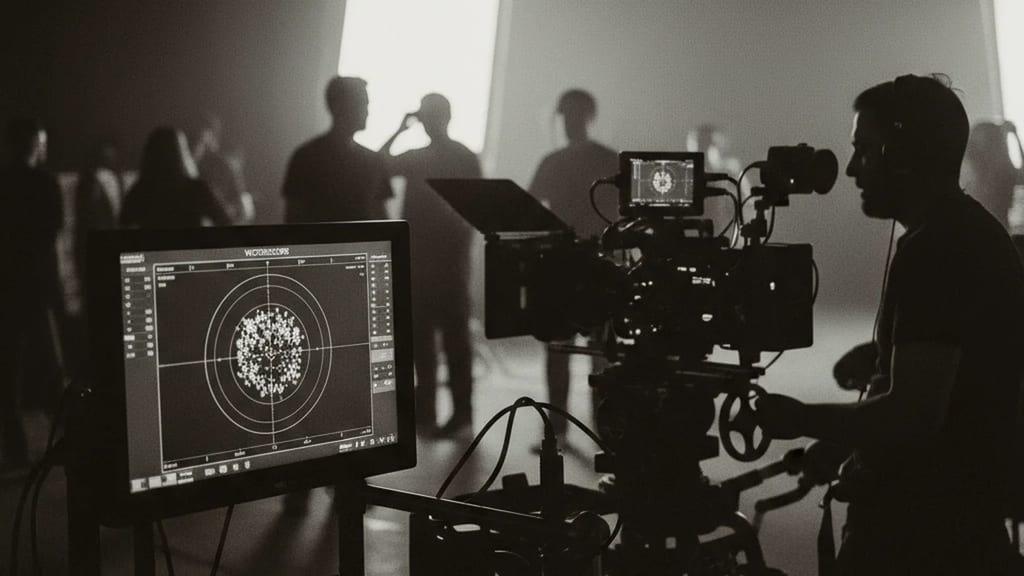
Waveform monitor display showing chrominance values in YUV color space with six primary color target points at 60° intervals; used for color correction and broadcast compliance.

Technical Details

The vectorscope operates with the YUV color space, displaying the U and V components (Cb/Cr in digital signals) on the horizontal and vertical axes. The six primary and secondary colors (red, magenta, blue, cyan, green, yellow) are positioned at 100% saturation as fixed target markers at 60° intervals. Modern digital vectorscopes operate with 10-bit resolution and support various broadcast standards like Rec. 709, Rec. 2020, and DCI-P3. Scaling is typically done in IRE units (Institute of Radio Engineers), with 75% and 100% bars serving as reference values.

History & Development

Tektronix developed the first commercial vectorscope Model 520 for the television industry in 1968. The breakthrough came in 1974 with the Model 1480 Waveform/Vector Monitor, which combined both measurement devices. In the 1980s, vectorscopes became established as standard in television studios for compliance with FCC transmission standards. The transition to digital technology brought software-based vectorscopes in editing systems like Avid Media Composer and later in DaVinci Resolve starting in 2000.

Practical Application in Film

During the color grading of "Mad Max: Fury Road" (2015), Colorist Eric Whipp used vectorscopes to control the extreme orange-blue contrasts in the desert scenes. DoPs use vectorscopes on set to monitor skin tones, which should be located on a characteristic line between orange and red at approximately the 11 o'clock position. In post-production, the vectorscope enables precise color matching between different cameras or shots. Broadcast standards like EBU R103 prescribe maximum color deviations that can only be maintained through vectorscope control.

Comparison & Alternatives

While the waveform monitor displays brightness distribution, the vectorscope focuses exclusively on color information. RGB parades display the three color channels separately, whereas the vectorscope visualizes color relationships holistically. Modern false-color displays overlay exposure information directly in the camera image but do not replace the precise color analysis of the vectorscope. In HDR workflows, gamut scopes complement the traditional vectorscope with expanded color spaces.
From the crafts

Perspectives

Cinematographer

Ich verwende das Vectorscope täglich zur Kontrolle der Hauttöne und zur Sicherstellung konsistenter Farbtemperaturen zwischen verschiedenen Lichtquellen. Besonders bei Mixed-Light-Situationen erkenne ich sofort Farbstiche und kann diese bereits am Set korrigieren, statt sie der Post-Production zu überlassen. Die Zielmarkierungen helfen mir, die Farbsättigung für den jeweiligen Broadcast-Standard im zulässigen Bereich zu halten.

Director

Für mich ist das Vectorscope ein Werkzeug zur Übersetzung meiner visuellen Vision in messbare Parameter, die ich dem DoP und Coloristen kommunizieren kann. Wenn ich eine bestimmte Farbstimmung anstrebe, erkenne ich am Vectorscope sofort, ob wir die gewünschte Ästhetik erreichen. Es hilft mir auch dabei, ungewollte Farbverschiebungen zwischen Einstellungen zu vermeiden, die die narrative Kontinuität stören könnten.

Producer

Das Vectorscope reduziert Korrekturschleifen in der Post-Production erheblich, da bereits am Set broadcast-konforme Farbwerte sichergestellt werden. Moderne Software-Vectorscopes in den Editing-Suites kosten praktisch nichts zusätzlich, während Hardware-Monitore mit integriertem Vectorscope ab 3.000 Euro die Set-Effizienz steigern. Fehlerhafte Farbaufzeichnungen können nachträglich Mehrkosten von 50-100 Euro pro Drehtag in der Farbkorrektur verursachen.

More in the lexikon

Related terms

Test your knowledge

Quiz

1. Was beschreibt „Vectorscope" am besten?

2. Zu welchem Department gehört „Vectorscope"?

3. Wie viele verschiedene Fachperspektiven bietet dieser Eintrag?

Report an error
From the Filmfarm ecosystem

Understand visual language, budget productions, connect crew.

The Lexikon is part of the Filmfarm ecosystem — alongside budgeting (FilmBalance), an industry magazine (FilmCircus) and crew networking (FilmCall, CrewMesh). One shared vocabulary for the whole production.

FilmFarm FilmRadarComing soonFilmPulseComing soonFilmNumbersComing soonFilmCapitalComing soonFilmLabComing soonFilmBalanceComing soonFilmCircusComing soon