Technical Details
VFX productions typically work in resolutions from 2K (2048×1556 pixels) to 4K (4096×3112 pixels), up to 8K for IMAX projects. Render times range from 2-50 hours per frame, depending on complexity and quality requirements. Modern VFX studios utilize render farms with 1000-10000 CPU cores. Main categories include: Matte Painting (digital landscapes), Crowd Simulation, Fluid Dynamics (water, smoke, fire), Character Animation, and Environment Extension (set enlargements). Software standards are Maya, Houdini, Nuke, and proprietary tools from major studios.
History & Development
The first digital VFX emerged in 1973 in "Westworld" with pixelated robot POV shots. "Tron" (1982) used 15 minutes of computer animation with a production cost of $17 million. The breakthrough came with "Terminator 2" (1991) featuring the fluid T-1000, rendered on Silicon Graphics workstations. "Jurassic Park" (1993) established photorealistic CGI characters with 63 VFX shots. Since 2000, entirely digital environments have dominated: "Sky Captain" (2004) was shot entirely against greenscreen; current Marvel productions contain up to 2500 VFX shots with budgets of $200-300 million.
Practical Application in Film
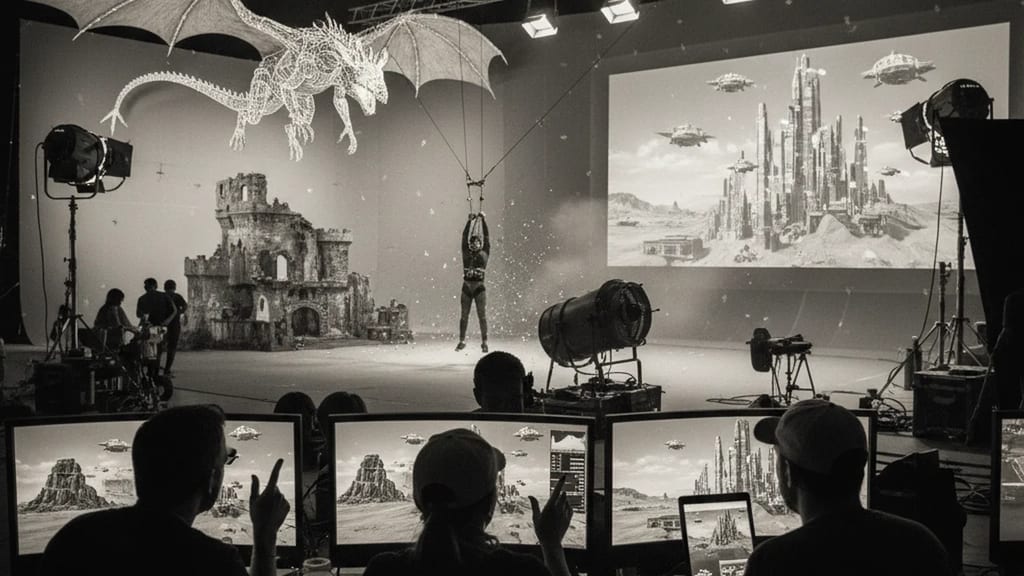
Typical VFX workflow: Onset supervision documents lighting conditions and camera data; tracking markers enable 3D reconstruction. Rotoscoping separates foreground and background; keying removes greenscreen backgrounds. Matchmoving calculates camera movements for CGI integration. "Avengers: Endgame" utilized 2900 VFX shots from 14 studios; "Blade Runner 2049" combined miniature models with CGI for Los Angeles 2049. Set extensions enlarge practical builds: "Mad Max: Fury Road" digitally doubled the number of vehicles; "The Crown" reconstructed Buckingham Palace interiors.
Comparison & Alternatives
VFX differ from SFX by their point of creation: SFX are created on set (explosions, mechanical rigs), while VFX are done in post-production. Motion capture transfers actor performances to digital characters, whereas pure CGI animation works without live-action reference. Practical effects offer authentic light interaction and actor support, while VFX enable impossible camera moves and environments. Virtual Production combines both approaches: LED walls display real-time environments during shooting ("The Mandalorian" uses 75-foot diameter LED stages). Cost-efficiency is a deciding factor: Simple set extensions cost $5000-15000 per shot; complex character animations cost $100000-500000.