Filmlexikon.
Support
Virtual Production
Camera · Technique

Virtual Production

Murnau AI illustration
flow production roll red v raptor

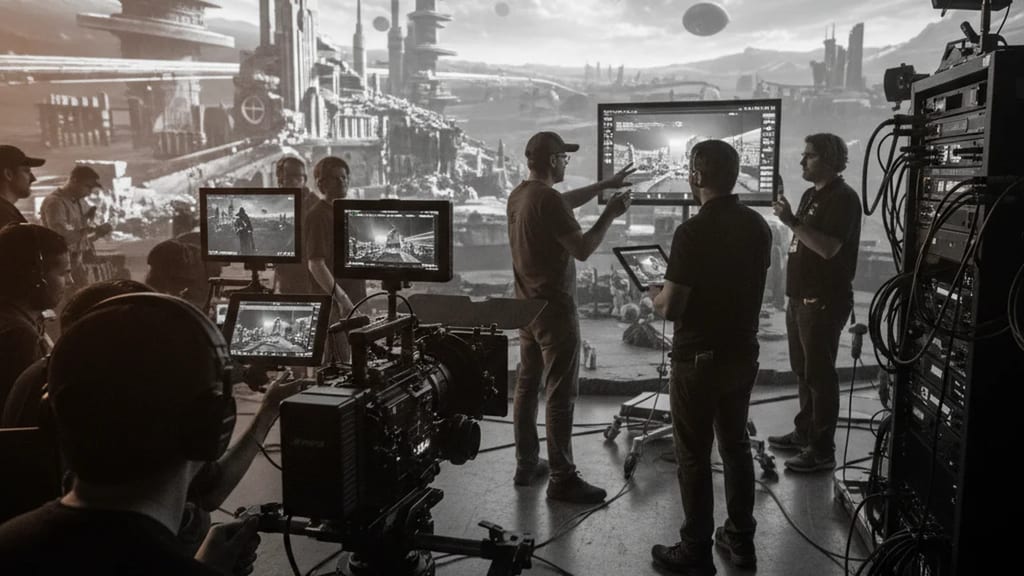
LED volume (up to 23m diameter, 4,000 nits) enabling in-camera VFX without greenscreen. Unreal Engine renders virtual environments in real-time for up to 48 simultaneous camera perspectives.

Technical Details

Standard LED volumes measure 6.1 x 4.3 meters with a height of 4.6 meters; modern installations reach up to 23 meters in diameter. The LED panels operate at 1,000-4,000 nits brightness and cover the Rec.2020 color space. Mo-Sys StarTracker or similar systems capture camera position with sub-millimeter accuracy at 60fps. Nvidia RTX A6000 cards or comparable GPUs render the virtual environments, calculating up to 48 camera perspectives simultaneously. A distinction is made between In-Camera VFX (ICVFX) for final shots and Previsualization for planning purposes.

History & Development

George Lucas' volume experiments originated in 2016 from frustration with greenscreen limitations during the Star Wars prequels. ILM developed the first functional StageCraft system in 2018 for "Solo: A Star Wars Story." The breakthrough came in 2019 with "The Mandalorian," where 50-70% of all shots were created within the LED volume. Epic Games' Unreal Engine integrated native ICVFX functions in 2020, while Sony Pictures, Netflix, and Warner Bros. established their own volume studios.

Practical Application in Film

"The Batman" (2022) utilized virtual production for Gotham driving scenes; "Top Gun: Maverick" combined practical cockpits with LED-generated flight environments. Typical workflows begin with asset creation in Maya/3ds Max, import into Unreal Engine, and calibration of the LED walls. Advantages include natural lighting conditions, immediate playback control, and elimination of rotoscoping work. Disadvantages: limited set size, moiré effects with certain camera settings, and high power consumption of 150-300kW per hour.

Comparison & Alternatives

Virtual production replaces traditional bluescreen/greenscreen methods with in-camera compositing. Compared to location shoots, it reduces travel costs and weather dependency, while post-production VFX are still needed for complex creature work or environments beyond LED resolution. Hybrid approaches combine LED volumes with practical set extensions for maximum flexibility.
From the crafts

Perspectives

Cinematographer

Ich muss die LED-Refresh-Rate auf die Shutter-Angle abstimmen – bei 180° und 24fps arbeite ich mit 23.976fps, um Flicker zu vermeiden. Die natürliche Lichtführung durch die LED-Wand eliminiert komplexe Greenscreen-Beleuchtung, aber ich verliere die präzise Kontrolle über Spill und Farbtemperatur. Mein Fokus liegt auf der Kalibrierung zwischen LED-Output und Kamerasensor, da bereits 2% Abweichung im Gamut sichtbare Farbverschiebungen erzeugt.

Director

Ich erhalte erstmals am Set das finale Bild ohne Postproduktion – Schauspieler reagieren authentisch auf die sichtbare Umgebung statt auf Tennisbälle vor Greenscreen. Die Echtzeit-Anpassung von Tageszeit und Wetter ermöglicht spontane kreative Entscheidungen während der Aufnahme. Allerdings begrenzt die LED-Auflösung extreme Close-ups, und ich muss Blocking präziser planen, da der virtuelle Raum physische Grenzen hat.

Producer

Ein LED-Volume kostet 15.000-25.000 Euro pro Drehtag, aber eliminiert Location-Scouting, Genehmigungen und VFX-Nachbearbeitung im Wert von 200.000-500.000 Euro pro komplexer Umgebung. Die Vorlaufzeit steigt um 8-12 Wochen für Asset-Entwicklung, dafür reduziert sich die Postproduktion um 30-40%. Meine größte Herausforderung: qualifizierte Virtual Production Supervisors sind rar und kosten 2.500 Euro pro Tag.

More in the lexikon

Related terms

Test your knowledge

Quiz

1. Zu welchem Department gehört „Virtuelle Produktion"?

2. Wie viele verschiedene Fachperspektiven bietet dieser Eintrag?

Report an error
From the Filmfarm ecosystem

Understand visual language, budget productions, connect crew.

The Lexikon is part of the Filmfarm ecosystem — alongside budgeting (FilmBalance), an industry magazine (FilmCircus) and crew networking (FilmCall, CrewMesh). One shared vocabulary for the whole production.

FilmFarm FilmRadarComing soonFilmPulseComing soonFilmNumbersComing soonFilmCapitalComing soonFilmLabComing soonFilmBalanceComing soonFilmCircusComing soon