Filmlexikon.
Support
VFX
VFX · Terms

VFX

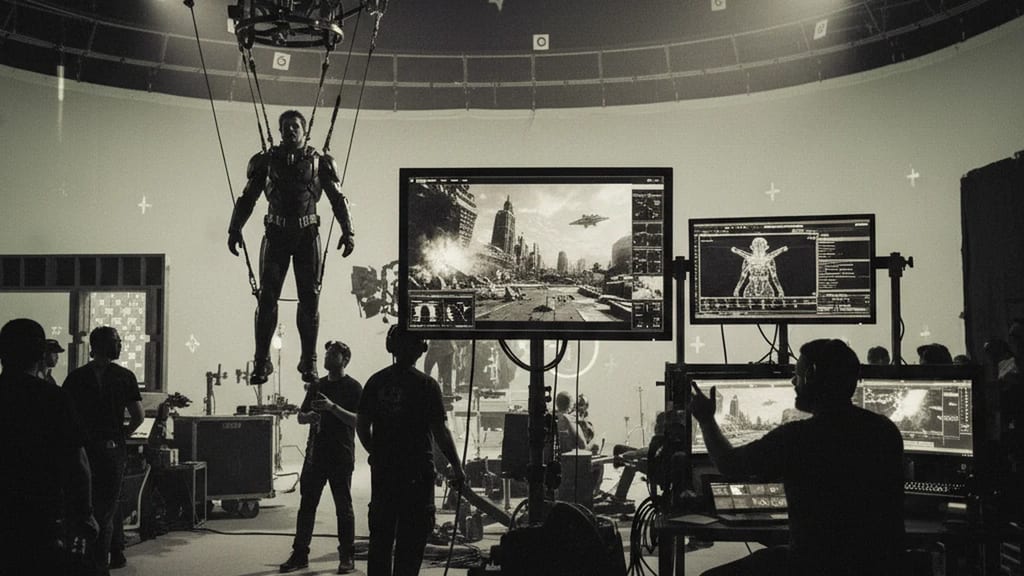
Murnau AI illustration
flow roll camera crew control room production desk production came practical light practical

Digital post-production creating computer-generated imagery (CGI) to augment or replace practical effects. Pipeline includes modeling, animation, lighting, and compositing at 4K resolution.

Technical Details

Modern VFX pipelines operate by default in 4K resolution (4096×2160 pixels) with a color depth of 16-bit or 32-bit per channel. Render farms process up to 10,000 frames daily for complex sequences. The pipeline is divided into five main areas: Modeling (3D object creation), Texturing (surface design), Animation, Lighting (illumination calculation), and Compositing (image integration). Simulations for fluids or particles often require 64-128 GB of RAM per workstation. Typical render times range from 2-3 hours per frame for standard shots to over 50 hours for highly complex sequences.

History & Development

The first digital VFX emerged in 1973 in "Westworld" through pixel-based image manipulation. "The Last Starfighter" (1984) featured the first fully computer-animated spaceships. Industrial Light & Magic revolutionized photorealistic CGI characters in 1991 with the fluid T-1000 in "Terminator 2." "Jurassic Park" (1993) established digital creatures as a standard. Since 2009, real-time engines like Unreal Engine 5 have enabled virtual productions with immediate visualization on set.

Practical Application in Film

"Avatar" (2009) used 2,500 VFX shots with a total budget where 60% was allocated to digital effects. Marvel productions integrate an average of 2,000-3,000 VFX shots per film. Invisible Effects, such as set extensions or weather adjustments, often constitute 40-50% of all VFX shots. The workflow begins with Previs (Previsualization), followed by On-Set Supervision, Asset Creation, and Final Compositing. Stereoscopic 3D productions double the VFX effort through separate eye calculations.

Comparison & Alternatives

VFX differ from SFX (Special Effects) in their digital creation versus practical implementation on set. Motion Graphics focus on graphic elements, while VFX aim for photorealistic integration. Virtual Production combines VFX technology with live-action through LED walls and real-time rendering. Practical effects remain indispensable for haptic interactions and actor reactions. Hybrid approaches utilize practical foundations with digital enhancement for optimal cost-benefit ratios.
From the crafts

Perspectives

Cinematographer

Ich muss bereits beim Dreh an die spätere VFX-Integration denken und entsprechende Referenzkugeln, Tracking-Marker und HDRI-Aufnahmen für korrekte Beleuchtungsreferenzen erstellen. Meine Kameraführung und Objektivwahl beeinflusst direkt die Komplexität des späteren Trackings - ruhige Kamerafahrten mit längeren Brennweiten vereinfachen die Arbeit der VFX-Artists erheblich. Die Belichtung muss so kalkuliert werden, dass sowohl die Live-Action-Elemente als auch die geplanten digitalen Ergänzungen im gleichen Dynamikbereich liegen.

Director

VFX geben mir die Möglichkeit, unmögliche Welten und Kreaturen zu erschaffen, aber ich muss die Balance zwischen digitaler Perfektion und emotionaler Glaubwürdigkeit finden. In der Previs-Phase entwickle ich bereits die visuelle Sprache der Effekte und definiere, welche Story-Beats durch VFX unterstützt werden. Entscheidend ist für mich, dass die Schauspieler trotz Greenscreen und Tennisbällen als Referenz authentische Reaktionen zeigen - deshalb arbeite ich eng mit der VFX-Supervision zusammen, um die Vision klar zu kommunizieren.

Producer

VFX-Budgets mache ich abhängig von Shot-Komplexität und Vendor-Kapazitäten - ein Hero-Shot kostet zwischen 50.000-200.000 Euro, während Standard-Cleanup bei 2.000-5.000 Euro liegt. Die Pipeline-Planung startet bereits in der Entwicklung, da VFX-intensive Sequenzen 6-12 Monate Postproduktion benötigen. Ich kalkuliere 15-20% Puffer für Änderungswünsche ein und verhandle feste Pakete statt Stundensätze, um Kostenkontrolle zu behalten.

More in the lexikon

Related terms

Test your knowledge

Quiz

1. Was beschreibt „VFX" am besten?

2. Zu welchem Department gehört „VFX"?

3. Wie viele verschiedene Fachperspektiven bietet dieser Eintrag?

Report an error
From the Filmfarm ecosystem

Understand visual language, budget productions, connect crew.

The Lexikon is part of the Filmfarm ecosystem — alongside budgeting (FilmBalance), an industry magazine (FilmCircus) and crew networking (FilmCall, CrewMesh). One shared vocabulary for the whole production.

FilmFarm FilmRadarComing soonFilmPulseComing soonFilmNumbersComing soonFilmCapitalComing soonFilmLabComing soonFilmBalanceComing soonFilmCircusComing soon