Filmlexikon.
Support
Variable Frame Rate
Camera · Technique

Variable Frame Rate

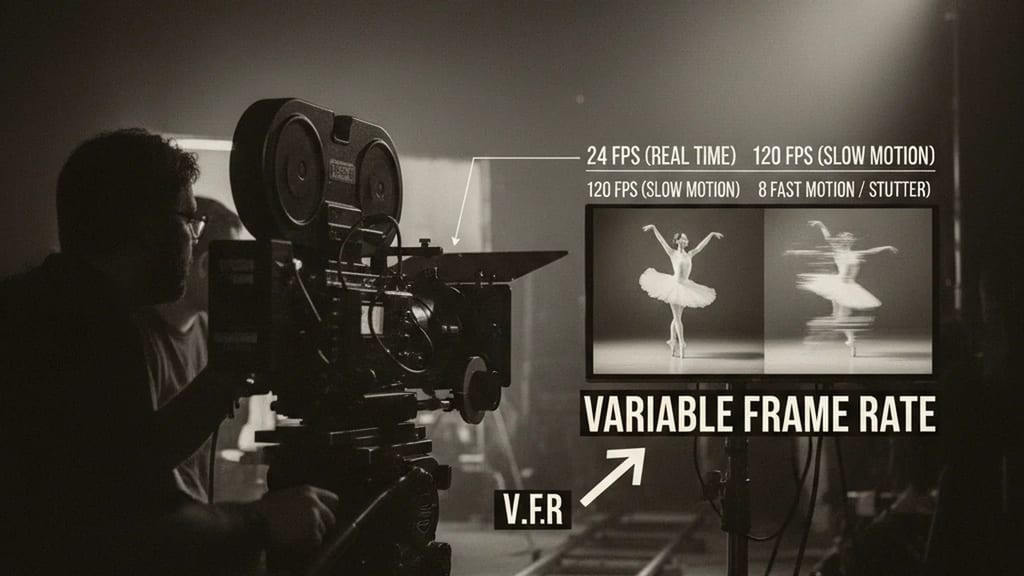
Murnau AI illustration
flow frame rate frame para roll take

Camera technique that dynamically adjusts frame rate during recording (1–120 fps on systems like ARRI Alexa 35) to achieve seamless time-remapping effects in-camera without post-production.

Technical Details

In 2007, the RED One introduced true Variable Frame Rate as the first cinema camera, offering a spectrum from 1 to 60 fps. Current systems like the ARRI Alexa 35 achieve 1-120 fps at 4K resolution, and the Sony FX9 manages 1-180 fps in Super35. The change is achieved through electronic shutter control and adjusted sensor readout. Ramping modes enable smooth transitions between frame rates over defined periods of 2-30 seconds. The camera mathematically interpolates intermediate values and automatically adjusts exposure time and ISO to changing light levels.

History & Development

In 1985, Phantron developed the first mechanical Variable-Speed camera for 16mm film, with a range of 6-150 fps. The digital era began in 2005 with the Silicon Imaging SI-2K, which offered software-based frame rate changes from 1-30 fps. In 2008, the RED Scarlet expanded the spectrum to 1-300 fps. ARRI followed in 2010 with the Alexa series (1-60 fps), and Sony in 2019 with the FX9 (1-180 fps). Current high-end cameras like the Phantom TMX 7510 reach over 1.75 million fps at reduced resolution.

Practical Application in Film

Christopher Nolan utilized Variable Frame Rate in "Dunkirk" (2017) for seamless transitions between timelines – from 24 fps to 48 fps for aerial combat sequences. "Mad Max: Fury Road" (2015) switched from 24 to 48 fps during car chases for increased clarity in fast-moving action. The workflow requires specialized post-production software like DaVinci Resolve or Avid Symphony, which automatically correct timecode discrepancies. Disadvantages arise from more complex audio synchronization and increased data volumes at higher frame rates.

Comparison & Alternatives

Variable Frame Rate differs from High Frame Rate (HFR) by the ability to change within a single shot, whereas HFR refers to consistently high frame rates. Speed ramping as a post-production technique creates similar effects through time manipulation but does not achieve the organic quality of true frame rate changes. Phantom high-speed cameras offer extreme frame rates up to 12 million fps, but without variable functionality during recording.
From the crafts

Perspectives

Cinematographer

Ich nutze Variable Frame Rate hauptsächlich für dramatische Speed-Ramping-Effekte, bei denen ich während einer Kamerabewegung von 24 auf 120 fps hochfahre - das erzeugt organischere Übergänge als Post-Effekte. Die automatische Belichtungsanpassung funktioniert zwar gut, aber ich muss trotzdem manuell nachkorrigieren, besonders bei extremen Sprüngen von 24 auf 240 fps, wo sich die Schärfentiefe merklich verändert.

Director

Variable Frame Rate gibt mir die Kontrolle über Zeitwahrnehmung direkt am Set - ich kann emotional wichtige Momente durch Verlangsamung verstärken, ohne in der Post darauf warten zu müssen. Besonders kraftvoll ist der nahtlose Übergang von Normalzeit in Zeitlupe bei Wendepunkten der Handlung, wie ich es bei Kampfszenen einsetze, wo Adrenalin die subjektive Zeitwahrnehmung verändert.

Producer

Variable Frame Rate verdoppelt bis vervierfacht meine Speicher- und Backup-Kosten bei höheren Bildraten, gleichzeitig spare ich aber Post-Production-Zeit für Speed-Ramping-Effekte ein. Die Synchronisation mit Playback und Stunts wird komplizierter, da sich Timing während der Aufnahme ändert - ich plane daher 20% mehr Zeit für VFR-Drehtage und zusätzliche DIT-Kapazitäten für die erhöhten Datenmengen.

More in the lexikon

Related terms

Test your knowledge

Quiz

1. Was beschreibt „Variable Bildrate" am besten?

2. Zu welchem Department gehört „Variable Bildrate"?

3. Wie viele verschiedene Fachperspektiven bietet dieser Eintrag?

Report an error
From the Filmfarm ecosystem

Understand visual language, budget productions, connect crew.

The Lexikon is part of the Filmfarm ecosystem — alongside budgeting (FilmBalance), an industry magazine (FilmCircus) and crew networking (FilmCall, CrewMesh). One shared vocabulary for the whole production.

FilmFarm FilmRadarComing soonFilmPulseComing soonFilmNumbersComing soonFilmCapitalComing soonFilmLabComing soonFilmBalanceComing soonFilmCircusComing soon