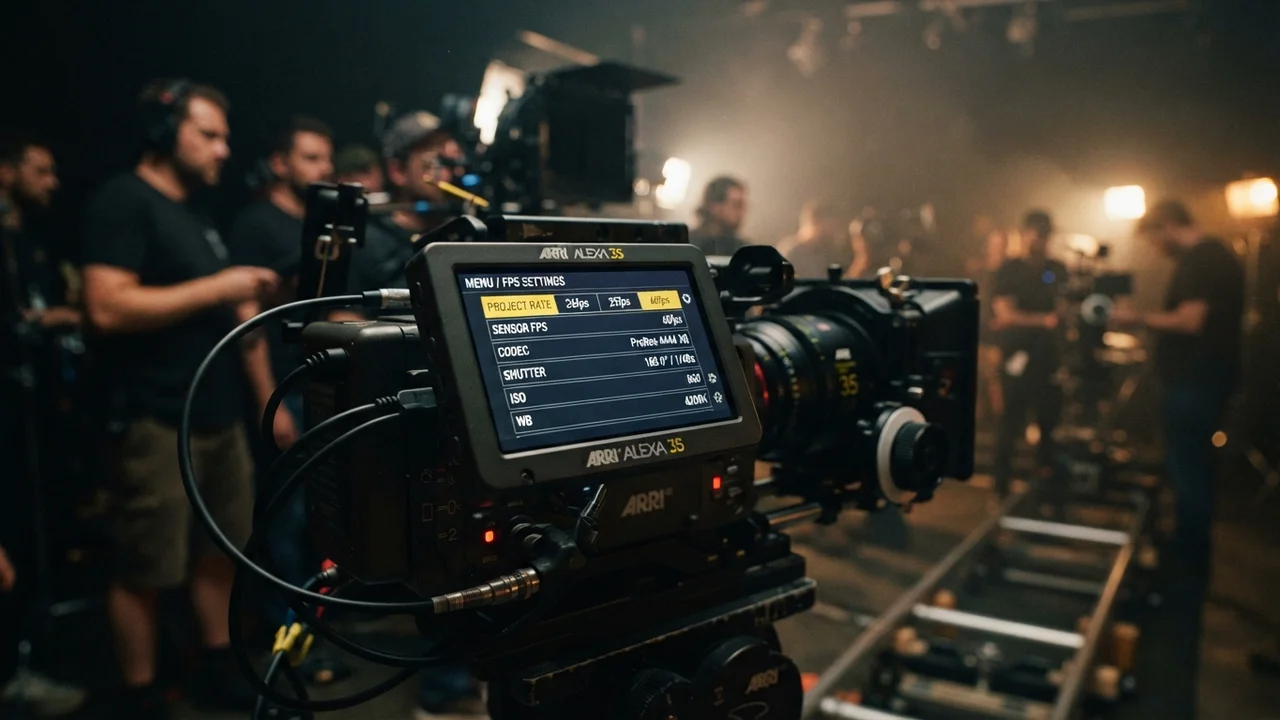
Technical Foundations and Standards
Frame Rate (Bildrate) is measured in frames per second (fps) and describes how many individual images are recorded or displayed per second. This number directly influences:
- Motion Fluidity: Higher fps = smoother motion
- Motion Blur: Lower fps = more natural motion blur
- Storage Space: Proportional linear - 60 fps = 2.5x more data than 24 fps
- Lighting Requirements: Higher fps require significantly more light
Industry Standards by Region and Application
Film Industry (Worldwide):
- 24 fps - Gold standard for feature films, established since 1929
- 48 fps - Modern High Frame Rate (HFR) option for 3D and action (Avatar 2, Avatar 3)
- 96 fps - Experimental HFR cinema production (rare)
Television and Streaming:
- 25 fps (PAL) - Europe, Africa, Asia, Australia broadcast standard
- 29.97 fps (NTSC Drop-Frame) - North America, Japan, parts of South America
- 24 fps - Netflix, premium streaming worldwide
- 30 fps - YouTube, web content standard
Sports and Live Broadcasting:
- 50 fps (PAL) - European sports broadcasting
- 59.94 fps (NTSC) - North American sports broadcasting
- 60 fps - High-speed sports analysis
High-Speed and Slow Motion:
- 60 fps - Standard for 2.5x slow motion
- 120 fps - Standard for 5x slow motion (commercials, action films)
- 240 fps - Extreme slow motion (rarer)
- 1,000+ fps - Scientific and ballistic high-speed
Shutter Angle and Motion Blur - The Critical Relationship
Frame rate alone does not determine the "look" of a shot. At least as important is the Shutter Angle, which controls the exposure time per frame.
180-Degree Shutter Rule (Standard):
- Shutter Speed = 1 / (2 × fps)
- 24 fps: 1/48 second
- 25 fps: 1/50 second
- 30 fps: 1/60 second
- 60 fps: 1/120 second
- 120 fps: 1/240 second
This rule creates "natural" motion blur with kinetic flair. A smaller shutter angle (e.g., 90 degrees) creates sharper, more digital-looking images. A larger shutter angle (e.g., 270 degrees) creates more dramatic motion blur with a softer aesthetic.
Example: 24 fps with a 180-degree shutter looks cinematic and emotional. 24 fps with a 90-degree shutter looks digital and technical. 48 fps with a 180-degree shutter looks hyper-realistic.
History and Standardization of Frame Rate
Early Cinema Era (1890s-1920s):
- Thomas Edison established 46 fps in 1891 with the Kinetoscope due to mains frequency reasons
- The Lumière brothers reduced it to 16 fps in 1895 for cost reasons (less film consumption)
- Silent films varied between 16-24 fps, depending on the studio and region
- Lack of standardization led to compatibility issues
Establishment of the 24 fps Standard (1929):
- Hollywood standardized on exactly 24 fps in 1929 for sound film
- Reason: 24 fps was the sweet spot between:
- Sufficient frame rate for smooth motion
- Acceptable film consumption and production costs
- Synchronizable with 50/60 Hz mains frequency for synchronous motors
- This standard became the global cinema norm and exists to this day
Television Era (1950s-1970s):
- 1953: PAL standard (Europe, Australia, Asia): 25 fps, 625 lines
- 1953: NTSC standard (North America, Japan): 29.97 fps (30000/1001), 525 lines
- This drop-frame complexity arose from adaptation to 60 Hz mains frequency
Digital Revolution (2000s-2010s):
- 2000s: Digital cameras (RED, ARRI) enabled arbitrary frame rates
- 2009: Avatar and other 3D films experimented with 48 fps
- 2012: "The Hobbit" was shot entirely in 48 fps (mixed reactions)
- 2023: Avatar 2 and 3 selectively use 48 fps for action sequences
Practical Application Scenarios
Narrative Feature Films (24 fps):
- Creates an emotional, dreamlike, "cinematic" atmosphere
- Optimized for psychological storytelling
- Internationally marketable
- Examples: All major feature films, prestigious TV series
Documentaries and Reportages (25/30 fps):
- Appears authentic and immediate
- The "TV look" is familiar to viewers
- Good compromise between motion fluidity and cost
- Examples: BBC Documentaries (25 fps), National Geographic (30 fps)
Sports Broadcasting (50/60 fps):
- Motions are crystal clear and analytical
- Instant replays possible without separate systems
- Especially important for fast ball games
- Examples: Soccer, Tennis, American Football
Action Sequences with Slow Motion (shot at 60-120 fps, played back at 24 fps):
- 60 fps → 24 fps = 2.5x slow motion
- 120 fps → 24 fps = 5x slow motion
- Allows dramatic staging of fast moments
- Examples: Mad Max: Fury Road, John Wick Franchise
Commercials and Commercial Production (24 or 60 fps):
- Often 24 fps for a "premium/luxury" look
- 60 fps for product demonstrations and fast action
- Hybrid approaches combine both
Music Videos (variable):
- Pop: Often 24 or 30 fps for energy
- Artistic: Frequently 60 fps for spectacular dance choreography
- Slow-motion videos: Shot at 120+ fps, played back at 24 fps
Technical Requirements by Frame Rate
Lighting
This is one of the biggest practical factors:
| Frame Rate | Relative Lux Requirement | Example Setup |
|---|
| 24 fps | 1x (Base) | 2-4 Arri SkyPanel 600W |
| 30 fps | 1.25x | 3 Arri SkyPanel 600W |
| 60 fps | 4x | 8 Arri SkyPanel 600W or 2x HMI 4K |
| 120 fps | 8x | 4x HMI 12K or large LED array |
Storage Management
| Frame Rate | Format | Data Rate | 1 Hour of Footage |
|---|
| 24 fps | 4K ProRes 422 | 2.5 Gbps | 1.1 TB |
| 24 fps | 4K RAW | 3.2 Gbps | 1.4 TB |
| 60 fps | 4K ProRes 422 | 6.3 Gbps | 2.8 TB |
| 120 fps | 4K ProRes 422 | 12.5 Gbps | 5.6 TB |
Focus and Camera Requirements
- 24-30 fps: Standard manual focus support
- 60 fps: More precise focus planning required
- 120 fps: Autofocus is preferred; manual focus requires experienced focus pullers
Differences Between Similar Standards
24 fps vs. 25 fps:
- 24 fps: Cinematic style, with longer motion blur
- 25 fps: European TV look, slightly faster, more motion fluidity
- Conversion: 24→25 fps requires a 4% speed-up (minimally perceptible)
25 fps vs. 30 fps:
- 25 fps: PAL standard, crisp with 50 Hz mains frequency
- 30 fps: NTSC standard, more modern and web-friendly
- Conversion: 25→30 fps requires a 20% speed-up or frame interpolation
60 fps vs. 120 fps:
- 60 fps: 2.5x slow motion at 24 fps (standard for action)
- 120 fps: 5x slow motion at 24 fps (more dramatic, requires 2x light)
Modern Alternatives and Future
Motion Interpolation:
- Some TV sets and streaming players interpolate intermediate frames (e.g., 24→120 fps)
- Controversial: Some see it as "motion smoothing," others find it useful
Variable Frame Rates (VFR):
- Modern cameras allow frame rate changes during recording
- Creates sped-up/slowed-down effects without separate recordings
Adaptive Frame Rate Matching:
- Netflix and other platforms adjust streaming frame rate to devices
- Reduces bandwidth at 24 fps, enables 60 fps on 120Hz displays
AI-based Frame Interpolation:
- Artificial intelligence can synthesize intermediate frames
- Quality varies but is promising for upscaling