Filmlexikon.
Support
Para
Lighting · Terms

Para

Murnau AI illustration
axial cut cross cut cross cutting cut cutter cutting on dialogue cutting on movement cutting rhythm

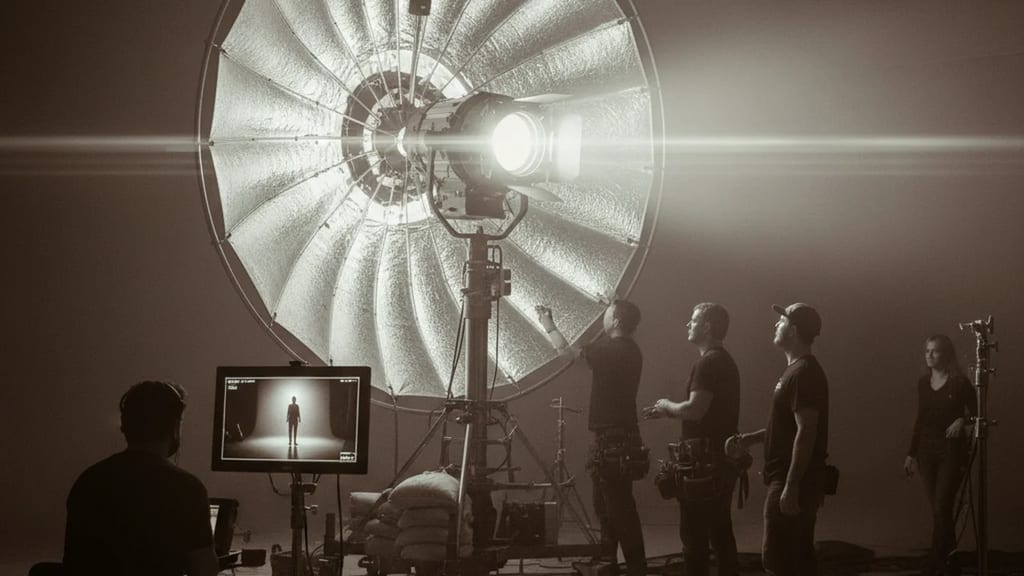
Parabolic reflector with polished aluminum or glass mirror that focuses light in a 12–25° beam angle, producing hard, parallel light for long-distance throws.

Technical Details

Standard parabolic reflectors achieve a beam angle of 12° to 25° with maximum light output. The surface is made of polished aluminum or silver-plated glass with a reflectivity of 92-96%. Modern designs use segmented mirrors or Fresnel-like structures for weight reduction. The light source holder is precisely positioned at the focal point, with even a 2 mm deviation significantly degrading light distribution. Professional models offer focusing by axial displacement of the light source by ±10 mm.

History & Development

In 1912, Kliegl Brothers developed the first film-ready parabolic reflector for studio lighting. In 1935, Mole-Richardson revolutionized the technique with the "Type 412 Brute Arc," a 225-ampere system with a 61 cm parabolic mirror. In the 1960s, HMI lamps enabled more compact designs with higher light output. Modern LED arrays since 2010 allow for variable color temperature and DMX control with a 70% reduction in power consumption.

Practical Use in Film

Cinematographer Roger Deakins used parabolic reflectors for the moonlight scenes in "1917" (2019) to achieve hard shadows with maximum throw. For daylight exterior shots, 120 cm paras compensate for the sun as fill light from up to 50 meters away. The precise light control is particularly suitable for selectively illuminating individual actors in group scenes. Disadvantages include the high weight (25-80 kg) and the complex alignment for moving shots.

Comparison & Alternatives

In contrast to Fresnel spotlights, parabolic reflectors produce harder, parallel light without a halo. Softboxes and diffusers create softer illumination but achieve only a fraction of the throw. LED panels with parabolic optics today offer similar light quality with lower weight and power consumption. For extreme wide-angle shots, classic parabolic reflectors remain without alternative, while softer light shapers are preferred for close-ups and portraits.

From the crafts

Perspectives

Cinematographer

Ich setze Parabolreflektoren ein, wenn ich hartes, gerichtetes Licht über große Distanzen brauche – perfekt für dramatische Schatten oder um einzelne Gesichter aus einer Menschenmenge herauszuarbeiten. Die präzise Kontrolle über Lichtrichtung und -intensität gibt mir die Möglichkeit, auch bei schwierigen Lichtverhältnissen die gewünschte Bildstimmung zu erreichen, ohne auf mehrere kleinere Leuchten angewiesen zu sein.

Director

Parabolreflektoren helfen mir dabei, spezifische emotionale Atmosphären zu schaffen – das harte, gerichtete Licht verstärkt Spannungsmomente und schafft klare Hell-Dunkel-Kontraste für Film Noir-Ästhetik. Wenn ich Charaktere isolieren oder deren psychologischen Zustand durch Licht-Schatten-Spiel visualisieren möchte, bietet mir die präzise Lichtführung des Paras genau die narrative Kontrolle, die ich brauche.

Producer

Ein Parabolreflektor kostet zwischen 3.000 und 15.000 Euro, benötigt aber spezielle Transport-Cases und erfahrene Beleuchter für sicheren Aufbau – das bedeutet höhere Personalkosten und längere Setup-Zeiten. Dafür ersetzen große Paras oft drei bis vier kleinere Leuchten, reduzieren den Stromverbrauch am Set und ermöglichen Aufnahmen, die sonst zusätzliche Drehtage erfordern würden.

More in the lexikon

Related terms

Test your knowledge

Quiz

1. Was beschreibt „Parabolreflektor" am besten?

2. Zu welchem Department gehört „Parabolreflektor"?

3. Wie viele verschiedene Fachperspektiven bietet dieser Eintrag?

Report an error
From the Filmfarm ecosystem

Understand visual language, budget productions, connect crew.

The Lexikon is part of the Filmfarm ecosystem — alongside budgeting (FilmBalance), an industry magazine (FilmCircus) and crew networking (FilmCall, CrewMesh). One shared vocabulary for the whole production.

FilmFarm FilmRadarComing soonFilmPulseComing soonFilmNumbersComing soonFilmCapitalComing soonFilmLabComing soonFilmBalanceComing soonFilmCircusComing soon