Technical Details
Commercially available V-Flats use 5mm thick foam core boards with a white surface (reflectivity 85-90%) and a matte black reverse side (absorption 95%). The hinges are made of gaffer tape or piano hinge constructions. More compact versions measure 75 x 150 cm, while large versions range up to 120 x 240 cm. Modern versions utilize foldable fabric coverings on aluminum frames with reflectivity values between 80-95% (white), 60-70% (silver), or absorption values of 98% (black).
History & Development
V-Flats originated in Hollywood studios in the 1940s as a cost-effective alternative to heavy wooden flats. Initially, two separate white canvases were used, joined with clamps. The combination of white and black sides became established in the 1960s. From the 1980s onwards, foam core boards gained traction, being lighter and cheaper than the previous plywood constructions.
Practical Use in Film
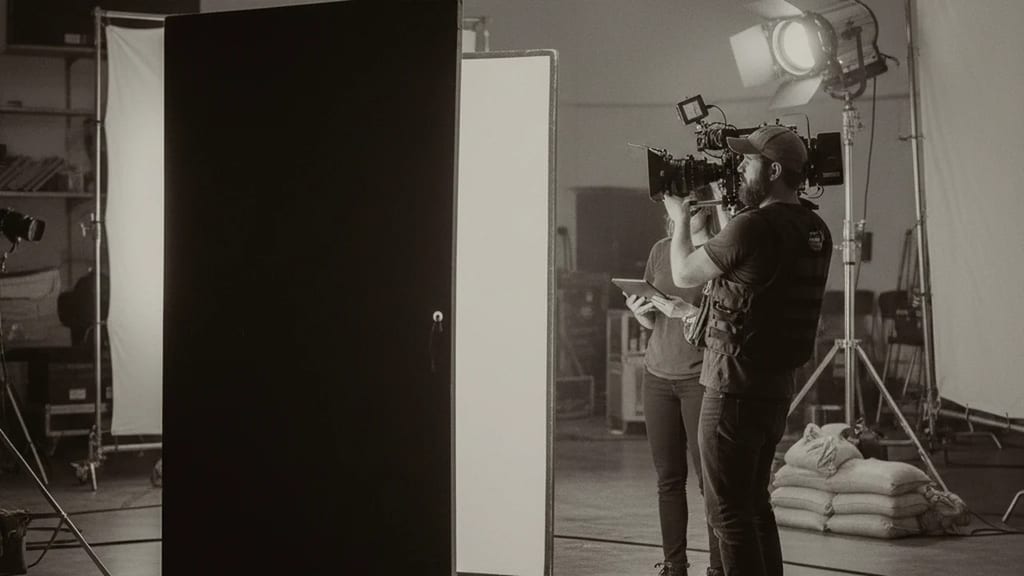
V-Flats serve as light bouncers to fill shadows, as negative fill to darken areas, or as background control. For portraits, they are positioned to the side of the camera at a 45° angle to diffuse harsh light. They are suitable as backdrops for talking-head shots or product photography. The V-shape creates even, gradual illumination without hard transitions. In confined spaces, they function as mobile studio walls, obscuring unwanted background elements.
Comparison & Alternatives
Unlike round reflectors (Ø 107 cm), V-Flats offer a larger illuminated surface area with 2 m² of working surface. Softboxes produce more directed light, while V-Flats provide diffusion. Modern LED panels (e.g., Aputure Nova P300c) are increasingly replacing passive reflectors with controllable light sources. Foldable Lastolite systems are more transport-friendly but do not achieve the stability of V-Flats. For budget productions, DIY V-Flats made from foam core remain the most cost-effective solution compared to LED alternatives costing €800-€1500.