Filmlexikon.
Support
Collapsible Reflector
Lighting · Equipment

Collapsible Reflector

Murnau AI illustration
daylight 5600k tungsten 3200k 1 2 ctb 1 4 ctb ctb full ctb 1 2 cto

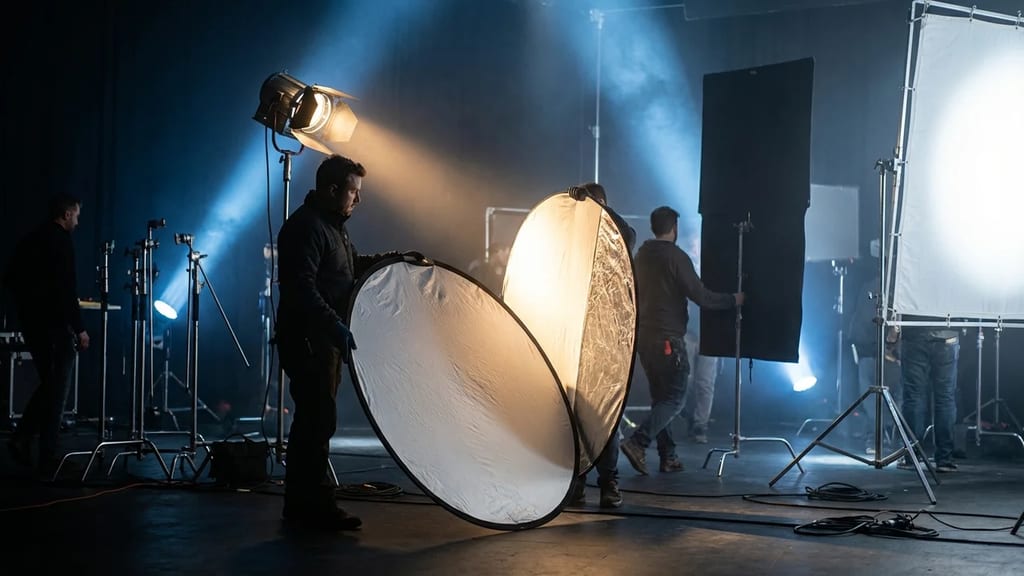
Collapsible reflector with steel ring frame, foldable to 1:9 of original volume via torsion; offers multiple surfaces for light control and fill.

Technical Details

The frame is made of a continuous steel band (0.8-1.2 mm thickness), formed into a ring and collapsible by torsion. Standard surfaces include silver (reflectivity 85-90%), gold (color temperature shift +800K), white (diffuse reflection 75-80%), black (absorption >95%), and translucent diffusers (light reduction 1.5-2 stops). Professional models achieve packed dimensions of 1:9 compared to their deployed state and weigh between 200g (60cm) and 1.8kg (200cm).

History & Development

In 1984, American photographer and inventor Gary Fong developed the first commercial collapsible reflector with a spiral frame. Photoflex launched the first mass-produced model, "LiteDisc," in 1986. In the 1990s, 5-in-1 systems with interchangeable covers became the industry standard. Modern variants, since 2010, integrate LED lighting into the frame or offer motorized adjustment for remote heads.

Practical Use in Film

On "Mad Max: Fury Road" (2015), cinematographer John Seale used large-format collapsible reflectors (180cm) to fill light vehicle interiors during driving shots. Standard workflows include setting eye lights for close-ups (60-80cm distance), brightening shadows in available light situations, and background separation through targeted light spill. The quick setup and breakdown allow for spontaneous light adjustments between takes without re-rigging time.

Comparison & Alternatives

Compared to rigid reflector boards, collapsible reflectors offer 90% less transport volume, but achieve only 70% of the maximum reflectivity of stiff surfaces due to minimal surface tension. Modern LED panels are increasingly replacing reflectors in controllable shooting conditions as they function independently of existing light sources. However, collapsible reflectors remain the preferred choice for exterior shoots with sunlight and in confined spaces due to their passive operation and independence from power.
From the crafts

Perspectives

Cinematographer

Ich setze 110cm-Silberreflektoren standardmäßig für Eye-Light bei Portraitaufnahmen ein, da sie selbst bei bewölktem Himmel ausreichend Füllicht liefern. Die schnelle Handhabung durch den Assistenten ermöglicht mir spontane Lichtkorrekturen während der Aufnahme, ohne dass ich die Kameraposition verlassen muss. Bei goldenen Reflektoren muss ich allerdings den Weißabgleich um etwa 200K nach unten korrigieren.

Director

Ich nutze große transluzente Faltreflektoren als spontane Diffusoren, um hartes Sonnenlicht bei emotionalen Dialogen zu mildern - das schafft sofort eine intimere Stimmung ohne aufwändige Grip-Umbauten. Besonders bei Drehbuch-Änderungen am Set kann ich durch gezielte Reflektor-Positionierung die Lichtstimmung an die neue emotionale Situation anpassen. Die Mobilität erlaubt mir auch bei Walking-Shots kontinuierliche Gesichtsaufhellung.

Producer

Ein 5-in-1-Reflektor-Set kostet 150-400 Euro und ersetzt fünf separate Lichtmodifikatoren plus deren Transport - das spart mir etwa 60% der Equipment-Kosten in dieser Kategorie. Die Ein-Sekunden-Aufbauzeit reduziert meine Beleuchtungszeiten um durchschnittlich 15 Minuten pro Setup gegenüber starren Reflektoren. Bei Locations ohne Stromanschluss spare ich zusätzlich Generator-Kosten, da natürliches Licht optimal genutzt wird.

More in the lexikon

Related terms

Test your knowledge

Quiz

1. Was beschreibt „Faltreflektor" am besten?

2. Zu welchem Department gehört „Faltreflektor"?

3. Wie viele verschiedene Fachperspektiven bietet dieser Eintrag?

Report an error
From the Filmfarm ecosystem

Understand visual language, budget productions, connect crew.

The Lexikon is part of the Filmfarm ecosystem — alongside budgeting (FilmBalance), an industry magazine (FilmCircus) and crew networking (FilmCall, CrewMesh). One shared vocabulary for the whole production.

FilmFarm FilmRadarComing soonFilmPulseComing soonFilmNumbersComing soonFilmCapitalComing soonFilmLabComing soonFilmBalanceComing soonFilmCircusComing soon