Cinematographer
Aus DoP-Perspektive ist dieses Element essentiell für die visuelle Gestaltung. Es ermöglicht mir die gewünschte Farbstimmung und das ästhetische Bild konsistent umzusetzen.
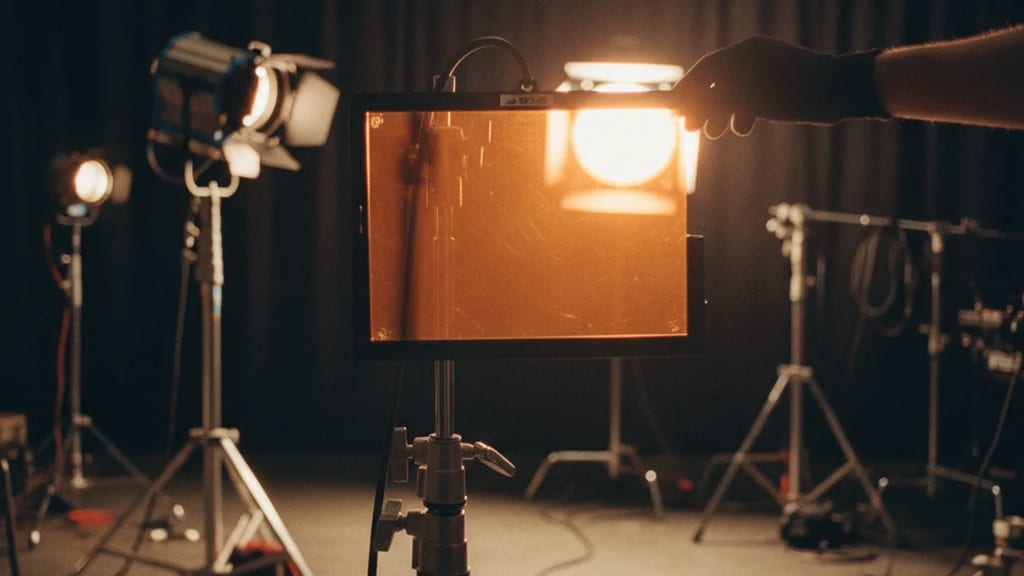
Adjustment of daylight-balanced lighting (~5600–6500K) to tungsten/artificial light (3200K), typically using orange CTO correction gels.
"Tungsten Correction" (also Daylight-to-Tungsten Correction) refers to adjusting a daylight-balanced light source to match the color temperature of artificial light (Tungsten/incandescent, standard 3200 K). A classic scenario: an HMI or LED source balanced for daylight (approx. 5600 K) is to be used indoors with existing incandescent lamps or together with tungsten fixtures, without creating a color break in the image between bluish and warm light.
The usual tool is a CTO gel (Color Temperature Orange), which is stretched in front of the source. It absorbs parts of the blue spectrum and shifts the color temperature downwards, towards warmer tones. The counterpart is CTB (Color Temperature Blue), which conversely raises tungsten to daylight. With LEDs and many HMIs, this correction can today also be achieved electronically via the preset color temperature; however, the gel remains the reference method, especially for non-dimmable sources and mixed lighting situations.
CTO gels are available in graduated densities. The following conversions correspond to the manufacturer specifications from LEE Filters (starting value 6500 K daylight):
| Density | LEE No. | Conversion |
|---|---|---|
| Full CTO | 204 | 6500 K → 3200 K |
| 3/4 CTO | 285 | 6500 K → 3600 K |
| 1/2 CTO | 205 | 6500 K → 3800 K |
| 1/4 CTO | 206 | 6500 K → 4600 K |
| 1/8 CTO | 223 | 6500 K → 5550 K |
The effect is often specified in Mired Shift (positive value = warmer). Mired values can be added, allowing the necessary correction for a specific source and target color temperature to be combined. With Rosco, CTO gels are sometimes referenced to a different starting color temperature (approx. 5500 K), which is why target values may differ slightly between manufacturers. Related are the "Straw" variants (LEE 441-444), which additionally introduce a slight yellow cast.
Light loss must be considered: the denser the CTO gel, the more output it absorbs. With electronically dimmable LED sources, this loss is avoided because the correction is applied directly via the light color.
Aus DoP-Perspektive ist dieses Element essentiell für die visuelle Gestaltung. Es ermöglicht mir die gewünschte Farbstimmung und das ästhetische Bild konsistent umzusetzen.
Diese professionelle Lösung erhöht die Produktionseffizienz und reduziert Post-Production-Anforderungen. Sie ermöglicht flexible, schnelle Anpassungen während des Drehs.
Als Gaffer ist dies ein unverzichtbares Werkzeug meines täglichen Handwerkszeugs. Es ermöglicht mir professionelle Lichtkontrolle und schnelle Anpassungen auf Set, was Zeit spart und Qualität sichert.
1. Zu welchem Department gehört „Kunstlichtkorrektur"?
2. Wie viele verschiedene Fachperspektiven bietet dieser Eintrag?
The Lexikon is part of the Filmfarm ecosystem — alongside budgeting (FilmBalance), an industry magazine (FilmCircus) and crew networking (FilmCall, CrewMesh). One shared vocabulary for the whole production.