Overview
The TTArtisan 90mm f/1.25 is a fast, manual telephoto lens from the Chinese manufacturer TTArtisan. With a focal length of 90mm and a maximum aperture of f/1.25, it is designed as a classic portrait and available light lens: it produces a very shallow depth of field with pronounced background blur (bokeh) and allows for shooting in low light without additional illumination. The lens operates purely manually – focus and aperture are set mechanically on the lens rings; there is no electronic coupling or autofocus.
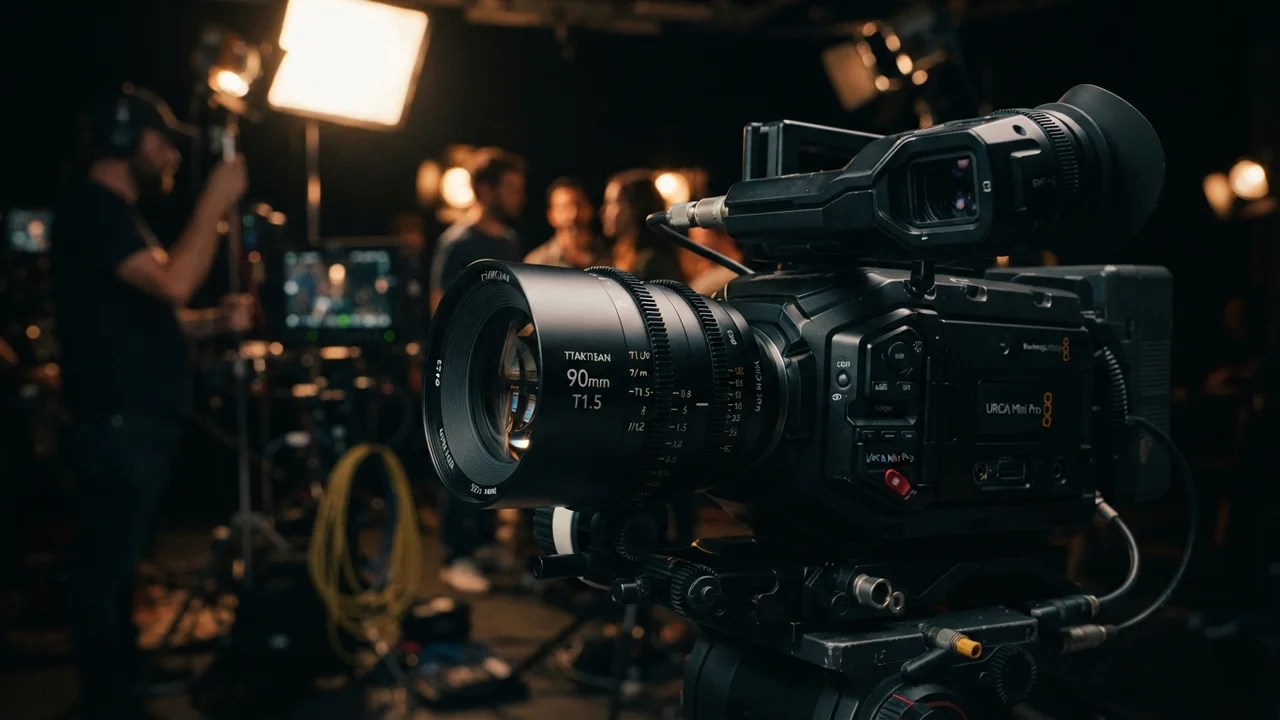
The full-frame mirrorless variants were introduced at the end of December 2021; a version for the Leica M-mount appeared earlier in 2021. In the motion picture and indie film sectors, such extremely fast prime lenses are occasionally used for stylized close-ups and low-light looks, although without the features typical of cinema optics such as a continuous T-stop, follow focus gears, or a de-clicked aperture ring from the factory.
Technical Specifications
| Feature | Value |
|---|
| Focal Length | 90 mm |
| Maximum Aperture | f/1.25 |
| Minimum Aperture | f/16 |
| Optical Construction | 11 elements in 7 groups (incl. four apochromatic doublets) |
| Diaphragm Blades | 10 |
| Minimum Focusing Distance | 1.0 m |
| Filter Thread | 77 mm |
| Weight | approx. 1 kg (slight variations depending on mount and measurement method) |
| Focus | manual |
The lens is available for several mirrorless mounts: Sony E, Nikon Z, Canon RF, and L-mount (Leica/Sigma/Panasonic) for full-frame, as well as Fujifilm GFX and Hasselblad X1D for medium format. Additionally, there is a variant for the Leica M rangefinder mount.
On-Set Usage
Due to its high light transmission and long focal length, the lens is suitable for tightly framed portraits and close-ups with a strongly isolated background. The lens barrel has a 1/4-inch tripod thread, which allows for a better balance point on a tripod or rig with the comparatively heavy build.
For professional film productions, it should be noted that this is a still photography lens: the aperture ring is clicked (mount-dependent), the focus and zoom paths are not standardized for pull-focus, and the aperture markings are f-stops (geometric), not T-stops (light-technically measured). Therefore, for repeatable focus pulls or multi-camera matching, gears must be retrofitted and values manually calibrated.