Filmlexikon.
Support
Timecode
Editing · Technique

Timecode

Murnau AI illustration
foley mixer mix production sound mixer re recording mixer sound mixer zoom recorder sound devices zoom

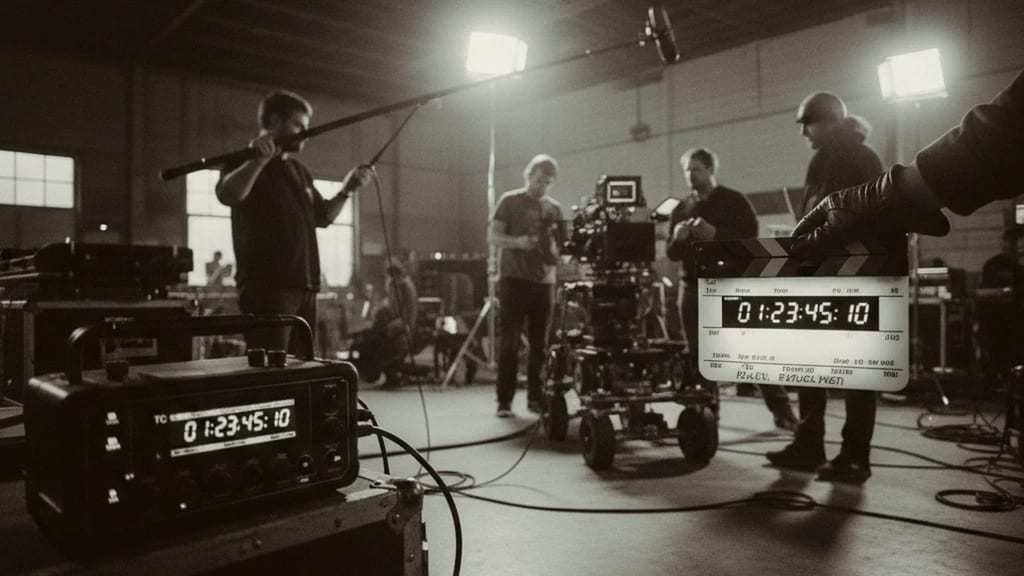
Unique temporal address (HH:MM:SS:FF) for each frame, synchronizing camera and audio recorder. Identical timecodes across all on-set devices are essential for post-production sync.

Technical Details

The SMPTE (Society of Motion Picture and Television Engineers) timecode operates with a resolution of 80 bits per frame and transmits data at 2400 bits/s. At 24fps, one frame corresponds to 41.67 milliseconds, and at 25fps, it is 40 milliseconds. Linear Timecode (LTC) is recorded as an audio signal on separate audio tracks, while Vertical Interval Timecode (VITC) is embedded in the vertical blanking interval of the video signal. Drop-frame timecode compensates for the discrepancy between 29.97fps and 30fps by skipping specific frame numbers (00 and 01) every minute, except for those ending in zero.

History & Development

NASA developed the first SMPTE timecode in 1967 for the Apollo missions to synchronize telemetry data. In 1969, the television industry adopted the system, and in 1975, it was standardized as SMPTE 12M. The introduction of digital video technology in the 1980s established timecode as an indispensable tool for non-linear editing. With HD formats, new frame rates like 23.976fps and 59.94fps were added in 2000. Modern productions have increasingly utilized Network Time Protocol (NTP) for IP-based workflows since 2010.

Practical Application in Film

In "Dunkirk" (2017), Christopher Nolan synchronized three different timelines using precise timecode references between IMAX cameras, 65mm film, and digital recordings. Multi-camera productions like "1917" (2019) rely on generator lock systems that synchronize all cameras to the same master timecode. In post-production, timecode enables the automatic conforming of proxy material to high-resolution files. Sound designers use timecode for frame-accurate placement of Foley effects and ADR takes.

Comparison & Alternatives

Unlike Burnt-In Timecode (BTC), embedded timecode remains invisible and does not affect the final image. Broadcast Wave Format (BWF) integrates timecode information directly into audio files, while separate WAV files require external synchronization. Modern alternatives like PTP (Precision Time Protocol) achieve sub-microsecond accuracy for 4K/8K productions. GPS-based timecode generators provide absolute time references for documentaries and live events without a central synchronization source.
From the crafts

Perspectives

Cinematographer

Ich verlasse mich bei Multi-Kamera-Setups auf präzise Timecode-Synchronisation, um in der Post identische Momente zwischen verschiedenen Brennweiten perfekt matchen zu können. Generator-Lock-Systeme mit Master-Timecode sind für mich essentiell, besonders bei Steadicam-Aufnahmen, wo ich nicht permanent verkabelt sein kann. Ohne frame-genaue Referenz würde das Conforming meiner RAW-Dateien zu einem logistischen Albtraum.

Director

Timecode gibt mir die Sicherheit, spontane Momente aus verschiedenen Kameraperspektiven später präzise rekonstruieren zu können, ohne die natürliche Performance durch mehrere Takes zu verwässern. Bei improvisierten Dialogen kann ich so die beste emotionale Nuance jedes Schauspielers frame-genau kombinieren. Die exakte Synchronisation ermöglicht mir kreative Entscheidungen in der Post, die während des Drehs noch nicht festgelegt werden müssen.

Producer

Einheitliche Timecode-Standards reduzieren meine Post-Production-Kosten erheblich, da das Conforming automatisiert ablaufen kann statt aufwendiger manueller Synchronisation. Bei internationalen Co-Produktionen stelle ich sicher, dass alle Units denselben Master-Timecode verwenden, um später keine teuren Re-Syncs zahlen zu müssen. GPS-basierte Timecode-Generatoren kosten zwar 2.000€ extra, sparen aber bei Dokumentationen ohne zentrale Regie Wochen an Schnitt-Zeit.

More in the lexikon

Related terms

Test your knowledge

Quiz

1. Was beschreibt „Timecode" am besten?

2. Zu welchem Department gehört „Timecode"?

3. Wie viele verschiedene Fachperspektiven bietet dieser Eintrag?

Report an error
From the Filmfarm ecosystem

Understand visual language, budget productions, connect crew.

The Lexikon is part of the Filmfarm ecosystem — alongside budgeting (FilmBalance), an industry magazine (FilmCircus) and crew networking (FilmCall, CrewMesh). One shared vocabulary for the whole production.

FilmFarm FilmRadarComing soonFilmPulseComing soonFilmNumbersComing soonFilmCapitalComing soonFilmLabComing soonFilmBalanceComing soonFilmCircusComing soon