Filmlexikon.
Support
Timecode Sync
Editing · Technique

Timecode Sync

Murnau AI illustration
foley mixer mix production sound mixer re recording mixer sound mixer zoom recorder sound devices zoom

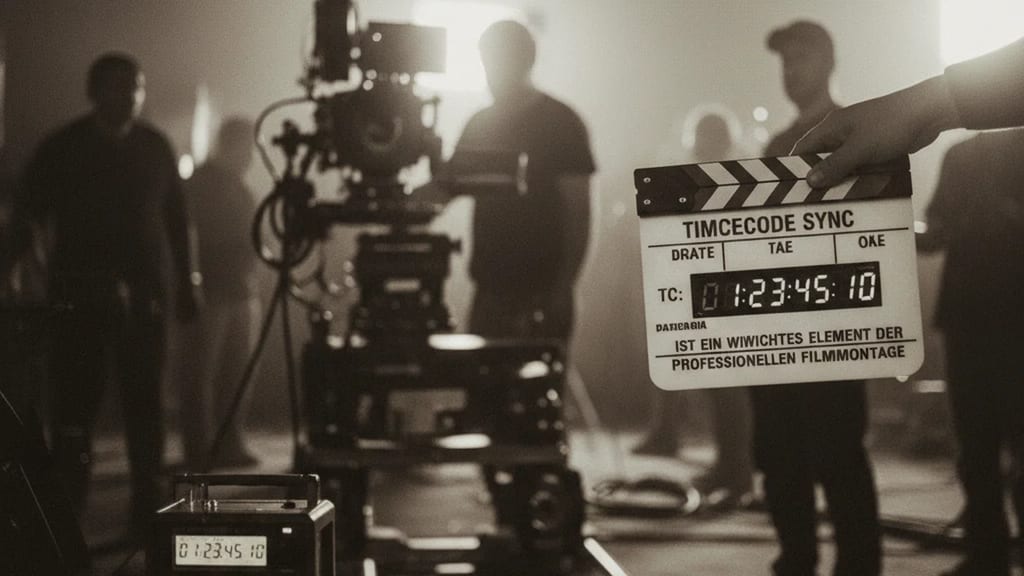
Frame-accurate synchronization of all cameras and audio devices via SMPTE timecode with ±1 frame accuracy. Modern wireless systems like Tentacle Sync achieve ±0.1 ppm precision.

Technical Details

The SMPTE Timecode (Society of Motion Picture and Television Engineers) operates with an accuracy of ±1 frame with a drift of a maximum of 1 frame per 8 hours. Linear Timecode (LTC) is transmitted as an audio signal with a fundamental frequency of 2400 Hz, while Vertical Interval Timecode (VITC) is embedded in the blanking intervals of the video signal. Modern systems use Tentacle Sync or similar devices, which achieve an accuracy of ±0.1 ppm via wireless synchronization. The Jam Sync process synchronizes all devices to a master generator, with high-precision quartz oscillators stabilizing the time base.

History & Development

SMPTE introduced the first timecode standard in 1967, which was standardized as SMPTE 12M in 1969. In 1971, Nagra developed the first timecode generator for audio recorders, revolutionizing multi-camera productions. In 1994, SMPTE 12M-1 extended the standard with User Bits for additional metadata. Since 2010, wireless sync systems like Tentacle Sync E have become established, utilizing GPS references for automatic synchronization.

Practical Application in Film

In "1917" (2019), over 20 cameras were synchronized using timecode for the seemingly continuous long takes. Documentaries like "Free Solo" used timecode sync for up to 12 cameras running simultaneously at different climbing positions. The standard workflow begins with jam syncing all devices at the start of the shooting day, followed by re-jamming every 4-6 hours. In post-production, auto-sync in Avid or DaVinci Resolve enables frame-accurate synchronization without manual adjustment.

Comparison & Alternatives

PluralEyes and similar software solutions analyze waveforms for sync without timecode, but only achieve ±2-3 frames accuracy. Clap sync via slate remains standard for single-camera setups but fails in multi-cam productions with over 4 cameras. Word Clock only synchronizes audio devices at a 48 kHz sample rate, whereas timecode covers complete production workflows. Genlock synchronizes video signals at the pixel level but does not replace the temporal reference of timecode.
From the crafts

Perspectives

Cinematographer

Timecode-Sync befreit mich von der ständigen Sorge um Synchronität zwischen meinen A- und B-Kameras, besonders bei komplexen Steadicam-Fahrten oder Drohnenaufnahmen. Ich kann spontan eine dritte Kamera positionieren, ohne dass der Schnitt später Sync-Probleme bekommt. Bei Available-Light-Situationen spare ich wertvolle Zeit, da ich nicht auf Klappen-Sync angewiesen bin.

Director

Mit präzisem Timecode-Sync kann ich mehrere Kameras für emotionale Close-ups gleichzeitig laufen lassen, ohne Takes durch Klappen zu unterbrechen. Das gibt mir mehr authentische Reaktionen der Schauspieler, da der Moment nicht durch technische Unterbrechungen zerstört wird. Besonders bei Improvisation oder Kinder-Szenen ist diese unsichtbare Synchronisation dramaturgisch wertvoll.

Producer

Timecode-Sync reduziert die Postproduktionszeit um 15-20%, da der Schnitt sofort mit synchronem Material arbeiten kann statt manuell abzugleichen. Die Investition von 800-1200€ pro Kamera rechnet sich bereits ab 3 Drehtagen durch gesparte Editor-Stunden. Bei Multi-Cam-Produktionen verhindert es kostspielige Re-Shoots durch verlorene Sync-Referenzen.

More in the lexikon

Related terms

Test your knowledge

Quiz

1. Was beschreibt „Timecode-Sync" am besten?

2. Zu welchem Department gehört „Timecode-Sync"?

3. Wie viele verschiedene Fachperspektiven bietet dieser Eintrag?

Report an error
From the Filmfarm ecosystem

Understand visual language, budget productions, connect crew.

The Lexikon is part of the Filmfarm ecosystem — alongside budgeting (FilmBalance), an industry magazine (FilmCircus) and crew networking (FilmCall, CrewMesh). One shared vocabulary for the whole production.

FilmFarm FilmRadarComing soonFilmPulseComing soonFilmNumbersComing soonFilmCapitalComing soonFilmLabComing soonFilmBalanceComing soonFilmCircusComing soon