Filmlexikon.
Support
Mix
Sound · Terms

Mix

Murnau AI illustration
nanlite forza 150 nanlite forza 300 nanlite forza 500 nanlite forza 60 nanlite forza 720 nanlite forza nanlite nanlite pavotube 15c

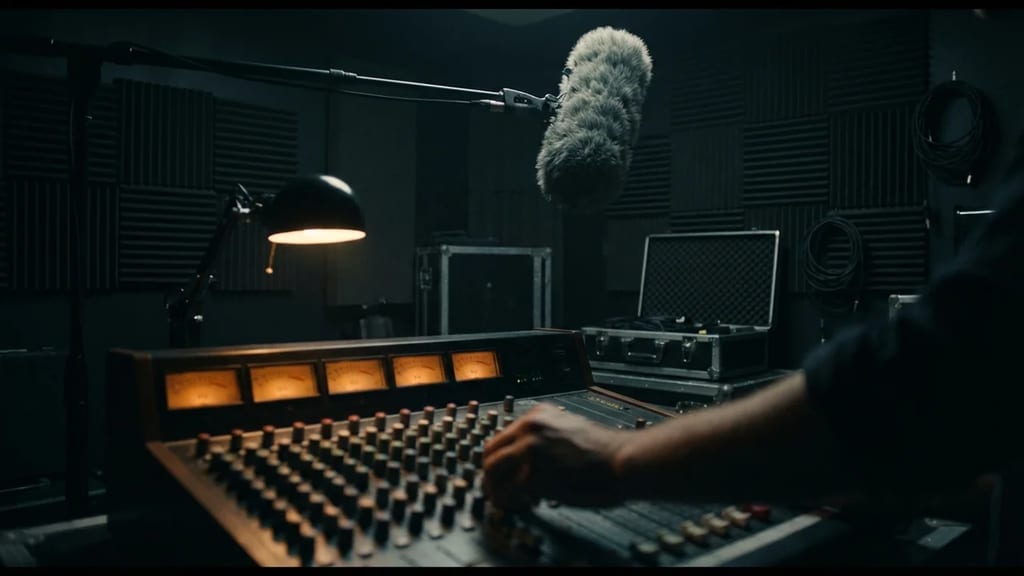
Combining and balancing all audio elements of a film into a cohesive soundscape with defined levels and spatial distribution.

Technical Details

Modern mixes operate with levels between -23 LUFS (Loudness Units Full Scale) for broadcast and -27 LUFS for cinema. Dynamics typically range between -40 dB and +6 dB, with dialogue usually between -20 dB and -12 dB. Surround formats utilize the following configurations: 5.1 with six discrete channels (L, C, R, Ls, Rs, LFE), 7.1 with eight channels, and Dolby Atmos with up to 128 object-based audio tracks. Mixing is done on calibrated monitoring systems according to X-Curve standards with an 85 dB SPL reference level.

History & Development

In 1931, RCA introduced the first multitrack mixing console for film productions. In 1940, Disney developed the first multichannel process, "Fantasound," with three front channels for "Fantasia." Dolby Stereo established itself in 1975 with "Tommy," followed by 5.1 surround in 1992 with "Batman Returns." Digital Theatre Systems (DTS) launched in 1993 with "Jurassic Park." Dolby Atmos revolutionized object-based mixing in 2012 with "Brave," enabling precise 3D positioning of sound objects.

Practical Application in Film

"Mad Max: Fury Road" (2015) used over 3,500 individual tracks for the final mix, with vehicle sounds built up in 16 layers. "Blade Runner 2049" employed Dolby Atmos with 64 simultaneous objects for immersive city soundscapes. The mixing process is divided into Pre-Mix (grouping by category), Final Mix (overall balance), and Print Master (technical adjustment for various playback formats). Typical mixing times are 2-4 weeks for feature films, depending on complexity and the number of formats.

Comparison & Alternatives

Mixing differs from editing through creative balance rather than mere assembly. Sound design develops sound material; mixing shapes its final presentation. Stem mixing creates separate main groups (dialogue/music/effects) for later adjustments, while Full-Mix directly produces the final version. Object-based mixing (Dolby Atmos, DTS:X) is increasingly replacing channel-based methods as it allows automatic adaptation to different speaker configurations. Immersive formats like 360° audio for VR require binaural or Ambisonics mixing instead of conventional surround techniques.
From the crafts

Perspectives

Cinematographer

Ich koordiniere mit der Tonmischung besonders bei Szenen mit starken visuellen Bewegungen, da Schwenks und Zooms die räumliche Klangpositionierung beeinflussen. Bei Dolby Atmos-Produktionen stimme ich Kamerabewegungen mit den geplanten 3D-Klangobjekten ab, damit visuelle und auditive Dynamik harmonieren. Meine Aufnahmeformate bestimmen auch die technischen Mischstandards - HDR-Material erfordert oft erweiterte Dynamikbereiche auch im Ton.

Director

Ich nutze die Mischung als narrative Ebene, um Zuschauer durch Klangfokussierung zu lenken - leise Dialoge zwingen zur Konzentration, während überwältigende Surroundeffekte Bedrohung vermitteln. In der Mischsitzung justiere ich emotional entscheidende Momente durch Pegelverschiebungen und räumliche Positionierung. Die Balance zwischen Dialog-Verständlichkeit und atmosphärischer Immersion bestimmt maßgeblich die Wirkung meiner Inszenierung.

Producer

Ich kalkuliere 8-15% des Postproduktionsbudgets für die Mischung, wobei Dolby Atmos-Formate 20-30% Aufschlag bedeuten. Mischstudios kosten 800-2.500€ pro Tag, die Formatvielfalt (Kino/TV/Streaming/International) verlängert den Prozess um 30-50%. Early Bird-Buchungen in renommierten Studios sparen 15-20%, während Last-Minute-Termine Premiumpreise verursachen. Internationale Versionen erfordern separate Dialog-Stems, was zusätzliche Mischzeit bedeutet.

More in the lexikon

Related terms

Test your knowledge

Quiz

1. Was beschreibt „Mischung" am besten?

2. Zu welchem Department gehört „Mischung"?

3. Wie viele verschiedene Fachperspektiven bietet dieser Eintrag?

Report an error
From the Filmfarm ecosystem

Understand visual language, budget productions, connect crew.

The Lexikon is part of the Filmfarm ecosystem — alongside budgeting (FilmBalance), an industry magazine (FilmCircus) and crew networking (FilmCall, CrewMesh). One shared vocabulary for the whole production.

FilmFarm FilmRadarComing soonFilmPulseComing soonFilmNumbersComing soonFilmCapitalComing soonFilmLabComing soonFilmBalanceComing soonFilmCircusComing soon