Filmlexikon.
Support
Third Stop
Camera · Terms

Third Stop

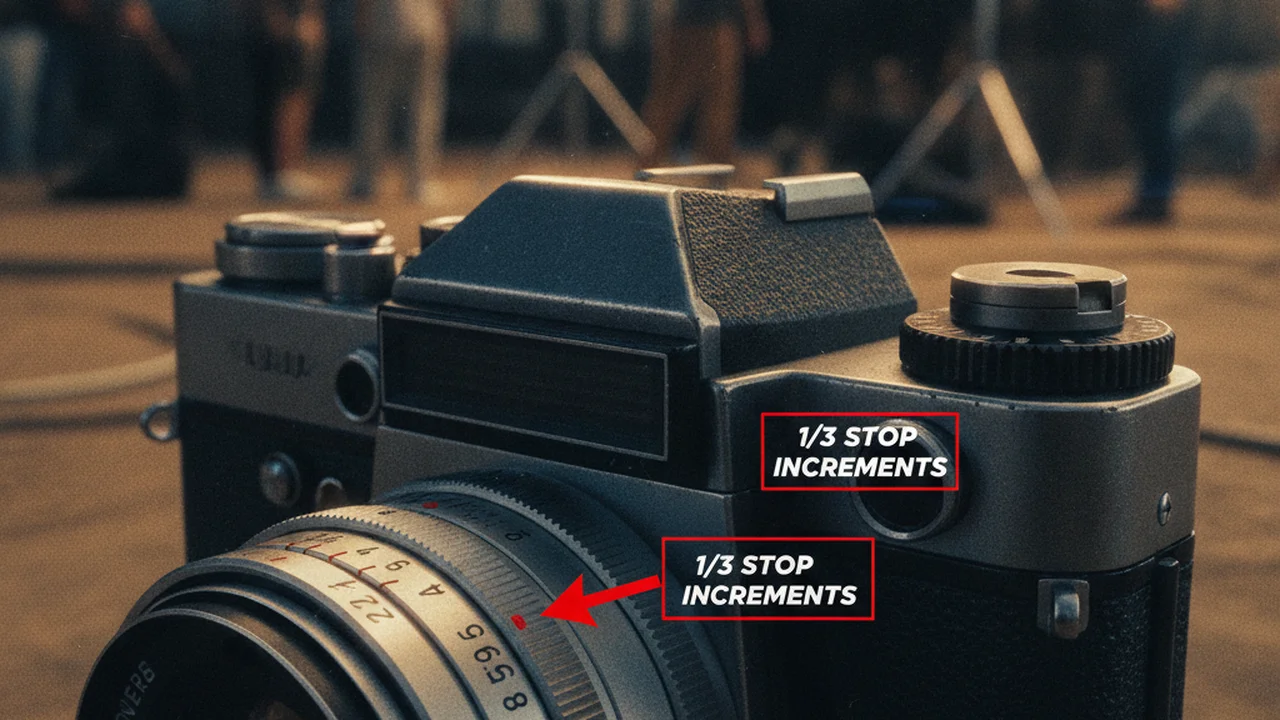
Murnau AI illustration
flow para roll stop take

Exposure correction of 1/3 stop (factor 1.26), enabling subtle brightness adjustments between full f-stops for precise shot matching.

Technical Details

Mathematically, 1/3 of a stop corresponds to a factor of 1.26 (the cube root of 2). With an initial aperture of f/2.8, the next third stop is f/3.2, and at f/4.0, it's f/4.5. Modern cinema cameras like the ARRI Alexa or RED V-Raptor offer 1/3-stop increments as standard via their electronic controls. Mechanical iris aperture rings on classic lenses often have corresponding click stops between the main markings. The accuracy in professional systems is ±0.05 f-stops.

History & Development

Third stops emerged in the 1960s with the development of TTL exposure meters for still cameras. Kodak established precise exposure tolerances with its Vision3 film stock in 1975, making third-stop corrections meaningful. The digital revolution from 2000 onwards amplified their importance, as sensors offer less exposure latitude than film negative. ARRI first integrated 1/3-stop control directly into the Alexa camera menus in 2010.

Practical Application in Film

Cinematographer Roger Deakins systematically used third-stop corrections in "Blade Runner 2049" for seamless brightness transitions between practical light sources and LED panels. When matching different camera positions, third stops enable exact alignment without post-production exposure adjustments. Digital Intermediate Colorists use corresponding 1/3-stop corrections in DaVinci Resolve or Baselight for precise shot matching. In available light scenarios, third-stop corrections compensate for minimal cloud movements without visible brightness jumps.

Comparison & Alternatives

Full stops double or halve the amount of light, while third stops allow for subtle adjustments. Sixth stops (1/6 stop) offer even finer control but usually exceed practical measurement accuracy. ND filters with a 0.3 density correspond to one stop, and 0.1 ND filters to a third stop. Variable ND filters allow for stepless transitions but suffer from color shifts at extreme settings. ISO adjustments in 1/3 increments offer identical exposure control with constant depth of field.

From the crafts

Perspectives

Cinematographer

Ich nutze Drittel-Blenden täglich für exaktes Shot-Matching zwischen verschiedenen Setups, besonders bei Dialogszenen mit Over-Shoulder-Wechseln. Die 1/3-Stop-Kontrolle an der Alexa Mini ermöglicht mir präzise Anpassungen ohne Filterwechsel, wenn sich Wolken minimal vor die Sonne schieben. Bei Mischung aus Tageslicht und HMI-Scheinwerfern gleiche ich mit Drittel-Korrekturen feine Helligkeitsunterschiede aus, die dem Auge kaum auffallen, aber digital kritisch sind.

Director

Ich verwende Drittel-Blenden für subtile emotionale Akzentuierung - eine minimale Abdunklung um 1/3 Stop verstärkt die Intimität einer Nahaufnahme, ohne dass es dem Zuschauer bewusst wird. Bei Übergängen zwischen Szenen schaffe ich mit graduellen Helligkeitsanpassungen unbewusste Stimmungsverschiebungen. Die präzise Kontrolle hilft mir, die visuelle Dramaturgie feinfühliger zu gestalten, als es mit groben Blendenschritten möglich wäre.

Producer

Drittel-Blenden-Präzision reduziert meine Color-Grading-Kosten erheblich, da weniger Shot-Matching in der Post notwendig ist. Die Zeitersparnis am Set durch schnelle 1/3-Stop-Anpassungen statt Filterwechsel bedeutet etwa 15 Minuten weniger pro Setup-Wechsel. Bei Außenaufnahmen minimieren präzise Belichtungskorrekturen Nachdreh-Risiken durch inkonsistente Helligkeiten, was bei Stargage oder Locationmieten kritische Kostenfaktoren sind.

More in the lexikon

Related terms

Test your knowledge

Quiz

1. Was beschreibt „Drittel Blende" am besten?

2. Zu welchem Department gehört „Drittel Blende"?

3. Wie viele verschiedene Fachperspektiven bietet dieser Eintrag?

Report an error
From the Filmfarm ecosystem

Understand visual language, budget productions, connect crew.

The Lexikon is part of the Filmfarm ecosystem — alongside budgeting (FilmBalance), an industry magazine (FilmCircus) and crew networking (FilmCall, CrewMesh). One shared vocabulary for the whole production.

FilmFarm FilmRadarComing soonFilmPulseComing soonFilmNumbersComing soonFilmCapitalComing soonFilmLabComing soonFilmBalanceComing soonFilmCircusComing soon