Filmlexikon.
Support
Stop
Camera · Terms

Stop

Murnau AI illustration
flow para roll take nd filter compensation pixel resolution

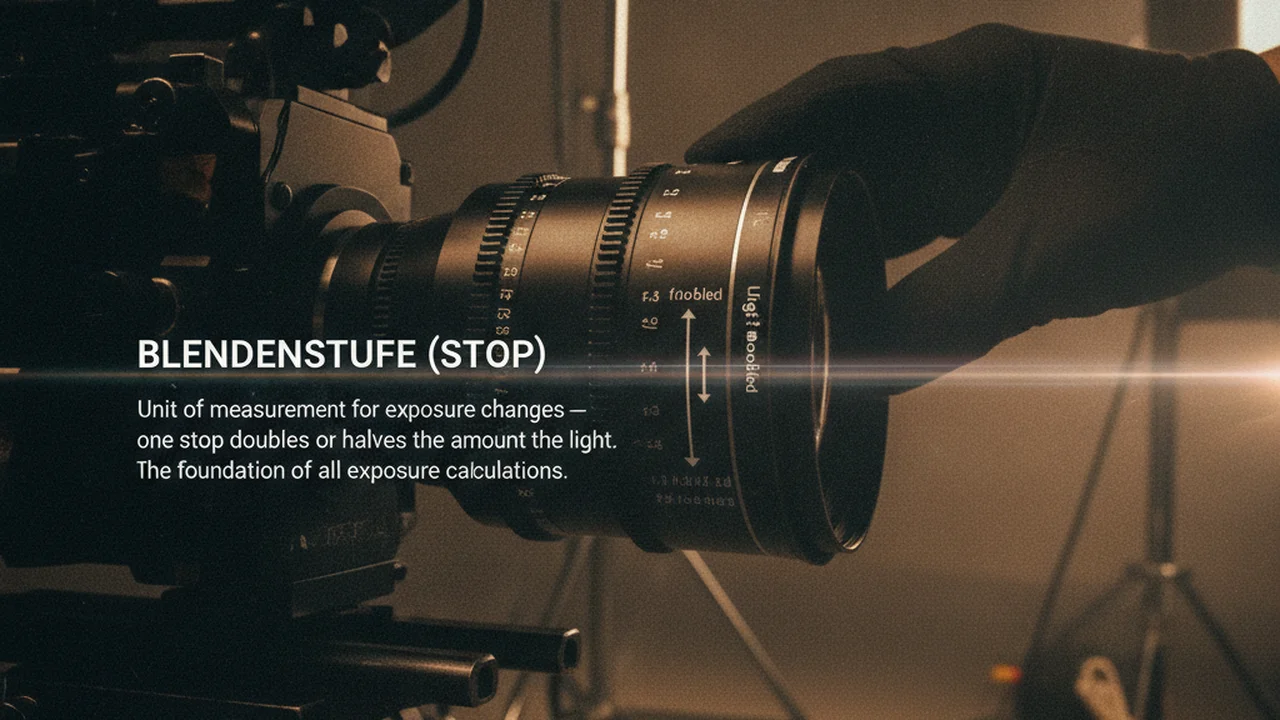
Unit of measurement for exposure changes — one stop doubles or halves the amount of light. The foundation of all exposure calculations.

Technical Details

The aperture values follow a standardized series: f/1.0, f/1.4, f/2.0, f/2.8, f/4.0, f/5.6, f/8.0, f/11, f/16, f/22. Each stop reduces the amount of light by a factor of √2 (≈1.414). Modern cameras operate with 1/3-stops (0.33 EV) or 1/2-stops (0.5 EV) for more precise exposure adjustments. The mathematical basis is derived from the ratio of focal length to the iris's aperture diameter. For cinema lenses, the T-stop scale is often used, which indicates the actual light transmission value and accounts for lens losses.

History & Development

The stop system evolved from early 19th-century photography. In 1895, the Royal Photographic Society standardized the f-number notation. Its cinematographic application became established with the first professional film cameras around 1920. The introduction of T-stops by the Society of Motion Picture and Television Engineers (SMPTE) in the 1960s significantly improved accuracy in film productions.

Practical Application in Film

Cinematographer Roger Deakins frequently uses T/2.0-2.8 for his characteristic depth of field in films like "Blade Runner 2049". For outdoor daylight shots, T/5.6-8.0 are typically used, while night scenes often require T/1.4-2.0. Precise stop control allows for consistent exposure between different camera positions. Emmanuel Lubezki used constant T/2.8 settings for "The Revenant" to maintain the natural image mood with available light.

Comparison & Alternatives

Stops differ from ISO and shutter speeds in their direct mechanical influence on depth of field. While ISO changes affect image noise and shutter adjustments alter motion blur, the aperture remains the primary creative tool for depth of field control. Variable ND filters (Neutral Density) offer alternative light reduction without changing depth of field. Modern digital cameras allow for post-production corrections, but in-camera aperture selection remains crucial for optical image quality.
From the crafts

Perspectives

Cinematographer

Ich nutze Blendenstufen als primäres Werkzeug für die Schärfentiefe-Gestaltung – bei T/1.4 isoliere ich Protagonisten vom Hintergrund, während T/5.6 für Ensemble-Szenen alle Akteure scharf hält. Die präzise 1/3-Stop-Kontrolle an modernen Cine-Objektiven ermöglicht mir seamless Matching zwischen A- und B-Kamera, besonders bei komplexen Lighting-Setups mit mehreren Kamerapositionen.

Director

Blendenstufen bestimmen die emotionale Tiefe meiner Bilder – offene Blenden bei T/2.0 schaffen Intimität und lenken den Fokus auf Gesichtsausdrücke, während geschlossene Blenden bei T/8.0 die Umgebung als narratives Element einbeziehen. Ich plane Blendenwechsel als dramaturgisches Mittel, um zwischen subjektiver Charakterperspektive und objektiver Erzählhaltung zu wechseln.

Producer

Blendenwahl beeinflusst direkt meine Beleuchtungskosten – offene T-Stops reduzieren den HMI-Bedarf um bis zu 75%, während geschlossene Blenden teure Zusatzbeleuchtung erfordern. Bei Low-Budget-Produktionen plane ich Drehtage um Available Light und T/1.4-2.0, was Gaffer-Stunden spart und Location-Flexibilität erhöht.

More in the lexikon

Related terms

Test your knowledge

Quiz

1. Was beschreibt „Blendenstufe" am besten?

2. Zu welchem Department gehört „Blendenstufe"?

3. Wie viele verschiedene Fachperspektiven bietet dieser Eintrag?

Report an error
From the Filmfarm ecosystem

Understand visual language, budget productions, connect crew.

The Lexikon is part of the Filmfarm ecosystem — alongside budgeting (FilmBalance), an industry magazine (FilmCircus) and crew networking (FilmCall, CrewMesh). One shared vocabulary for the whole production.

FilmFarm FilmRadarComing soonFilmPulseComing soonFilmNumbersComing soonFilmCapitalComing soonFilmLabComing soonFilmBalanceComing soonFilmCircusComing soon