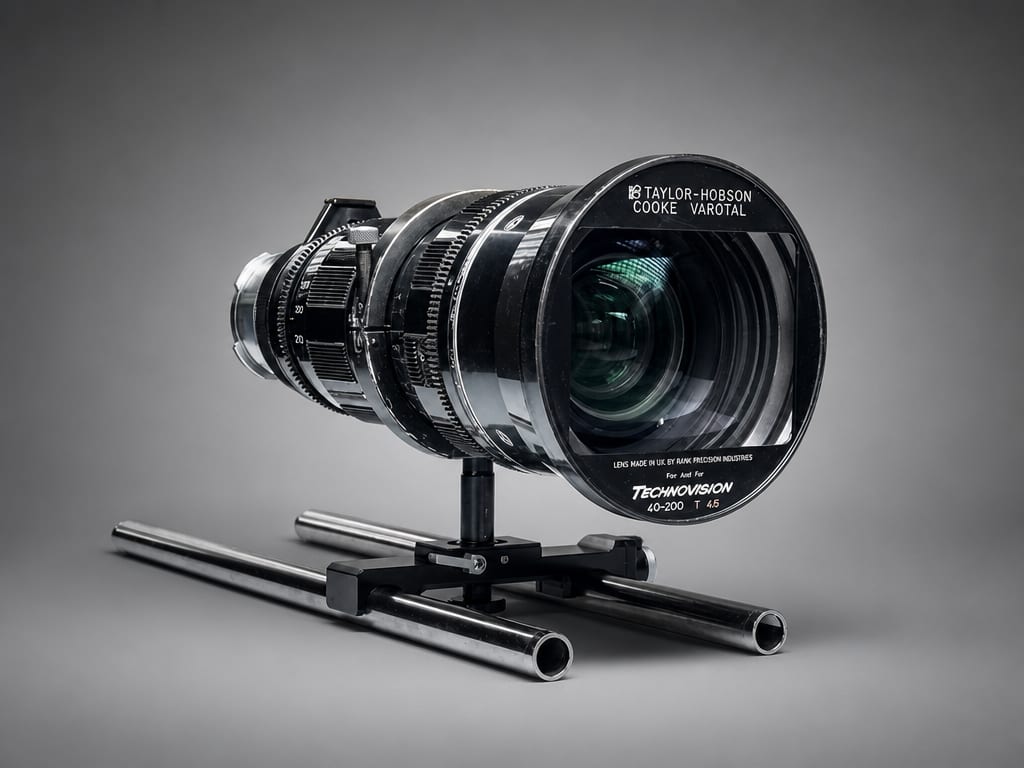
Technical Details
The Technovision Cooke lenses operate with a 2x anamorphic adapter that is mounted in front of spherical Cooke lenses. Available focal lengths include 25mm, 32mm, 40mm, 50mm, 75mm, 100mm, and 150mm, with a maximum aperture of T2.3 to T2.8. The optical system produces characteristic horizontal lens flares, oval bokeh circles, and slight distortion at the image edges. The minimum focus distance ranges from 0.6m to 1.5m depending on the focal length. The filter thread is consistently 104mm.
The construction is based on the Technovision anamorphic element, which can be combined with various spherical Cooke series, including Speed Panchros and early S4 lenses. This hybrid construction creates the warm, organic look of Cooke optics with the visual width of anamorphic shooting.
History & Development
Joe Dunton developed the Technovision system in the late 1960s as a cost-effective alternative to Panavision's monopoly on anamorphic camera technology. In 1971, collaboration began with Cooke Optics to equip popular spherical Cooke lenses with anamorphic properties. The first commercial use occurred in 1972 for European productions.
The system gained popularity in the 1970s and early 1980s, especially in Europe and among independent productions that could not afford Panavision's expensive equipment. With the advent of more modern anamorphic systems and Cooke's own Anamorphic/i series from 2013 onwards, the original Technovision Cooke combination was used less frequently.
Practical Use in Film
Technovision Cooke lenses were used in films such as "The Man Who Fell to Earth" (1976) and various European productions of the 1970s. The characteristic look combines Cooke's warm skin tones with anamorphic artifacts like horizontal streaks from light sources.
The workflow requires 35mm film with appropriate de-squeeze in post-production. The lenses are prone to breathing effects when focusing and exhibit noticeable edge distortion, which must be considered during camera operation. Close-ups benefit from the warm Cooke characteristics, while wide shots utilize the cinematic width of the anamorphic format.
Comparison & Alternatives
Unlike original anamorphic systems such as Panavision or Hawk, the adapter construction introduces additional optical compromises. Modern alternatives include Cooke's Anamorphic/i series or ARRI Master Anamorphics, which were designed without adapters and deliver optically superior results.
Technovision Cooke differs from other adapter systems through the specific Cooke optics used as a base. Today's productions typically opt for dedicated anamorphic lenses, while vintage Technovision Cooke sets are rented for period pieces or stylistic purposes.